Environmental, Social, and Governance (ESG) Criteria
Understanding ESG criteria: A comprehensive guide to sustainable and responsible investing.
What Is ESG?
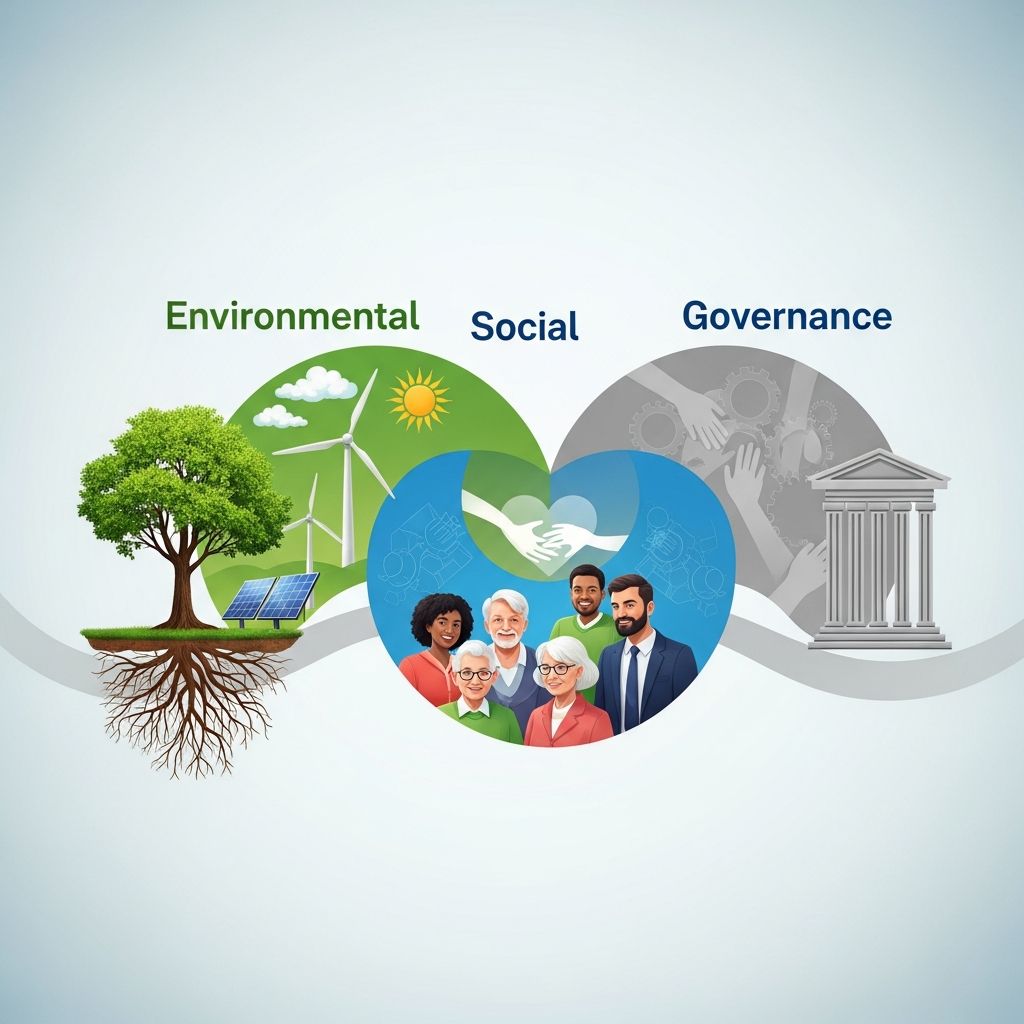
Environmental, Social, and Governance (ESG) represents a set of non-financial factors and standards used to measure and evaluate a company’s broader impact beyond traditional financial metrics. ESG criteria have become fundamental to modern investing, providing stakeholders—including investors, employees, customers, and communities—with a comprehensive framework to assess how organizations manage risks and opportunities related to sustainability, ethics, and accountability.
ESG stands as the bedrock of sustainable and responsible investing, reflecting the growing recognition that companies must consider their environmental footprint, social responsibilities, and governance structures to create long-term value. Rather than focusing solely on profitability, ESG criteria encourage organizations to demonstrate commitment to generating positive impacts on the environment, promoting social equity, and maintaining transparent, ethical business practices.
The Three Pillars of ESG
ESG comprises three interconnected dimensions that together provide a holistic assessment of corporate sustainability and responsibility:
Environmental
The environmental pillar examines how a company manages its relationship with the natural world and addresses ecological challenges. It evaluates an organization’s environmental impact and its efforts to minimize harm to ecosystems and resources.
Key environmental criteria include:
- Climate change and carbon emissions: Reducing greenhouse gas emissions, investing in renewable energy sources, participating in carbon offset programs, and setting science-based climate targets aligned with global warming mitigation efforts.
- Energy efficiency: Cutting energy consumption through facility upgrades, implementing smart energy management systems, and adopting green technologies that reduce operational energy demands.
- Water management: Addressing water scarcity through recycling initiatives, improving water-use efficiency, protecting watersheds, and implementing sustainable water sourcing strategies.
- Pollution control: Reducing air and water pollution by utilizing non-toxic materials, installing advanced pollution control systems, and maintaining strict adherence to environmental regulations.
- Waste and resource management: Minimizing waste generation, promoting recycling programs, adopting circular economy principles, and transitioning away from linear consumption models.
- Deforestation prevention: Preventing deforestation in supply chains, promoting sustainable forestry practices, and supporting biodiversity conservation efforts.
- Biodiversity protection: Preserving ecosystems, protecting endangered species, and promoting responsible land use practices that maintain ecological integrity.
Environmental criteria serve as indicators of how companies manage climate-related risks and opportunities, assess their vulnerability to environmental challenges, and demonstrate stewardship of natural resources essential for long-term sustainability.
Social
The social pillar evaluates how a company interacts with people—its employees, customers, suppliers, business partners, and the broader communities where it operates. Strong social policies help businesses foster inclusivity, fairness, and ethical responsibility, creating positive ripple effects across entire industries and communities.
Key social criteria include:
- Human rights observance: Ensuring ethical and fair treatment for all individuals, both within the organization and across supply chains, particularly in developing economies where standards may be less robust.
- Compliance with labor standards: Upholding fair wages, maintaining safe working conditions, respecting employee rights, and ensuring compliance with labor regulations globally.
- Employee health and safety: Prioritizing worker well-being through comprehensive safety programs, health benefits, mental health support, and injury prevention initiatives.
- Diversity and inclusion: Building diverse workforces across gender, ethnicity, age, and background, fostering inclusive workplace cultures that value different perspectives.
- Customer satisfaction and data privacy: Actively improving customer experience through feedback mechanisms, quality service delivery, responsible data handling, and protecting customer privacy.
- Training and development: Investing in employee growth through professional development programs, skills training, and career advancement opportunities.
- Community relations initiatives: Building strong local relationships by investing in education, supporting social programs, and contributing to environmental initiatives in operating communities.
- Responsible supply chain management: Ensuring suppliers meet ethical standards, environmental requirements, and labor practices consistent with company values.
The social dimension recognizes that companies are embedded within communities and must contribute positively to social well-being while maintaining ethical relationships with all stakeholders.
Governance
Governance represents the backbone of ESG, shaping how a company is run and ensuring it operates with integrity, accountability, and transparency. It covers leadership structures, financial reporting standards, executive compensation, and ethical decision-making processes. Strong governance policies help prevent corporate misconduct—including fraud, bribery, and conflicts of interest—while fostering trust among investors, employees, and the public.
Key governance criteria include:
- Board composition and diversity: Maintaining a balanced board with diverse backgrounds, skills, and perspectives that strengthen decision-making quality and reduce groupthink.
- Executive pay alignment: Ensuring fair, transparent compensation structures that align executive incentives with long-term company goals and shareholder interests.
- Anti-bribery and corruption measures: Implementing strict policies and monitoring systems to prevent fraud, bribery, conflicts of interest, and unethical business practices.
- Financial transparency and reporting: Maintaining accurate, timely, and comprehensive financial disclosures that comply with accounting standards and regulatory requirements.
- Internal controls and audits: Establishing robust internal control systems and conducting regular independent audits to verify financial accuracy and operational compliance.
- Shareholder rights and engagement: Protecting shareholder interests through fair voting rights, transparent communication, and mechanisms for stakeholder input on major corporate decisions.
- Whistleblower protections: Creating safe channels for employees and stakeholders to report misconduct without fear of retaliation.
Governance criteria examine how company leadership makes decisions, maintains accountability, manages risks, and ensures ethical conduct across all organizational levels.
Why ESG Matters
ESG criteria have emerged as essential considerations for modern investing and business operations for several compelling reasons:
Risk Management: ESG factors help identify potential risks—environmental liabilities, labor disputes, governance failures—that could impact financial performance and company valuation.
Long-Term Value Creation: Companies with strong ESG practices typically demonstrate better long-term financial performance, resilience, and ability to adapt to changing market conditions and regulations.
Stakeholder Expectations: Investors, employees, customers, and communities increasingly demand transparency regarding how companies manage environmental and social impacts and maintain ethical governance.
Regulatory Compliance: Governments worldwide are implementing ESG-related regulations, making compliance with environmental, social, and governance standards increasingly mandatory for business operations.
Climate and Social Imperatives: With climate change representing the defining challenge of our era and social inequality demanding attention, ESG frameworks help organizations contribute meaningfully to sustainability and equity.
ESG Versus Corporate Social Responsibility (CSR)
While ESG and Corporate Social Responsibility are related concepts, they differ in meaningful ways:
| Aspect | CSR | ESG |
|---|---|---|
| Definition | A company’s voluntary commitment to ethical and responsible business practices | A set of measurable criteria used to assess a company’s environmental, social, and governance impact |
| Scope | Broad and value-driven, emphasizing philanthropy and community engagement | Data-driven and standardized, focusing on risk management and financial impact |
| Focus | Voluntary initiatives and social good contributions | Measurable sustainability metrics and governance standards |
| Measurement | Often qualitative and subjective | Quantifiable and standardized across industries |
| Investment Integration | Secondary consideration in investment decisions | Central to investment analysis and decision-making |
ESG provides a more structured, quantifiable framework for assessing corporate sustainability compared to the broader, more voluntarily-focused approach of traditional CSR.
How ESG Impacts Investing
ESG criteria significantly influence investment decisions and portfolio construction. Institutional investors increasingly integrate ESG analysis into their research processes to evaluate companies’ long-term viability and sustainability performance. Investment firms analyze ESG metrics alongside traditional financial data to identify companies that effectively manage risks and opportunities related to environmental challenges, social responsibilities, and governance standards.
Investors use ESG ratings and scores—developed by specialized rating agencies—to compare companies’ sustainability performance within industries and sectors. These assessments help investors identify leaders and laggards in ESG practices, informing portfolio selection and engagement strategies with company management.
Growing evidence suggests that strong ESG performance correlates with improved risk management, enhanced operational efficiency, better employee retention, and stronger stakeholder relationships—factors that typically translate into superior financial outcomes over extended investment horizons.
ESG Principles and Opportunities
ESG principles organize sustainability efforts around three main areas that generate significant opportunities:
Environmental Principles focus on decarbonization, preserving biodiversity, promoting circular economy models, and driving innovation in sustainable technologies. These efforts combat climate change, reduce companies’ carbon footprints, and encourage optimal use of natural resources.
Social Principles emphasize diversity and inclusion, health and safety, employee training and development, customer commitment, responsible supply chain practices, human rights protection, and community development. These initiatives stimulate research funding for social good, promote social improvements in education and health, and foster equality and integration.
Governance Principles establish transparent decision-making processes, robust control mechanisms, and compliance systems that encourage development of technologies with positive societal impacts and sustainable innovations benefiting broader populations.
Frequently Asked Questions (FAQs)
Q: How do companies measure ESG performance?
A: Companies measure ESG performance through quantifiable metrics within each pillar. Environmental metrics include carbon emissions, energy consumption, and waste reduction. Social metrics track diversity statistics, employee satisfaction, and community investment. Governance metrics assess board independence, executive compensation ratios, and compliance records. Many organizations use ESG frameworks and reporting standards, such as the Global Reporting Initiative (GRI) or Sustainability Accounting Standards Board (SASB), to standardize measurement and reporting.
Q: Why are ESG criteria important for investors?
A: ESG criteria help investors identify companies with strong management of environmental, social, and governance risks—factors that significantly impact long-term financial performance. Companies with robust ESG practices typically demonstrate better risk management, operational efficiency, stakeholder relationships, and regulatory compliance, potentially translating into superior returns and lower volatility.
Q: What is ESG rating and how does it work?
A: ESG rating agencies assess companies’ ESG performance based on standardized criteria and publicly available data, assigning scores that indicate relative sustainability performance. These ratings help investors compare companies within sectors and identify sustainability leaders, though rating methodologies can vary significantly between agencies.
Q: How do ESG criteria relate to climate change?
A: ESG criteria address climate change through the environmental pillar, which evaluates companies’ greenhouse gas emissions, renewable energy investments, climate risk management, and adaptation strategies. These factors help assess how companies contribute to climate mitigation and prepare for climate-related physical and transition risks.
Q: Can small businesses implement ESG practices?
A: Yes, businesses of all sizes can implement ESG practices tailored to their scale and industry. Small businesses can start with foundational steps such as reducing energy consumption, implementing fair labor practices, establishing governance structures, and transparently communicating their sustainability efforts to stakeholders.
Q: What role does technology play in ESG?
A: Technology enables ESG implementation and measurement through digital tools that track environmental metrics, automate compliance monitoring, enhance data transparency, and facilitate stakeholder communication. Advanced analytics and AI help organizations identify ESG risks, optimize resource efficiency, and demonstrate accountability.
References
- ESG Criteria: What You Need to Know — Greenly. 2024. https://greenly.earth/en-us/blog/company-guide/esg-criteria-what-you-need-to-know
- ESG Criteria | Socially Responsible Investment — Iberdrola. 2024. https://www.iberdrola.com/social-commitment/esg-criteria
- What is ESG? A Guide for Businesses — British Business Bank. 2024. https://www.british-business-bank.co.uk/business-guidance/guidance-articles/sustainability/what-is-esg-a-guide-for-smaller-businesses
- ESG (Environmental, Social, & Governance) — Corporate Finance Institute. 2024. https://corporatefinanceinstitute.com/resources/esg/esg-environmental-social-governance/
- What is ESG and Why is it Important? — The Corporate Governance Institute. 2024. https://www.thecorporategovernanceinstitute.com/insights/guides/what-is-esg-and-why-is-it-important/
- What is Environmental, Social and Governance (ESG)? — IBM. 2024. https://www.ibm.com/think/topics/environmental-social-and-governance
Similar Articles








Read full bio of Sneha Tete