Enterprise Value: Definition, Formula & Calculation
Understanding Enterprise Value: A comprehensive guide to calculating and using EV in company valuation and analysis.
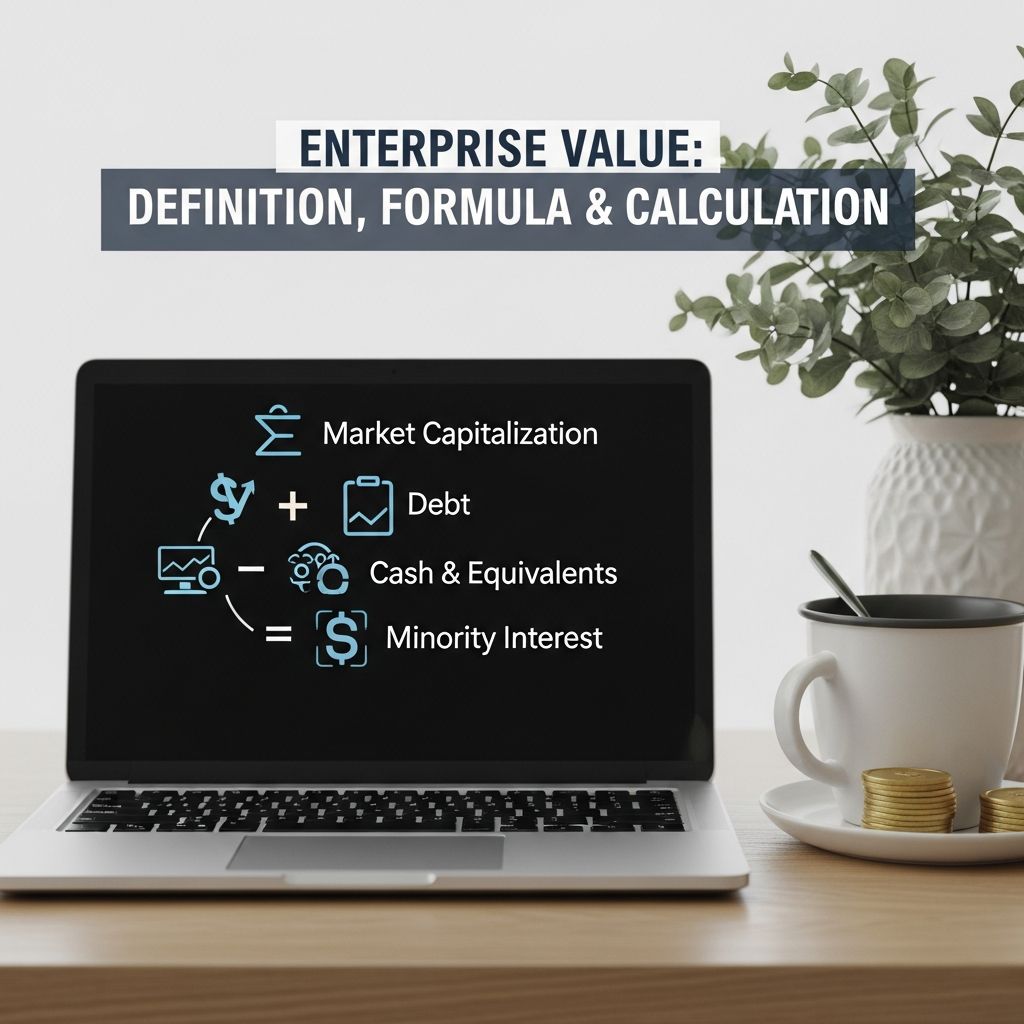
What is Enterprise Value?
Enterprise Value (EV), also known as Total Enterprise Value (TEV), represents the total market value of a company’s operations available to all stakeholders. Unlike market capitalization, which only reflects the equity value of a company, enterprise value provides a more comprehensive picture by including all capital providers—both equity shareholders and debt holders. This metric is fundamental to corporate finance, investment analysis, and mergers and acquisitions.
Enterprise value can be understood as the theoretical purchase price of a company if it were to be acquired. It reflects what a buyer would need to pay to assume control of the business and its liabilities. This makes EV particularly valuable in M&A situations and comparative valuation analysis.
The key distinction between enterprise value and equity value is that EV is capital structure-neutral. This means the metric is unaffected by how a company chooses to finance its operations—whether through debt, equity, or a combination of both. This characteristic makes enterprise value an invaluable tool for comparing companies with different capital structures and financing strategies.
Understanding the Enterprise Value Formula
The enterprise value formula is straightforward but comprehensive. It combines equity value with all non-equity claims on the company:
Enterprise Value = Market Capitalization + Total Debt – Cash and Cash Equivalents + Preferred Stock + Minority Interest
Alternatively, the formula can be expressed as:
Enterprise Value = Equity Value + Net Debt + Preferred Stock + Minority Interest
Where Net Debt = Total Debt – Cash and Cash Equivalents
Components of the Enterprise Value Formula
Market Capitalization: This is the total equity value of the company, calculated by multiplying the stock price by the number of fully-diluted shares outstanding. Fully diluted shares include common shares, in-the-money options, warrants, and convertible securities.
Total Debt: This includes all interest-bearing liabilities, comprising both short-term and long-term debt obligations. When calculating enterprise value for acquisition purposes, the acquirer assumes responsibility for paying off this debt.
Cash and Cash Equivalents: This includes the company’s liquid assets such as cash on hand, short-term investments, marketable securities, commercial paper, and money market funds. Cash is subtracted from enterprise value because an acquirer can use the target company’s cash to pay down assumed debt, reducing the net purchase price.
Preferred Stock: Preferred shares represent ownership interests that have priority claims over common equity but are subordinate to debt. These are added to reflect all ownership interests in the company.
Minority Interest (Non-Controlling Interest): When a parent company owns a subsidiary but not 100% of it, the minority interest represents the portion owned by other parties. This is included because the parent’s consolidated financial statements include 100% of the subsidiary’s revenues, expenses, and cash flows, even though it doesn’t own the entire company.
Enterprise Value vs. Equity Value
The relationship between enterprise value and equity value is critical to understanding company valuation. Equity value represents the residual value available to common shareholders after all other claims have been satisfied. It is calculated by subtracting non-equity claims from enterprise value:
Equity Value = Enterprise Value – Net Debt – Preferred Stock – Minority Interest
Consider a practical example: if Company A has an enterprise value of $100 million, total debt of $30 million, and cash of $10 million, the equity value would be $80 million. This equity value represents what common shareholders would receive after debt holders are paid.
The distinction matters significantly in practice. Two companies with identical market capitalizations might have vastly different enterprise values. Company A with $60 million in market cap, $20 million in cash, and no debt has an enterprise value of $40 million. Company B with the same $60 million market cap, no cash, and $30 million in debt has an enterprise value of $90 million. The difference reflects that Company B is more leveraged and would be more expensive to acquire due to assumed debt obligations.
Why Enterprise Value Matters
Enterprise value is critical for several reasons in finance and investment analysis:
Capital Structure Independence: Since EV is unaffected by a company’s financing decisions, it enables fair “apples to apples” comparisons between companies with different debt-to-equity ratios. A company that finances operations primarily through debt will not appear artificially cheaper or more expensive than an equity-financed competitor.
Accurate Valuation: Enterprise value reflects the true operating value of a business. If management decisions increase debt without changing operations, the enterprise value theoretically remains unchanged, even though equity value would decline. This makes EV more reflective of actual business performance.
M&A Applications: In mergers and acquisitions, enterprise value represents the actual cost of acquiring a company. A potential acquirer must pay the market capitalization plus assume all debt, making EV the true purchase price metric.
Comparable Analysis: Enterprise value is fundamental to relative valuation methods that compare similar companies using multiples like EV/EBITDA, EV/EBIT, and EV/Revenue.
Enterprise Value Multiples
Enterprise value is most commonly used in conjunction with various financial metrics to create valuation multiples. These multiples are essential tools for comparable company analysis:
EV/EBITDA Multiple: This is calculated by dividing enterprise value by earnings before interest, taxes, depreciation, and amortization. The EV/EBITDA multiple is widely used because EBITDA represents earnings available to all capital providers regardless of capital structure.
EV/EBIT Multiple: This divides enterprise value by operating earnings and is useful for comparing companies’ operating profitability before financing decisions.
EV/Revenue Multiple: This metric divides enterprise value by total revenue and is particularly useful for valuing companies that are not yet profitable or have volatile earnings.
EV/Free Cash Flow Multiple: This divides enterprise value by free cash flow available to all investors and reflects the true cash-generating ability of the business.
The denominator in these multiples is critical—it must represent value available to all stakeholders, not just equity holders. This is why P/E ratios using net income are less useful for comparative analysis, as net income is only available to equity holders after debt service.
Calculating Enterprise Value: A Practical Example
To illustrate enterprise value calculation, consider three hypothetical companies, all with identical market capitalizations of $100 million:
Company A: Market Cap $100M, Total Debt $10M, Cash $5M, Preferred Stock $2M, Minority Interest $3M
Enterprise Value = $100M + $10M – $5M + $2M + $3M = $110M
Company B: Market Cap $100M, Total Debt $25M, Cash $8M, Preferred Stock $0M, Minority Interest $0M
Enterprise Value = $100M + $25M – $8M = $117M
Company C: Market Cap $100M, Total Debt $35M, Cash $12M, Preferred Stock $5M, Minority Interest $2M
Enterprise Value = $100M + $35M – $12M + $5M + $2M = $130M
Despite having identical equity values, these companies have dramatically different enterprise values, reflecting their different capital structures and true acquisition costs. Company C would be most expensive to acquire due to higher debt levels, while Company A would be least expensive.
Enterprise Value in Financial Modeling
In comprehensive financial models, free cash flow to the firm (FCFF) is typically projected and discounted using the weighted average cost of capital (WACC). This calculation directly produces enterprise value, as WACC represents the blended discount rate for all capital providers. This approach is superior to calculating equity value first and then adding back debt, as it ensures consistency between the cash flows and discount rate.
Financial analysts use enterprise value to determine company valuations under various scenarios. Sensitivity analysis on WACC and growth assumptions reveals the range of possible enterprise values, which can then be converted to equity values by subtracting net debt and other non-equity claims.
Enterprise Value Applications in Business
Mergers and Acquisitions: Enterprise value forms the foundation of M&A transaction pricing. Buyers use EV to understand the true cost of acquisition, including assumed liabilities. Sellers use EV multiples to benchmark fair value.
Relative Valuation: Comparable company analysis relies heavily on enterprise value multiples. Analysts identify peer companies and calculate median or mean EV/EBITDA multiples, then apply these multiples to target companies for valuation.
Leveraged Buyouts: In LBO scenarios, enterprise value helps determine the maximum purchase price and optimal debt-to-equity ratios. Financial sponsors analyze how different capital structures affect returns.
Credit Analysis: Lenders evaluate leverage ratios like Net Debt/EBITDA, which depend on accurate enterprise value calculation. These metrics assess default risk and covenant compliance.
Common Misconceptions About Enterprise Value
One widespread misunderstanding involves comparing companies with identical enterprise values but different equity values. Students and analysts sometimes incorrectly conclude that two companies with the same EV but different market capitalizations are equally attractive investments. However, the equity holder perspective matters—a company with lower market cap but higher debt might offer better equity returns if growth occurs, or higher risk if things deteriorate.
Another misconception is that enterprise value is always “better” than market capitalization for all analytical purposes. While EV is superior for comparable company analysis and acquisition valuation, market capitalization remains relevant for equity investors assessing returns and for calculating price-to-earnings multiples relevant to equity holders specifically.
Frequently Asked Questions
Q: How does enterprise value differ from market capitalization?
A: Market capitalization only represents equity value, while enterprise value includes all capital providers including debt holders. Enterprise value is therefore more comprehensive and better reflects the total value of the business to all stakeholders.
Q: Why do we subtract cash from enterprise value?
A: Cash is subtracted because an acquirer can use the target company’s cash to pay down assumed debt, reducing the net purchase price. From an economic standpoint, cash reduces the true acquisition cost.
Q: Can enterprise value be negative?
A: Yes, if a company has more cash than debt and a relatively low market capitalization, enterprise value could theoretically be negative. However, this is rare in practice and typically signals distress or significant undervaluation.
Q: Which is more important for equity investors—enterprise value or equity value?
A: Equity value is more directly relevant to equity investors, as it represents what they own. However, understanding enterprise value helps equity investors assess whether the company is efficiently using leverage and compare it to peers.
Q: How is enterprise value used in company valuations?
A: Enterprise value is used in relative valuation by applying EV/EBITDA or other multiples derived from comparable companies. It’s also used in DCF analysis where free cash flow to the firm is discounted using WACC to derive EV.
References
- Enterprise Value (TEV) | Formula + Calculator — Wall Street Prep. 2025. https://www.wallstreetprep.com/knowledge/enterprise-value/
- Enterprise Value (EV) – Formula, Definition and Examples of EV — Corporate Finance Institute. 2025. https://corporatefinanceinstitute.com/resources/capital_markets/what-is-enterprise-value-ev/
- Introduction To Enterprise Value — Investopedia. https://www.youtube.com/watch?v=c8HdwcRlWZk
Similar Articles








Read full bio of medha deb