Employed vs Self-Employed: Key Differences
Explore the critical differences between employment and self-employment to make informed career decisions.
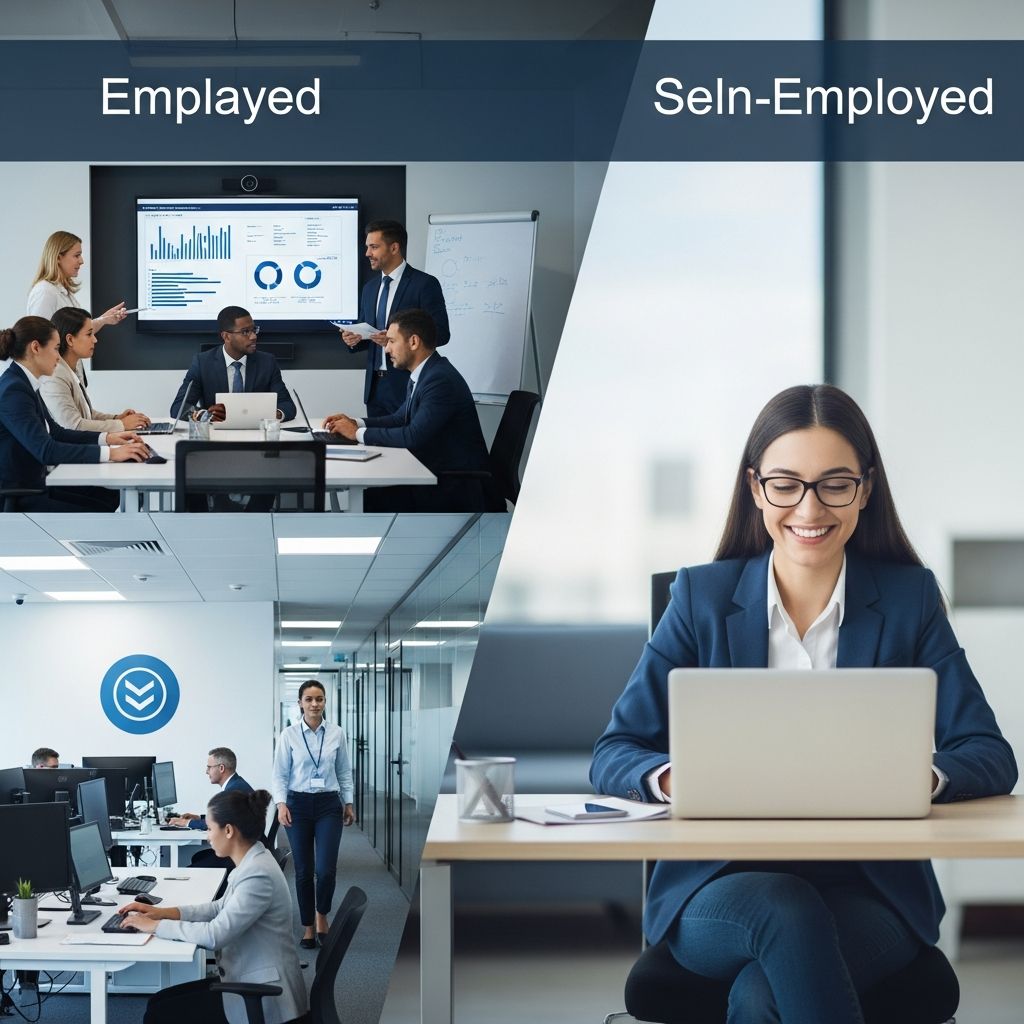
Understanding Employment and Self-Employment
The choice between traditional employment and self-employment represents one of the most significant career decisions you’ll make. While both paths offer distinct advantages and challenges, understanding the fundamental differences between them is essential for determining which aligns best with your professional goals, financial situation, and lifestyle preferences. Whether you’re considering leaving a corporate job to start your own business or deciding whether to pursue freelance work, this comprehensive guide breaks down the key distinctions across multiple dimensions.
What is Self-Employment?
Self-employment occurs when an individual works independently, either as the sole operator or key member of their own business venture. Unlike traditional employees who receive compensation through a salary or hourly wage, self-employed professionals generate income directly from clients or customers for services rendered. This employment model offers significant personal freedoms, including the ability to customize your work environment, set flexible hours, and potentially earn substantially more than you might in a traditional role.
Common forms of self-employment include freelancing, consulting, contracting, running a small business, and operating as an independent professional in fields such as writing, design, programming, accounting, and trades. The self-employed individual assumes full responsibility for the success or failure of their business venture.
Critical Differences Between Employment and Self-Employment
Tax Obligations and Financial Management
One of the most significant differences between employment and self-employment lies in how taxes are handled. Traditional employees benefit from automatic payroll deductions managed by their employer’s human resources department. Your employer withholds federal income tax, state income tax, Social Security, Medicare, and other applicable taxes from each paycheck, simplifying the tax process considerably.
Self-employed individuals, however, must manage their entire tax burden independently. This includes processing their own payroll taxes, arranging for deductions from payments at specified times throughout the year, and paying both employee and employer portions of Social Security and Medicare taxes through the Self-Employment Contributions Act (SECA). Beyond mere compliance, self-employed professionals can deduct approximately 100 percent of legitimate business expenses—from office supplies to equipment to professional services—whereas employees can only deduct approximately 20 percent of work-related expenses. This significant difference in deductible expenses can result in substantially lower effective tax rates for business owners, even when earning comparable gross income to employees.
Job Security Considerations
Job security operates differently in employment versus self-employment scenarios. Traditional employees typically receive a steady flow of work and earn paychecks on a predictable schedule. However, external factors such as company restructuring, changes in client relationships, shifts in contracts, or account losses can compromise employment stability without warning.
Self-employed professionals face different security challenges. Their income stability depends on maintaining a consistent client base and securing ongoing contracts. Economic downturns or shifts in market demand can quickly dry up work opportunities. However, the self-employed possess greater flexibility in responding to market changes. Because they control the services they provide, they can pivot to different industries, expand their service offerings, or develop new expertise areas more easily than traditional employees. This adaptability can create more long-term opportunities and income potential, even if short-term stability feels less certain.
Benefits and Insurance Coverage
The benefits landscape differs substantially between these two employment models. Employed professionals typically receive comprehensive benefits packages from their employers, including medical, dental, and life insurance. These benefits are often subsidized significantly, with employers covering a substantial portion of premiums. Additionally, employed workers remain eligible for unemployment benefits if they’re laid off or terminated, providing a crucial safety net during job transitions.
Self-employed individuals must secure their own insurance coverage independently from private carriers. While self-employed professionals cannot collect traditional unemployment benefits due to their employment status, they can deduct 100 percent of health insurance premiums as a business expense, improving their effective tax position. The challenge for self-employed workers lies in shopping for appropriate coverage and managing higher out-of-pocket costs compared to group plans available through employers.
Business Responsibilities
The scope of responsibilities varies dramatically between employees and self-employed professionals. Traditional employees typically perform tasks directly related to their specific job description. While many employees possess diverse skills, employers generally expect them to focus on their defined role within the organization. Managers assign tasks, set priorities, and provide direction.
Self-employed individuals function as complete business operators. They oversee all aspects of their enterprise, including business model development, marketing and client acquisition, financial bookkeeping and accounting, technology infrastructure, customer service, operations management, and strategic planning. Success requires competency across multiple domains or the resources to hire professionals for specialized tasks.
Work Schedule and Hours
Work hours and scheduling flexibility represent another major distinction. Employees typically work a traditional schedule with consistent weekday hours, fixed weekends off, and predetermined vacation and holiday time. Some roles involve rotating shifts or varying schedules, but these are generally communicated in advance by management. The predictability offers stability and facilitates personal planning.
Self-employed professionals enjoy significantly greater flexibility in scheduling. They can create their own work calendars, choosing when and how much to work each week. However, this freedom comes with a caveat: because the business’s success depends directly on their efforts, work often extends beyond typical business hours. Weekend work, evening commitments, and irregular hours are common, especially during growth phases or when managing demanding clients. The autonomy to control your schedule is powerful, but it requires strong self-discipline and boundary-setting to prevent overwork.
Work Environment and Atmosphere
Workplace environment standards differ significantly between traditional employment and self-employment. Employees typically work within established office environments governed by company policies. These policies often dictate workspace setup standards, decoration limitations, and dress codes ranging from formal business attire to business casual. Employers maintain these guidelines for professionalism, brand consistency, and workplace culture purposes.
Self-employed professionals enjoy substantial freedom regarding their work environment. They can work from home, rent dedicated office space, or utilize co-working facilities. They control all environmental elements—decor, furniture, atmosphere, music, temperature—to optimize their productivity and comfort. Dress codes don’t apply unless working on-site for a client. This environmental autonomy appeals to individuals who perform better with personalized workspaces and can significantly reduce commuting stress and time.
Financial Comparison: Employee vs. Self-Employed
| Factor | Employee ($250k compensation) | Self-Employed ($400k revenue) |
|---|---|---|
| Gross Income | $250,000 | $400,000 |
| Deductible Expenses | ~20% (Limited) | ~100% (Comprehensive) |
| Effective Tax Rate | 32%+ | 28.5% |
| Health Insurance Burden | Employer Subsidized | 100% Deductible Expense |
| 401(k) Contribution Limit | $23,500 (2024) | $69,000+ (Solo 401k) |
| Estimated Take-Home | ~$170,000 | ~$280,000+ |
Advantages of Traditional Employment
Traditional employment offers several compelling advantages that appeal to many professionals:
- Predictable income and regular paychecks without business uncertainty
- Automatic tax management through employer withholding
- Comprehensive benefits packages including health, dental, and life insurance
- Employer-funded retirement plans with potential matching contributions
- Unemployment insurance eligibility if laid off
- Structured work schedule with predictable hours and time off
- Limited responsibility for client acquisition and business operations
- Professional development opportunities and career advancement paths
- Legal protections against unfair dismissal and workplace discrimination
- No personal liability for business debts or failures
Advantages of Self-Employment
Self-employment presents distinct benefits for individuals seeking independence and control:
- Complete ownership of business revenue and profit generation
- Substantial tax deductions reducing effective tax rates
- Control over client selection and project acceptance
- Flexible scheduling and work environment customization
- Higher earning potential without employer salary caps
- Ability to pivot business models and service offerings
- Increased autonomy in decision-making and operations
- Opportunities to build business assets and enterprise value
- Greater contributions to retirement accounts
- Freedom from workplace politics and organizational constraints
Challenges of Traditional Employment
While employment provides stability, it comes with notable limitations:
- Income ceiling determined by employer compensation bands
- Limited control over daily tasks and projects
- Vulnerability to corporate restructuring and layoffs
- Restricted flexibility in work schedule and location
- Limited tax deduction opportunities
- Potential for workplace conflicts and organizational stress
- Career advancement dependent on company opportunities
- Commute requirements and fixed location constraints
- Limited ability to diversify income streams
- Professional development limited to employer initiatives
Challenges of Self-Employment
Self-employment demands resilience and introduces significant challenges:
- Income instability and irregular cash flow
- Complete responsibility for client acquisition and marketing
- Complex tax management and compliance requirements
- No employer-provided benefits or insurance
- Full liability for business debts and obligations
- Unpredictable work hours and difficulty disconnecting
- No unemployment insurance eligibility
- Difficulty obtaining business loans and credit
- Social isolation from workplace communities
- Higher stress from complete business responsibility
Making Your Decision: Key Considerations
Assess Your Financial Situation
Before transitioning to self-employment, ensure you have adequate financial reserves. Most experts recommend maintaining 6-12 months of living expenses in savings to weather income fluctuations while building your client base. Additionally, calculate realistic startup costs for equipment, software, marketing, and professional development.
Evaluate Your Skill Set and Market Demand
Self-employment success requires offering services with genuine market demand. Assess whether clients would pay for your expertise independently. Research competitor pricing, market saturation, and growth trends in your industry. Skills alone aren’t sufficient—market viability is essential.
Consider Your Personality and Work Style
Self-employment rewards self-discipline, initiative, and resilience. If you thrive with structure, clear expectations, and external motivation, traditional employment may suit you better. If you prefer autonomy, self-direction, and the challenge of building something independently, self-employment offers greater satisfaction.
Examine Your Family Situation
Consider how employment choice affects your family. Self-employment’s income uncertainty and hours can impact family stability and planning. Conversely, employment’s predictability provides security that matters during major life transitions. Discuss implications with your family before deciding.
Frequently Asked Questions
Q: Can I transition gradually from employment to self-employment?
A: Yes, many professionals start self-employment as a side venture while maintaining employment, gradually transitioning when self-employment income becomes sustainable. This approach reduces financial risk and allows testing your business viability before full commitment.
Q: What’s the difference between self-employed and independent contractor?
A: All independent contractors are self-employed, but not all self-employed individuals are independent contractors. Independent contractors typically work on specific projects for clients, while self-employed encompasses various business models including sole proprietors, small business owners, and freelancers.
Q: How do self-employed individuals handle health insurance?
A: Self-employed professionals can purchase individual health insurance plans directly from insurance carriers or through the Health Insurance Marketplace. The entire premium cost is tax-deductible as a business expense, improving their effective tax position compared to employees.
Q: Can self-employed people contribute to retirement plans?
A: Yes, self-employed individuals can establish Solo 401(k) plans allowing contributions significantly higher than traditional 401(k) limits—up to $69,000 annually (2024). This enables substantial retirement savings and tax reduction for business owners.
Q: What happens to self-employed income if I become unable to work?
A: Unlike employees with disability insurance through employers, self-employed individuals must purchase private disability insurance independently. This protects income during periods when illness or injury prevents work.
Q: Is self-employment better financially than employment?
A: Self-employment typically offers higher income potential and lower effective tax rates, but with greater financial risk and instability. Employed professionals gain security and predictability. The optimal choice depends on your skills, risk tolerance, and financial situation.
References
- Self-Employment vs. Employment: Key Differences — Indeed Career Guide. 2024. https://www.indeed.com/career-advice/career-development/self-employment-vs-employment
- Independent Contractor (Self-Employed) or Employee? — Internal Revenue Service (IRS). 2024. https://www.irs.gov/businesses/small-businesses-self-employed/independent-contractor-self-employed-or-employee
- Self-Employed vs. Employed: Taxes, Benefits, and Financial Planning — Wealthtender. 2024. https://wealthtender.com/insights/employee-vs-self-employed/
- Employee, Worker or Self-Employed: What Difference Does It Make? — Trade Union Congress (TUC). 2024. https://www.tuc.org.uk/guidance/employee-worker-or-self-employed-what-difference-does-it-make
- Self Employed vs Employed: All the Differences You Must Know — The Knowledge Academy. 2024. https://www.theknowledgeacademy.com/blog/self-employed-vs-employed/
Similar Articles








Read full bio of Sneha Tete