Empirical Rule: Understanding the 68-95-99.7 Distribution
Master the empirical rule: A fundamental statistical concept for analyzing normal distributions.
Understanding the Empirical Rule
The empirical rule, also known as the Three Sigma Rule or the 68-95-99.7 Rule, is a fundamental statistical principle that describes how data is distributed in a normal distribution. In mathematics and statistics, the empirical rule states that in a normal data set, virtually every piece of data will fall within three standard deviations of the mean. This rule is essential for anyone working with statistical data, financial analysis, quality control, or scientific research. Understanding this principle allows researchers, statisticians, and professionals to make accurate predictions about where data points will fall within a distribution, even when complete data is not yet available.
The empirical rule came about because the same shape of distribution curves continued to appear repeatedly to statisticians across different fields and industries. This consistent pattern led to the formulation of this powerful statistical tool that has become a cornerstone in data analysis and probability theory.
What is a Normal Distribution?
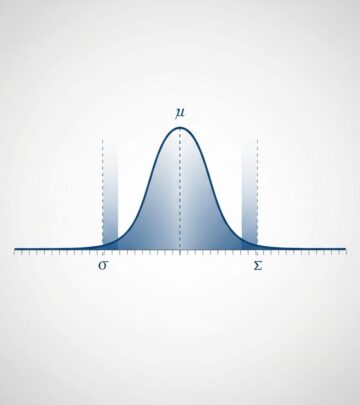
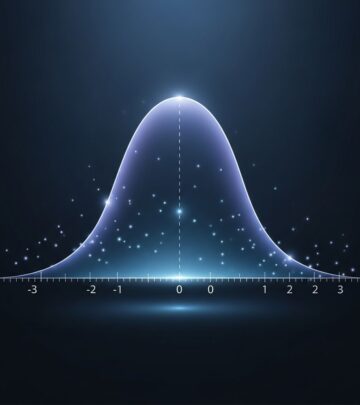
A normal distribution, also called a Gaussian distribution, is a probability distribution that is symmetric about the mean. In a normal distribution, the mean, mode, and median are all equal and fall at the center of the dataset. This means that half of the data should be at the higher end of the set, and the other half below, creating a bell-shaped curve when visualized.
The characteristics of a normal distribution are crucial for applying the empirical rule effectively. When data follows a normal distribution, it exhibits predictable patterns that allow statisticians to make informed inferences about the entire dataset based on samples or partial information. This symmetry and predictability make normal distributions incredibly valuable in practical applications across finance, science, engineering, and social sciences.
The 68-95-99.7 Breakdown
The empirical rule is named after its three primary percentage categories, which define where data falls within standard deviations of the mean:
68% Within One Standard Deviation
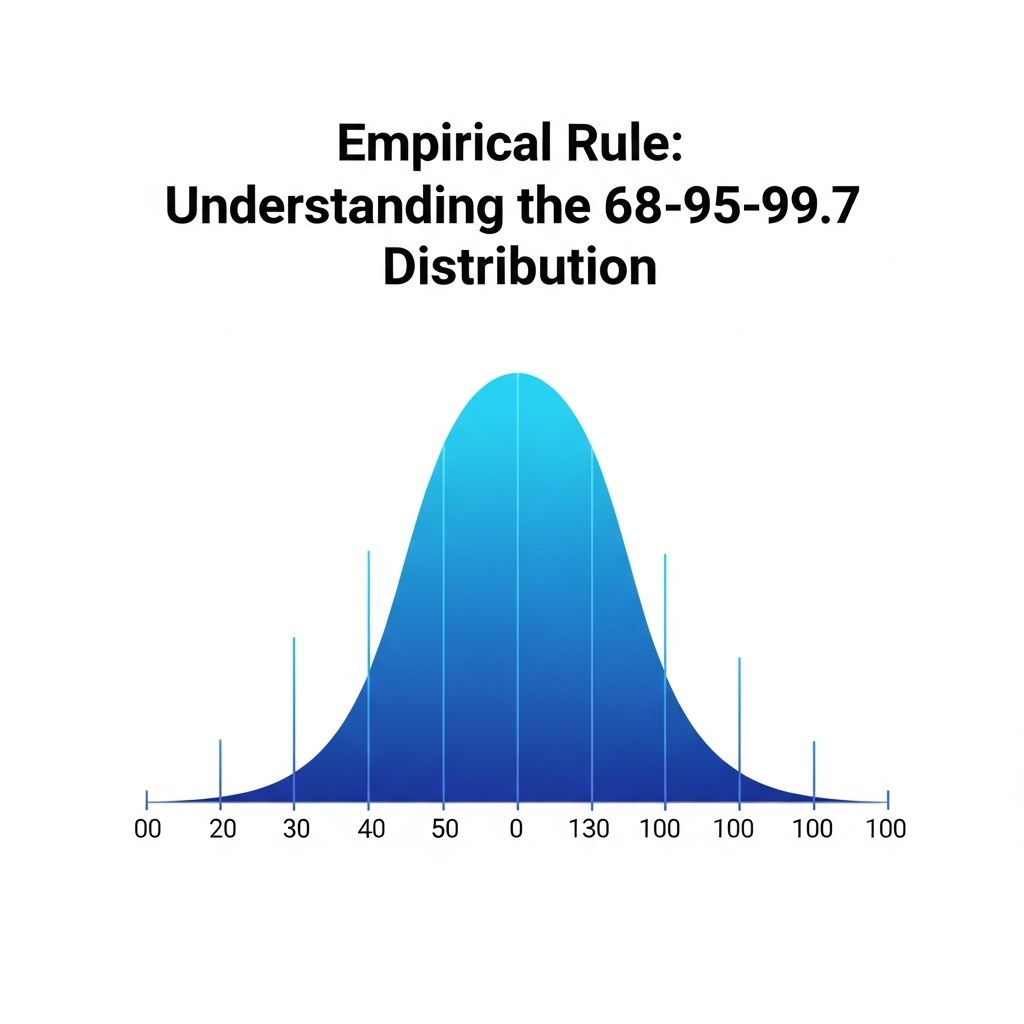
Approximately 68% of the data in a normal distribution falls within one standard deviation (±1σ) of the mean. This means that roughly two-thirds of all observations are clustered relatively close to the average value. This first band represents the most common data points and is essential for understanding the concentration of typical observations.
95% Within Two Standard Deviations
Approximately 95% of the data falls within two standard deviations (±2σ) of the mean. This wider band encompasses the vast majority of observations, leaving only about 5% of data in the tails of the distribution. This second band is particularly useful for quality control and risk assessment, as it captures nearly all normal occurrences while identifying potential outliers.
99.7% Within Three Standard Deviations
Approximately 99.7% of the data falls within three standard deviations (±3σ) of the mean. This outermost band represents virtually all data in a normal distribution, leaving only 0.3% as extreme outliers. This comprehensive coverage is why the empirical rule is sometimes called the Three Sigma Rule, emphasizing the three-sigma boundary that contains nearly all observations.
The Formula and Calculation
To apply the empirical rule effectively, the standard deviation must first be calculated. The standard deviation measures the spread of data around the mean and is fundamental to the empirical rule’s application. The formula for standard deviation is:
σ = √[Σ(x – μ)² / N]
Where:
- σ represents the standard deviation
- Σ indicates the sum of all values
- x represents each individual data point
- μ (mu) represents the mean (average)
- N represents the total number of data points
Once the standard deviation has been determined, the dataset can easily be subjected to the empirical rule, showing where pieces of data lie in the distribution. This calculation breaks down the normal distribution into three primary percentages, within which the majority of the data in the set should fall, excluding a minor percentage for outliers.
Practical Applications of the Empirical Rule
Forecasting and Prediction
The empirical rule is particularly useful for forecasting outcomes within a dataset. Statistically, once the standard deviation has been determined, projections can be made as to where data will fall within the set, based on the 68%, 95%, and 99.7% guidelines. Forecasting is possible because even without knowing all data specifics, analysts can make educated predictions about future data distribution based on these established percentages.
Data Analysis and Insight
In most cases, the empirical rule is primarily used to help determine outcomes when not all data is available. It allows statisticians and researchers to gain insight into where data will fall, once all information is gathered. This capability is invaluable in research settings, market analysis, and quality assurance processes where complete data collection may be time-consuming or expensive.
Testing Data Normality
The empirical rule also helps test how normal a data set is. If the data does not adhere to the empirical rule patterns, it is not a normal distribution and must be calculated accordingly using alternative statistical methods. This test serves as a diagnostic tool to determine which statistical approaches and models are most appropriate for a given dataset.
Quality Control and Risk Management
In manufacturing and quality control, the empirical rule helps identify products or processes that fall outside acceptable ranges. In finance and risk management, it aids in assessing portfolio risk and identifying extreme market movements. These applications demonstrate the rule’s versatility across different professional domains.
Real-World Examples
Example 1: Test Scores
Consider a university where final exam scores follow a normal distribution with a mean of 75 and a standard deviation of 8. Using the empirical rule, we can determine that approximately 68% of students scored between 67 and 83 (±1 standard deviation), 95% scored between 59 and 91 (±2 standard deviations), and 99.7% scored between 51 and 99 (±3 standard deviations). This helps educators understand score distribution and identify students who may need additional support or advanced placement.
Example 2: Manufacturing Specifications
A manufacturing facility produces components with a mean diameter of 10mm and a standard deviation of 0.2mm. The empirical rule indicates that 68% of components will have diameters between 9.8mm and 10.2mm, 95% between 9.6mm and 10.4mm, and 99.7% between 9.4mm and 10.6mm. Parts falling outside three standard deviations are considered defective and require investigation.
Advantages and Limitations
Advantages
- Provides quick estimates without complex calculations
- Works well for normally distributed data
- Facilitates forecasting with incomplete data
- Helps identify outliers and anomalies
- Applicable across numerous industries and fields
Limitations
- Only applies to normal distributions
- May not work well with skewed distributions
- Provides approximations, not exact values
- Requires accurate calculation of standard deviation
- Cannot be applied to non-continuous data
Comparison: Empirical Rule vs. Standard Deviation
| Aspect | Empirical Rule | Standard Deviation |
|---|---|---|
| Purpose | Describes data distribution patterns | Measures data spread around mean |
| Application | Predictions and forecasting | Foundation for calculations |
| Data Requirement | Normal distribution needed | Works with any distribution |
| Complexity | Simple percentages (68%, 95%, 99.7%) | Mathematical formula required |
| Result Type | Approximate ranges | Precise numerical value |
Frequently Asked Questions
Q: What does the empirical rule tell us?
A: The empirical rule tells us that in a normal distribution, approximately 68% of data falls within one standard deviation of the mean, 95% within two standard deviations, and 99.7% within three standard deviations. This helps predict where most data points will fall.
Q: Why is the empirical rule important in statistics?
A: The empirical rule is important because it provides a simple way to understand data distribution, make predictions with incomplete information, test whether data is normally distributed, and identify outliers. It’s a fundamental tool used across science, finance, and quality control.
Q: Can the empirical rule be applied to non-normal distributions?
A: No, the empirical rule specifically applies to normal distributions. For non-normal or skewed distributions, alternative statistical methods must be used. Always verify that your data follows a normal distribution before applying this rule.
Q: What is the relationship between standard deviation and the empirical rule?
A: Standard deviation is the foundation of the empirical rule. You must calculate the standard deviation first to determine the ranges for the 68%, 95%, and 99.7% boundaries. The empirical rule then uses these standard deviation multiples to describe data distribution patterns.
Q: How is the empirical rule used in financial analysis?
A: In finance, the empirical rule helps assess investment risk, identify unusual market movements, and set confidence intervals for portfolio returns. Financial analysts use it to understand the probability of various outcomes and to establish risk management parameters.
Q: What percentage of data falls outside three standard deviations?
A: Approximately 0.3% of data falls outside three standard deviations (beyond ±3σ) in a normal distribution. These extreme values are considered outliers and may warrant special investigation or treatment in analysis.
References
- Empirical Rule – What it is, How to Use, Formula — Corporate Finance Institute. 2025. https://corporatefinanceinstitute.com/resources/data-science/empirical-rule/
- Normal Distribution Problems: Empirical Rule — Khan Academy. 2025. https://www.khanacademy.org/math/ap-statistics/density-curves-normal-distribution-ap/stats-normal-distributions/
- The Normal Distribution and the 68-95-99.7 Rule — National Institute of Standards and Technology (NIST). 2023. https://www.nist.gov/
Similar Articles








Read full bio of Sneha Tete