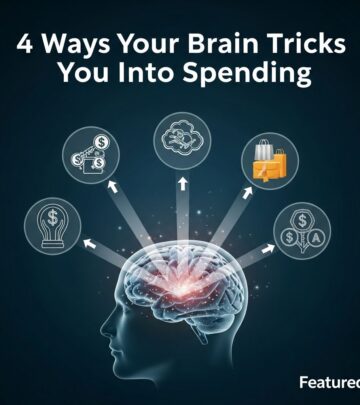
Emotions And Money: 5 Biases That Sabotage Your Investing
Discover how emotional impulses shape financial choices and master strategies for rational wealth building.

Money decisions are rarely purely logical; they are profoundly influenced by our emotional states, past experiences, and innate psychological tendencies. Understanding this interplay empowers individuals to navigate financial landscapes with greater clarity and confidence.
The Neural Foundations of Financial Choices
Human decision-making involves a delicate balance between rational thought and emotional impulses, governed by distinct brain regions. The prefrontal cortex handles logical analysis, while limbic areas process feelings and instincts. When stress arises during financial deliberations, hormones like cortisol and adrenaline surge, amplifying emotional responses.
Research in neuroeconomics reveals that purely logical decisions without emotional input often fail. Individuals with prefrontal cortex damage, despite intact cognitive abilities, make suboptimal choices because emotions provide essential context for evaluating risks and rewards. Positive emotions, such as hope for family security, drive saving and investing behaviors.
Core Emotional Biases Distorting Financial Judgment
Several well-documented biases stem from emotional wiring, leading to predictable errors in money management.
- Loss Aversion: People experience losses about twice as painfully as equivalent gains, prompting them to cling to underperforming assets or avoid necessary risks.
- Overconfidence: Investors frequently overestimate their predictive abilities, resulting in excessive trading that erodes returns compared to passive strategies.
- Herd Behavior: Fear of missing out propels masses into speculative bubbles, as seen in tech manias and crypto surges, only to face crashes.
- Present Bias: Preference for immediate pleasures undermines long-term planning, like opting for daily luxuries over retirement contributions.
- Sunk Cost Fallacy: Emotional attachment to past investments prevents cutting losses, even when data suggests otherwise.
These biases are universal, rooted in evolutionary survival mechanisms that prioritize short-term safety over abstract future gains.
How Upbringing and Culture Mold Money Mindsets
Financial attitudes form early through family dynamics, societal norms, and cultural narratives. Children observing parental frugality or extravagance internalize these patterns, which persist into adulthood. For instance, guilt from childhood scarcity might trigger compensatory spending on loved ones.
Diverse money personalities emerge: chronic savers hoard out of fear, spenders chase highs from purchases, while balanced types align actions with goals. Cultural emphasis on status symbols can fuel debt for appearances, overriding financial prudence. Recognizing one’s money script—core beliefs about wealth—allows for intentional reprogramming.
Market Volatility: The Emotional Amplifier
Financial markets are emotion incubators. Bull runs breed greed and euphoria, prompting over-allocation to hot sectors. Bear markets ignite fear, causing panic selling at lows. This cycle perpetuates underperformance; emotional traders buy high and sell low, inverting the ideal strategy.
Studies show that investors who react to headlines achieve returns far below market averages, as emotions cloud objective assessment. Long-term data underscores the value of steadfastness amid turbulence.
Practical Techniques to Tame Emotional Impulses
Countering biases requires deliberate habits and tools.
| Bias | Counter-Strategy | Example |
|---|---|---|
| Loss Aversion | Set predefined sell rules | Rebalance portfolio annually regardless of feelings |
| Present Bias | Automate savings/investments | Direct 20% of paycheck to retirement pre-decision |
| Herd Mentality | Stick to a written plan | Ignore social media hype; review fundamentals |
| Overconfidence | Seek diverse input | Consult fiduciary advisors quarterly |
| Sunk Cost | Focus on forward metrics | Evaluate future cash flows, not past spend |
Automation removes daily temptations, ensuring disciplined progress. Pausing 48 hours before major transactions allows rationality to prevail over adrenaline. Journaling decisions fosters self-awareness of recurring emotional patterns.
Building Emotional Resilience for Wealth Growth
Cultivate a growth mindset toward money by framing setbacks as learning opportunities. Visualization of long-term objectives reinforces commitment during downturns. Mindfulness practices reduce cortisol spikes, enhancing prefrontal control.
Professional guidance provides objectivity; advisors act as emotional buffers, enforcing plans when self-control wanes. Communities of like-minded individuals combat herd pressures through shared accountability.
Case Studies: Emotions in Action
During the 2008 crisis, loss-averse investors liquidated at bottoms, missing the decade-long recovery. Conversely, those who automated contributions and tuned out noise amassed substantial gains. Crypto enthusiasts in 2021, driven by FOMO, poured savings into peaks, suffering 80% drawdowns. These real-world vignettes highlight the high cost of unchecked emotions.
Frequently Asked Questions
What role does the brain play in money decisions?
The prefrontal cortex manages logic, but limbic systems drive emotions. Both are essential; pure logic without feeling leads to poor outcomes.
How can I overcome loss aversion?
Use rules-based rebalancing and diversify to normalize small losses as part of growth.
Why do people follow market crowds?
Evolutionary wiring favors group survival, manifesting as FOMO in investing.
Is emotional spending always bad?
Not if budgeted; awareness prevents regret spirals.
Can therapy help with money issues?
Financial therapy addresses deep-seated beliefs, improving decision quality.
Long-Term Strategies for Emotional Mastery
Sustainable wealth demands ongoing vigilance. Annual audits of biases, coupled with goal refreshes, keep emotions in check. Education in behavioral finance demystifies impulses, turning knowledge into power. Embrace delayed gratification as a superpower; compound interest rewards patience exponentially.
Ultimately, financial freedom arises not from suppressing emotions but harmonizing them with disciplined action. By illuminating the psychological undercurrents, individuals chart steadier paths to prosperity.
References
- The Psychology of Money: How Emotions Affect Financial Decisions — Lock Wealth Management. 2023. https://www.lockwealthmanagement.com/the-psychology-of-money-how-emotions-affect-financial-decisions
- The Psychology of Money: How Emotions Impact Your Financial Decision — Phronesis Wealth Management. 2023. https://www.phronesiswealthmanagement.com/blog/the-psychology-of-money-how-emotions-impact-your-financial-decision
- The Psychology of Money: How Biases Shape Your Financial Decisions — Harvard FCU Blog. 2023. https://blog.harvardfcu.org/the-psychology-of-money-how-biases-shape-your-financial-decisions
- The Psychology of Money — CIBC Wood Gundy Advisors (Dean Colling). 2023. https://woodgundyadvisors.cibc.com/dean-colling/blog/28103574-The-Psychology-of-Money
- How Behavioral Factors Influence Financial Decision Making — TCG Services. 2023-07-17. https://tcgservices.com/2023/07/17/the-psychology-of-money/
- The psychology of money and emotion — Vanguard Investor Resources. 2023. https://investor.vanguard.com/investor-resources-education/article/the-science-behind-money-and-emotion
Similar Articles








Read full bio of Sneha Tete