Embargo: Definition, Types, and Economic Impact
Understanding embargoes: Government trade restrictions and their global economic consequences.
What Is an Embargo?
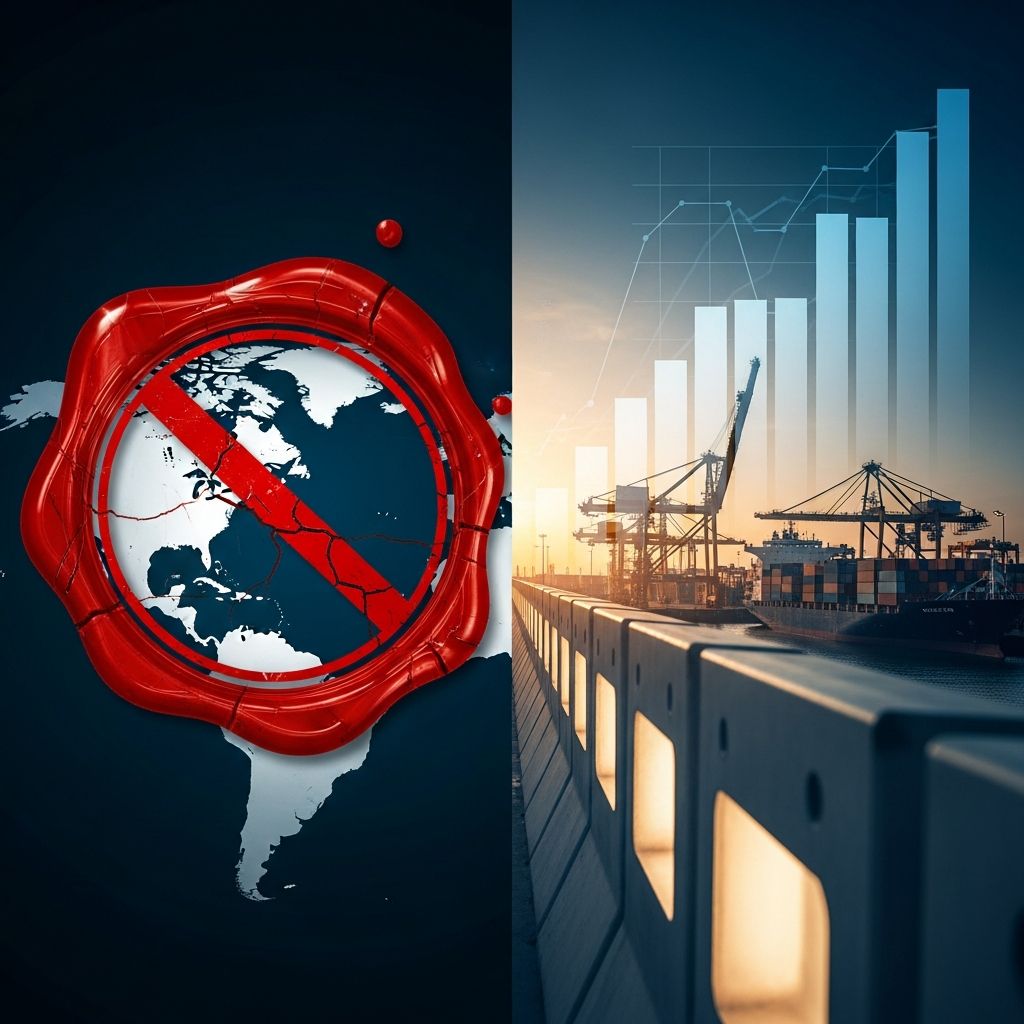
An embargo is a government-imposed restriction on the import or export of goods, services, currency, and other economic values to one or more countries or states. These restrictions serve as a critical tool in international relations, functioning as a non-violent method of economic coercion designed to influence the political or military behavior of targeted nations. Embargoes can be implemented during both wartime and peacetime, affecting various aspects of trade and economic activity between nations.
In modern international relations, embargoes act as an instrument of economic, scientific, technical, and financial pressure, aiming to force changes in a target state’s internal and foreign policies. The United Nations provides a framework for imposing embargoes as collective repressive measures against specific countries whose actions pose a threat to international security. Unlike military interventions, embargoes represent a measured diplomatic approach to addressing international conflicts and policy disagreements.
Types of Embargoes
Embargoes vary significantly in their scope, application, and objectives. Understanding the different types is essential to comprehend how governments use these trade restrictions strategically.
Trade Embargoes
A trade embargo is a broad prohibition on exports to one or more countries, though the term is often used to refer to a ban on all commerce. Trade embargoes represent the most comprehensive form of trade restriction, potentially affecting an entire range of goods and services between nations. These embargoes can be imposed unilaterally by a single country or multilaterally by a group of nations working together.
Strategic Embargoes
Strategic embargoes restrict only the sale of goods that make a direct and specific contribution to a country’s military power. Rather than affecting all trade, these embargoes target military technology, weapons systems, and dual-use items that could enhance a nation’s defense capabilities. During the Cold War, the Coordinating Committee for Multilateral Export Controls (COCOM) managed a multilateral embargo that restricted the export of strategic goods from its member states to the Soviet Union. More recently, strategic embargoes have been imposed against countries such as Iraq, Libya, and North Korea to prevent them from increasing their military power.
Commodity-Specific Embargoes
Certain embargoes target specific commodities or categories of goods. An oil embargo, for example, prohibits only the export of oil, affecting energy supplies without restricting other trade sectors. Similarly, arms embargoes focus exclusively on restricting the export of weapons and military equipment to particular nations or groups, often employed to prevent escalation of conflicts or to maintain international peace.
Humanitarian Exceptions
Broad embargoes often allow the export of certain goods, such as medicines and foodstuffs, to continue for humanitarian purposes. Most multilateral embargoes include escape clauses that specify a limited set of conditions under which exporters may be exempt from their prohibitions. These provisions ensure that civilian populations don’t suffer unnecessarily from restrictions imposed on governments.
Purposes and Objectives of Embargoes
Governments employ embargoes for a variety of political and strategic purposes. Understanding these objectives helps clarify why nations choose this form of economic pressure over other alternatives.
Political Signaling and Deterrence
Embargoes serve as a tool of economic warfare, employed to demonstrate a country’s resolve, send political signals, and deter other nations from undesired activities. By imposing trade restrictions, a government communicates its disapproval of another nation’s policies without resorting to military conflict. For example, in 1992 the United States redoubled its efforts to enforce compliance with its decades-long embargo against Cuba in order to retaliate for the downing of a civilian American airplane by the Cuban air force and to demonstrate its resolve to maintain the trade restrictions despite growing opposition to them at home and abroad.
Compelling Behavioral Change
One of the primary objectives of embargoes is to compel a targeted country to change its behavior or policy. By restricting access to essential goods, foreign investment, and markets, embargoes create economic pressure that can influence governmental decision-making. The assumption is that economic hardship will eventually force political or military leadership to alter their course of action.
Conflict Prevention and Resolution
Embargoes may also be employed to prohibit exports of arms and other war materials to belligerent states or to states in rebellion. In an attempt, usually collective, to force a cessation of hostilities, nations impose arms embargoes as a means of limiting military capabilities. For instance, in 1937 the United States imposed an arms embargo for this purpose on both sides in the Spanish Civil War, and in 1991 the United Nations attempted to halt the fighting in the former Yugoslavia by imposing an arms embargo against all the belligerents.
Military Capability Reduction
Embargoes can prevent potentially threatening countries from increasing their military power by restricting access to advanced technology and strategic materials. This form of embargo serves both defensive and preventive purposes in international relations.
Historical Examples of Embargoes
Throughout history, numerous embargoes have shaped international relations and economic development. Examining these cases reveals how embargoes affect both target nations and those imposing them.
The US Embargo Against Cuba
The United States embargo against Cuba began on March 14, 1958, during the overthrow of dictator Fulgencio Batista by Fidel Castro during the Cuban Revolution. Initially, the embargo applied only to arms sales; however, it later expanded to include other imports, eventually extending to almost all trade on February 7, 1962. This embargo became one of the longest-running trade restrictions in modern history, demonstrating both the persistence of embargo policies and their limited effectiveness in achieving political change.
Vietnam and Foreign Availability
The U.S. embargo against Vietnam provides an instructive example of how embargoes can be circumvented. American companies often complained that the embargo did not prevent Vietnamese consumers from acquiring American computers and other embargoed goods through third parties. The issue of “foreign availability” ultimately became one of the primary justifications offered for ending the U.S. embargo against Vietnam in 1994.
Cyber-Activity Sanctions
In response to cyber-attacks on April 1, 2015, President Obama issued an Executive Order establishing the first-ever economic sanctions specifically targeting cyber-attacks. The Executive Order was intended to impact individuals and entities responsible for cyber-attacks that threaten the national security, foreign policy, economic health, or financial stability of the US. The European Union implemented their first targeted financial sanctions regarding cyber activity in 2020, demonstrating the evolution of embargoes into new technological domains.
Economic and Social Effects of Embargoes
While embargoes are non-violent methods of influence, they can still significantly harm both people and the economies of the countries involved. Understanding these effects is crucial to evaluating the effectiveness and ethics of embargo policies.
Impact on Target Countries
Embargoes can block the importation of important goods and services to the civilian population of the state that is subject to the restriction. This can create severe shortages of essential commodities, medicines, and technologies, affecting the general population more severely than government or military leadership. The humanitarian consequences can be substantial, particularly when embargoes lack humanitarian exceptions for food and medicine.
Impact on Imposing Countries
In a state that imposes an embargo, businesses may lose the ability to trade or invest in the state that is subject to the embargo. Export-dependent industries face significant challenges when their primary markets become unavailable, leading to job losses and economic contraction in specific sectors. Companies must navigate complex compliance requirements to ensure adherence to embargo regulations.
Asymmetrical Economic Warfare
According to the World Economic Forum, the result of multinational embargoes is never a “zero-sum game.” Relying on the power of a government, a state with a stronger economy can cause more damage to the target state than it will suffer in response. This asymmetry reflects the fundamental imbalance in economic power between developed and developing nations. However, the punishment does not always lead to a change in the embargoed government’s political behavior, raising questions about embargo effectiveness.
Enforcement of Embargoes
The enforcement of an embargo may involve the detention of merchant vessels or other property to prevent their movement to a foreign territory. Such actions may be civil or hostile. Whereas civil embargoes consist of the detention of national vessels in home ports either to protect them from foreign depredation or to prevent goods from reaching a particular country, hostile embargoes involve the detention of the vessels or other property of a foreign country.
Embargoes are not imposed against enemy ships and other property, because their status as enemy property usually subjects them to other types of action (such as military attack), but they can be imposed by belligerents on neutral ships—who may also exercise the right of angary—and by neutrals on belligerent ships. For example, in 1941, before it officially became a belligerent, the United States seized German, Italian, Danish, and French ships lying idle in American waters and also froze the assets of the Axis powers.
Multilateral Versus Unilateral Embargoes
The effectiveness of embargoes depends significantly on whether they are implemented multilaterally or unilaterally. Multilateral embargoes require collective cooperation and are most likely to be effective when all countries that have the capacity to undermine them abide by their restrictions. When multiple nations coordinate their embargo efforts, the targeted country faces greater economic pressure and has fewer opportunities to circumvent restrictions through alternative trading partners.
The ability of a targeted country to acquire embargoed goods from a third party is likely to reduce the embargo’s effectiveness. If only one or a few nations impose an embargo while others continue trade with the target country, the embargo’s impact diminishes substantially. Additionally, embargoes put exporters in countries imposing the embargo at a disadvantage relative to their competitors in countries that do not abide by the embargo by denying them access to markets in the targeted country.
Compliance and Business Implications
For businesses operating in international trade, compliance with embargo regulations is essential. There are many steps that must be taken to ensure that a business entity does not accrue unwanted fines, taxes, or other punitive measures. Common examples of embargo checks include referencing embargo lists, cancelling transactions, and ensuring the validity of a trade entity. Before better tools became available, many companies relied on spreadsheets and manual processes to keep track of compliance issues. Today, there are software-based solutions that automatically handle sanctions and other complications with trade, helping businesses navigate the increasingly complex landscape of international trade restrictions.
Frequently Asked Questions
Q: What is the difference between an embargo and sanctions?
A: While often used interchangeably, embargoes specifically refer to trade restrictions on goods and services, whereas sanctions can include broader economic penalties such as asset freezes, travel bans, and restrictions on financial transactions. Embargoes are a subset of economic sanctions.
Q: Can embargoes include humanitarian exceptions?
A: Yes, many embargoes include provisions allowing the export of essential goods such as medicines and foodstuffs for humanitarian purposes. These exceptions ensure that civilian populations have access to critical supplies despite political tensions.
Q: How effective are embargoes in achieving political change?
A: Embargoes vary in effectiveness. While they create economic pressure, they don’t always compel targeted governments to change their behavior. Success depends on multilateral participation, the targeted country’s economic resilience, and the availability of alternative trading partners.
Q: Who can impose embargoes?
A: Individual countries can impose unilateral embargoes, or multiple countries can coordinate multilateral embargoes. International organizations, particularly the United Nations, can also authorize embargoes as collective repressive measures against specific nations.
Q: What compliance measures do businesses need to follow?
A: Businesses must reference embargo lists, verify trading partners’ validity, and ensure transactions don’t violate restrictions. Many organizations now use automated software solutions to manage compliance rather than manual tracking methods.
References
- Embargo – Definition, How They Happen, Types, Effects — Corporate Finance Institute. https://corporatefinanceinstitute.com/resources/economics/embargo/
- Embargo | International Trade Restrictions & Sanctions — Encyclopaedia Britannica. https://www.britannica.com/money/embargo-international-law
- Economic Sanctions — Wikipedia. https://en.wikipedia.org/wiki/Economic_sanctions
Similar Articles








Read full bio of medha deb