8 Innovative Ways Elon Musk Made Money Before Billionaire Status
Discover how Elon Musk built his fortune through creative ventures and strategic entrepreneurship.
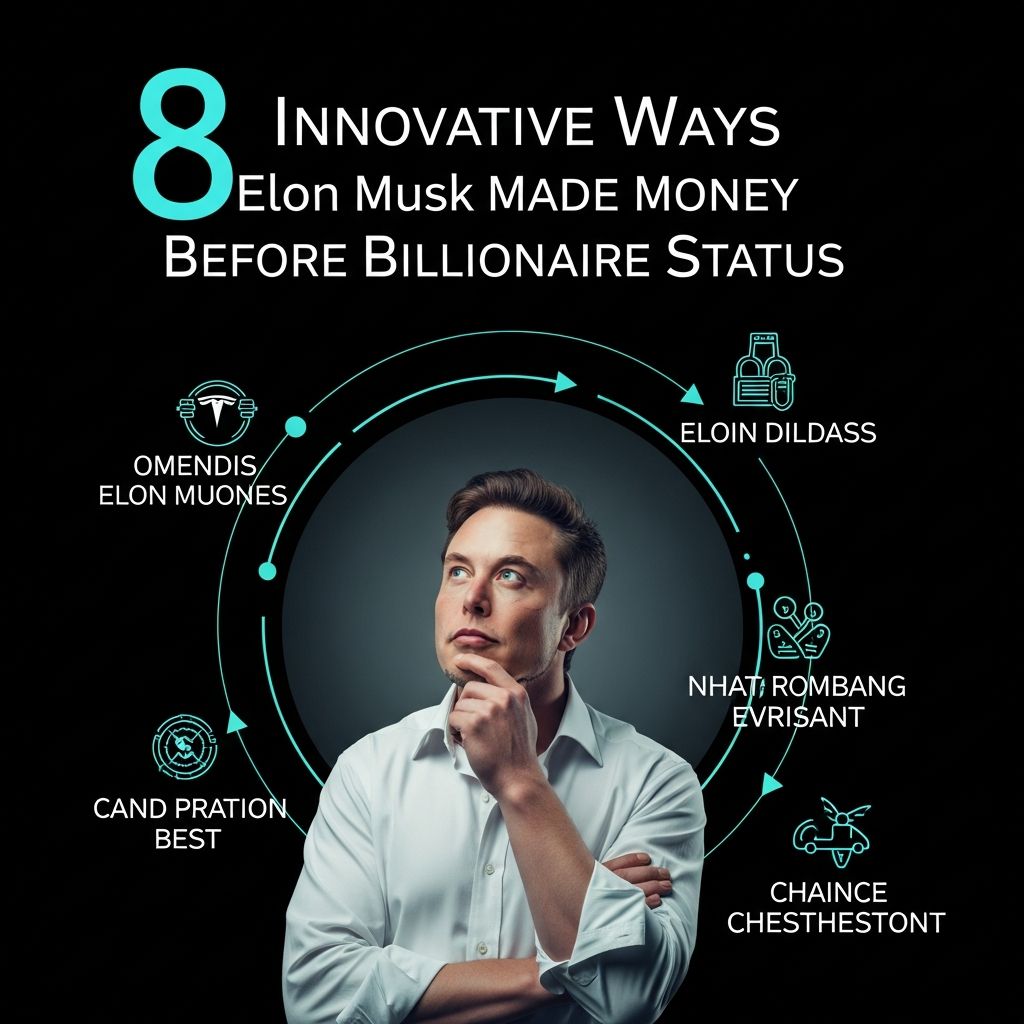
8 Innovative Ways Elon Musk Made Money Before He Was a Billionaire
Elon Musk’s journey to becoming one of the world’s richest individuals wasn’t instantaneous. Before Tesla became a household name and SpaceX revolutionized space exploration, Musk earned money through a series of creative and unconventional ventures. Each step along his entrepreneurial path provided valuable experience, financial capital, and lessons that would shape his future success. Understanding how Musk climbed the ladder of wealth reveals important insights into entrepreneurship, innovation, and the power of strategic thinking.
1. Creating and Selling a Video Game at Age 12
Musk’s entrepreneurial journey began remarkably early. At just 12 years old, he created and sold his first product: a space-themed video game called Blastar. The objective of the game was to destroy an alien ship filled with weapons of mass destruction, a theme that would later prove prophetic given Musk’s obsession with technology and space exploration.
Musk had been fascinated with computers from an early age and taught himself programming starting at age 9. When he completed Blastar, he submitted the source code to a South African magazine called PC and Office Technology. The magazine published his game and paid him $500 for the code—his first sale ever. Years later, Musk would downplay the achievement, describing it as “a trivial game… but better than Flappy Bird.” Nevertheless, this early success planted the seeds of entrepreneurial confidence that would define his career.
2. Working as a Boiler Room Cleaner
After leaving South Africa in 1988, Musk moved to Canada and took on a series of odd jobs while exploring different career paths. His early employment wasn’t glamorous. He first tended vegetables and shoveled grain bins at a cousin’s farm in Waldeck, Saskatchewan, then learned how to cut logs with a chainsaw in Vancouver.
Seeking better-paying work, teenage Musk visited the local unemployment office in British Columbia and asked a simple but strategic question: which jobs in the area paid the most? The answer surprised him—boiler room cleaning at a lumber mill offered $18 per hour, an excellent wage for 1989.
The job itself was grueling and dangerous. Musk would don a hazmat suit, crawl through narrow tunnels into the boiler room of the mill, and shovel hot boiler-room residue back through the tunnel into a wheelbarrow. The work involved extreme heat, confined spaces, and physically demanding labor. According to Musk’s own accounts, out of an original crew of 30 workers, only four—including Musk himself—lasted through the first week. This experience taught him resilience and the value of hard work, traits that would serve him well in his future entrepreneurial endeavors.
3. Selling Computer Parts and Building Custom Computers
While attending Queens University in Ontario, Musk discovered another profitable opportunity: building and selling computers from his dorm room. He would construct custom computers tailored to the specific needs of his fellow students. Some customers wanted high-performance gaming computers, while others needed simple word processors. Whatever the demand, Musk would build it.
His computer repair services were equally popular. If a student’s computer wasn’t booting properly or had a virus, Musk would troubleshoot and fix the problem. As he described it, “if their computer didn’t boot properly or had a virus, I’d fix it. I could pretty much solve any problem.” This side hustle provided steady income while Musk pursued his studies, and it demonstrated his early business acumen—identifying market needs and solving problems profitably.
4. Operating an Unlicensed Speakeasy
When Musk transferred to the University of Pennsylvania in 1992, he quickly applied his entrepreneurial instincts to a new venture. Along with his college roommate Adeo Ressi, Musk rented a cheap 10-bedroom frat house off campus. During the week, the two focused on their studies, but on weekends, they transformed their living space into something entirely different: an unlicensed speakeasy.
The operation was simple yet effective. They charged students $5 at the door for entry to weekend parties. According to Musk, approximately 500 students would show up each weekend, generating substantial revenue. This creative approach to financing their education was born out of necessity—Musk had accumulated over $100,000 in student loan debt and needed a way to help cover rent and expenses. The speakeasy venture demonstrated Musk’s ability to identify opportunities and monetize them, even in unconventional ways.
5. Co-Founding Zip2: The Internet Yellow Pages
In 1995, at age 24, Musk made a pivotal decision that would change his life. Along with his brother Kimbal, a friend, and a $28,000 investment from his father, he co-founded Zip2, an online city guide and business directory service. The concept was relatively simple but innovative for the time: Zip2 functioned as a web-friendly version of the Yellow Pages, listing business addresses alongside maps showing where each business was located.
The company’s early days were challenging. Investors considered the project too risky and refused to fund it. To conserve cash, the three founders would sleep in their rented office space. Musk himself wrote much of the code, applying the programming skills he had developed over years of self-study.
Despite these humble beginnings, Zip2 gradually gained traction. Newspaper publishers began using the service to provide their readers with local business information and maps. By 1999, the company’s success attracted the attention of Compaq, the major computer manufacturer. Compaq purchased Zip2 for $307 million, netting Musk approximately $22 million from the sale. This windfall provided the capital Musk needed to pursue his next venture and established him as a successful entrepreneur in the tech industry.
6. Co-Founding X.com: The Online Banking Pioneer
Flush with success and capital from the Zip2 sale, Musk wasted no time launching his next venture. In 1999, he invested $12 million of his own money to co-found X.com, an online financial services company focused on email payments and digital banking. The vision was bold: X.com aimed to become the future of online banking at a time when most Americans were skeptical about conducting financial transactions on the internet.
In early 2000, X.com merged with a rival company called Confinity. The merged entity was renamed PayPal and rapidly revolutionized online financial transactions. However, Musk’s tenure as CEO was contentious. Amid boardroom conflicts and disagreements about the company’s strategic direction, he was ousted from the CEO position.
Despite the leadership turmoil, PayPal continued to grow and attract acquisition interest from eBay. In July 2002, eBay purchased PayPal for $1.5 billion. As the majority shareholder at the time of the acquisition, Musk received approximately $180 million after taxes from the sale. This massive windfall transformed his financial situation and provided the resources necessary for his most ambitious ventures yet: SpaceX and Tesla.
7. Launching SpaceX and Pursuing Mars
After the PayPal-eBay deal, Musk attended a Mars Society meeting where he learned about plans to send mice into orbit. Inspired by this vision and frustrated with what he saw as stagnation in the space industry, Musk decided to take action. In 2002, he founded SpaceX with the ambitious goal of making humanity multiplanetary by enabling missions to the Moon, Mars, and beyond.
SpaceX represented a dramatic shift in Musk’s business focus. Rather than staying in the financial services or internet sectors, he dove into aerospace and space exploration—an industry with extraordinarily high barriers to entry, significant technical challenges, and massive capital requirements. Musk invested substantial portions of his PayPal wealth into SpaceX, betting on the company’s ability to revolutionize space travel through reusable rockets and advanced technology.
8. Co-Founding Tesla and Entering the Electric Vehicle Industry
The year after founding SpaceX, in 2003, Musk co-founded Tesla Motors (now Tesla, Inc.) and became the company’s CEO. Rather than starting from scratch, Musk joined an existing electric vehicle startup and transformed it into a global powerhouse. Tesla’s mission was ambitious: accelerate the world’s transition to sustainable energy through electric vehicles.
While other companies were skeptical about the market potential for electric vehicles, Musk and Tesla forged ahead. The company’s early years were marked by financial struggles and technical challenges, but Musk’s vision and persistence eventually paid off. Tesla would eventually become the world’s most valuable automaker and a symbol of innovation in the automotive industry.
The Pattern of Success
Looking at these eight ventures, several patterns emerge. First, Musk consistently identified emerging opportunities in industries others overlooked or underestimated. Second, he was willing to take on unglamorous work and learn practical skills that would serve him later. Third, he leveraged each success to fund the next venture, creating a compounding effect of wealth and influence. Finally, he maintained an entrepreneurial mindset regardless of his financial circumstances—from selling video games for $500 to building computers in a dorm room to founding billion-dollar companies.
Lessons for Aspiring Entrepreneurs
Musk’s pre-billionaire ventures offer valuable lessons for anyone seeking to build wealth through entrepreneurship. Start small and learn by doing. Identify genuine market needs and problems worth solving. Be willing to work hard and take on unglamorous jobs. Reinvest profits from successful ventures into new opportunities. Most importantly, think big while executing with discipline and focus.
Frequently Asked Questions
Q: What was Elon Musk’s first business venture?
A: Musk’s first business venture was creating and selling a video game called Blastar at age 12, which earned him $500 from a South African tech magazine.
Q: How much money did Musk make from Zip2?
A: When Compaq acquired Zip2 in 1999 for $307 million, Musk netted approximately $22 million from the sale.
Q: What happened to X.com and how did it become PayPal?
A: X.com merged with a rival company called Confinity in early 2000, and the combined entity was renamed PayPal. eBay later acquired PayPal for $1.5 billion in 2002, and Musk received approximately $180 million from the sale.
Q: When did Musk found SpaceX and Tesla?
A: Musk founded SpaceX in 2002 and co-founded Tesla Motors in 2003, both using capital he earned from his earlier ventures.
Q: How did Musk afford to live while building Zip2?
A: During Zip2’s early days, Musk and his co-founders slept in their rented office space to save money on living expenses while bootstrapping the company.
Q: What job paid Musk the most before he became wealthy?
A: The boiler room cleaning job at a lumber mill paid $18 per hour in 1989, which was the best-paying job Musk could find at the time as a teenager in Canada.
References
- 8 Innovative Ways Elon Musk Made Money Before He Was a Billionaire — Money.com. 2024. https://money.com/8-innovative-ways-elon-musk-made-money-before-he-was-a-billionaire/
- 7 Unique Jobs Elon Musk Had Before Becoming the Richest Person — Finance Buzz. 2024. https://financebuzz.com/jobs-elon-musk-had-before-wealthy
- How Elon Musk Made His First Million: The Early Ventures That Built a Billionaire — Gate.com. 2024. https://www.gate.com/crypto-wiki/article/how-elon-musk-made-his-first-million-the-early-ventures-that-built-a-billionaire
- How Did Elon Musk Become Rich? His Journey Explained — Matt Haycox. 2024. https://matt-haycox.com/how-did-elon-musk-become-rich/
- Business career of Elon Musk — Wikipedia Contributors. 2024. https://en.wikipedia.org/wiki/Business_career_of_Elon_Musk
Similar Articles








Read full bio of medha deb