Economics: Definition, Types, and Core Principles
Master the fundamentals of economics and understand how markets, resources, and human behavior shape economies.
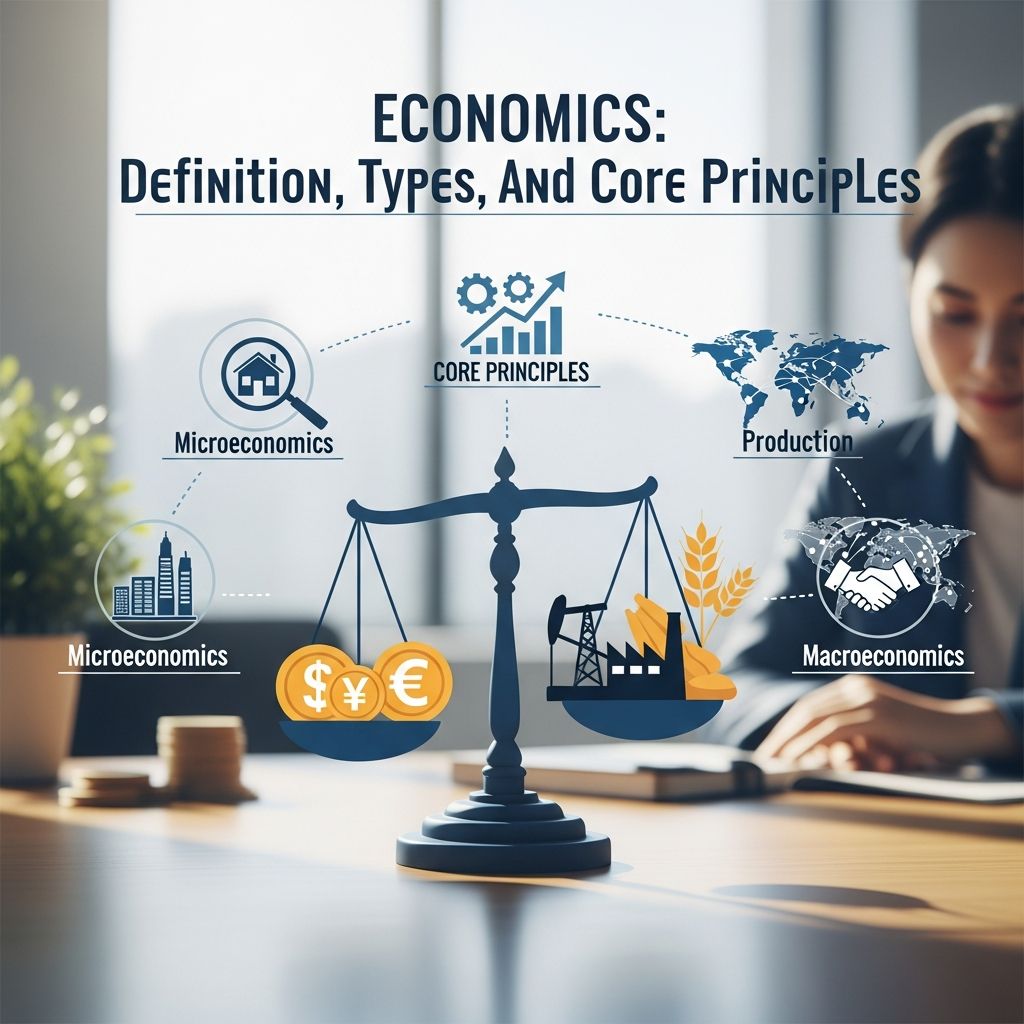
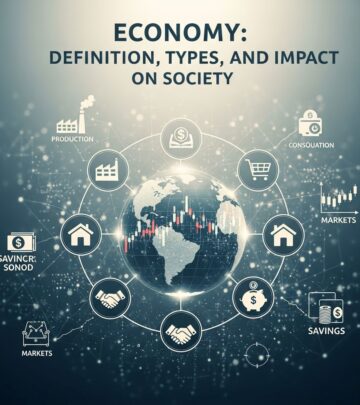
Economics is the social science that studies how individuals, businesses, governments, and nations make choices about allocating scarce resources to satisfy unlimited wants and needs. The term originates from the Greek words “oikos” (household) and “nomos” (law or rules), literally meaning “household management.” Today, economics encompasses far more than managing households—it examines the complex mechanisms that govern production, distribution, and consumption of goods and services across entire nations and the global economy.
At its core, economics attempts to answer fundamental questions: What should be produced? How should it be produced? Who should receive the produced goods? These questions drive economic inquiry and policy decisions worldwide.
Understanding the Definition of Economics
Economics can be defined as the study of human behavior and decision-making when faced with limited resources and unlimited desires. This discipline recognizes that every economy operates under constraints—finite labor, capital, land, and raw materials—while human wants continually expand. This tension between scarcity and unlimited wants creates the central economic problem.
Modern economics combines elements of mathematics, statistics, psychology, and history to analyze human behavior. Economists use data analysis, mathematical models, and empirical research to understand how people respond to incentives and make decisions about production, consumption, and investment.
The Two Main Branches of Economics
Economics traditionally divides into two complementary branches, each addressing different scales and aspects of economic activity:
Microeconomics
Microeconomics focuses on individual actors within the economy—consumers, workers, and businesses. This branch examines:
- How individual consumers decide what to purchase based on income and preferences
- How firms determine production levels and pricing strategies
- How labor markets function and wages are determined
- How specific industries operate and compete
- The impact of taxes, subsidies, and regulations on individual markets
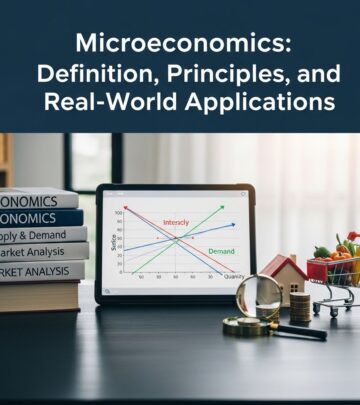
Microeconomics utilizes supply and demand analysis to explain price determination and market equilibrium. For example, if demand for coffee increases while supply remains constant, prices typically rise, encouraging suppliers to produce more and some consumers to purchase less. Microeconomic analysis helps businesses make production and pricing decisions while assisting policymakers in understanding how targeted regulations affect specific sectors.
Macroeconomics
Macroeconomics examines the economy as a whole, analyzing aggregate phenomena affecting entire nations or the global economy. Key areas of macroeconomic study include:
- National output and income (Gross Domestic Product)
- Overall price levels and inflation rates
- Employment rates and unemployment
- International trade and exchange rates
- Money supply and interest rates
- Government fiscal and monetary policy effectiveness
Macroeconomists study business cycles—periods of expansion and contraction in economic activity—and seek to understand what causes recessions and booms. They analyze how government policies influence overall economic performance and aim to promote stable growth, low unemployment, and controlled inflation.
Key Economic Principles
Several fundamental principles underpin economic analysis and help explain how economies function:
Scarcity and Opportunity Cost
Scarcity—the basic economic problem—exists because resources are finite while human wants are infinite. Every choice to produce or consume one item means forgoing another. This trade-off is called opportunity cost: the value of the next best alternative foregone when making an economic decision. Understanding opportunity cost helps explain why individuals and nations specialize in activities where they have comparative advantage.
Supply and Demand
The interaction between supply (quantity producers offer at various prices) and demand (quantity consumers desire at various prices) determines market prices and quantities. When demand exceeds supply, prices typically rise, and when supply exceeds demand, prices fall. Markets reach equilibrium when supply equals demand, clearing the market of excess inventory or unfulfilled demand.
Comparative Advantage
Developed by economist David Ricardo, comparative advantage explains why trade benefits all parties. A country has comparative advantage in producing a good if it can produce it at lower opportunity cost than another country. International specialization based on comparative advantage increases total production and benefits all trading partners.
Diminishing Marginal Returns
As more units of a variable input (like labor) are added to fixed inputs (like capital), the additional output produced by each new unit eventually decreases. This principle explains why a farmer cannot infinitely increase crop yields by simply hiring more workers—eventually, the additional benefit of each new worker declines.
Types of Economic Systems
Economies organize production and distribution through different systems, each with distinct characteristics:
Market Economies
In market economies, prices and the profit motive drive production and consumption decisions. Consumer demand and competition among producers determine what gets produced and at what price. Most developed nations operate predominantly as market economies, with varying degrees of government intervention. The United States, United Kingdom, and Germany exemplify market-based systems.
Command Economies
Command (or planned) economies rely on government central planning to determine production, pricing, and distribution. Government authorities decide what to produce, how much, and at what prices. Historical examples include the Soviet Union, though few pure command economies exist today. Cuba and North Korea maintain relatively centralized economic systems.
Mixed Economies
Most modern economies blend market and command elements, combining private enterprise with government regulation and intervention. Mixed economies maintain market mechanisms for many decisions while using government policy to address market failures, provide public goods, and ensure social welfare. Most European nations and Canada operate as mixed economies, balancing capitalist and socialist principles.
Economic Schools of Thought
Throughout history, economists have developed different theories explaining how economies function:
- Classical Economics: Emphasizes free markets, individual rationality, and the self-correcting nature of economies through price mechanisms
- Keynesian Economics: Highlights the role of aggregate demand, government spending, and the importance of fiscal policy in stabilizing economies
- Monetarism: Emphasizes the importance of money supply in controlling inflation and influencing economic activity
- Austrian Economics: Stresses individual decision-making, entrepreneurship, and skepticism toward government intervention
- Behavioral Economics: Incorporates psychological insights into economic analysis, recognizing that people often act irrationally
Fundamental Economic Indicators
Economists monitor several key indicators to assess economic health and performance:
| Indicator | Definition | Significance |
|---|---|---|
| Gross Domestic Product (GDP) | Total monetary value of all finished goods and services produced within a country during a specific period | Measures overall economic size and growth |
| Inflation Rate | Percentage increase in the general price level of goods and services over time | Indicates purchasing power changes and economic stability |
| Unemployment Rate | Percentage of the labor force actively seeking employment but without a job | Reflects labor market health and economic slack |
| Interest Rates | Cost of borrowing money, typically set by central banks | Influences investment, consumption, and economic activity |
| Trade Balance | Difference between exports and imports | Reflects international competitiveness and capital flows |
Modern Economic Challenges
Contemporary economies face several significant challenges requiring economic analysis and policy solutions:
- Income Inequality: Growing disparities in wealth and income distribution within and between nations
- Globalization: Increased international trade and capital flows creating both opportunities and disruptions
- Climate Change: Environmental externalities requiring economic consideration and policy response
- Technological Disruption: Rapid technological change affecting labor markets and business models
- Pandemic Economics: Understanding economic impacts of health crises and building resilience
Frequently Asked Questions
Q: What is the primary goal of economics?
A: The primary goal of economics is to understand how societies allocate scarce resources to satisfy unlimited wants, and to help policymakers and businesses make informed decisions that maximize efficiency and welfare.
Q: How do microeconomics and macroeconomics differ?
A: Microeconomics studies individual markets and decision-makers (consumers, firms), while macroeconomics examines the economy as a whole, focusing on aggregate phenomena like national income, employment, and inflation.
Q: What is opportunity cost?
A: Opportunity cost is the value of the next best alternative foregone when making an economic decision. It represents what you give up to choose something else.
Q: Why do economists study different economic systems?
A: Studying different systems helps economists understand how various organizational structures affect efficiency, growth, and welfare, and provides insights for policymakers designing economic institutions.
Q: How does supply and demand determine prices?
A: When demand exceeds supply, prices rise, encouraging more production and reducing consumption until equilibrium is reached. When supply exceeds demand, prices fall, reducing production and increasing consumption until markets clear.
Q: What are leading economic indicators?
A: Leading economic indicators are statistics that tend to change before the economy changes direction, helping predict future economic performance. Examples include consumer confidence, housing starts, and stock market movements.
Q: How does inflation affect the economy?
A: Moderate inflation can encourage spending and investment, but high inflation erodes purchasing power, discourages saving, and creates uncertainty. Deflation can be equally harmful, discouraging spending and investment.
References
- Principles of Microeconomics — N. Gregory Mankiw, Cengage Learning. 2020. https://www.cengage.com/
- Macroeconomics — Paul Krugman and Robin Wells, Worth Publishers. 2023. https://www.worthpublishers.com/
- Economic Data and Statistics — U.S. Bureau of Economic Analysis (BEA). 2025. https://www.bea.gov/
- National Bureau of Economic Research — NBER Research Program. 2025. https://www.nber.org/
- OECD Statistics Database — Organisation for Economic Co-operation and Development. 2025. https://stats.oecd.org/
Similar Articles








Read full bio of Sneha Tete