Economic Profit vs. Accounting Profit: Key Differences
Understand the critical differences between economic and accounting profit for better business decisions.
Understanding the Difference Between Economic Profit and Accounting Profit
In the world of business and finance, profit is often viewed as a straightforward concept—revenue minus expenses. However, the reality is more nuanced. Two distinct types of profit calculations exist: accounting profit and economic profit. While these terms are sometimes used interchangeably, they represent fundamentally different approaches to measuring a company’s financial performance and efficiency. Understanding the distinction between these two profit types is essential for business owners, investors, financial analysts, and anyone making strategic decisions about resource allocation and investment opportunities.
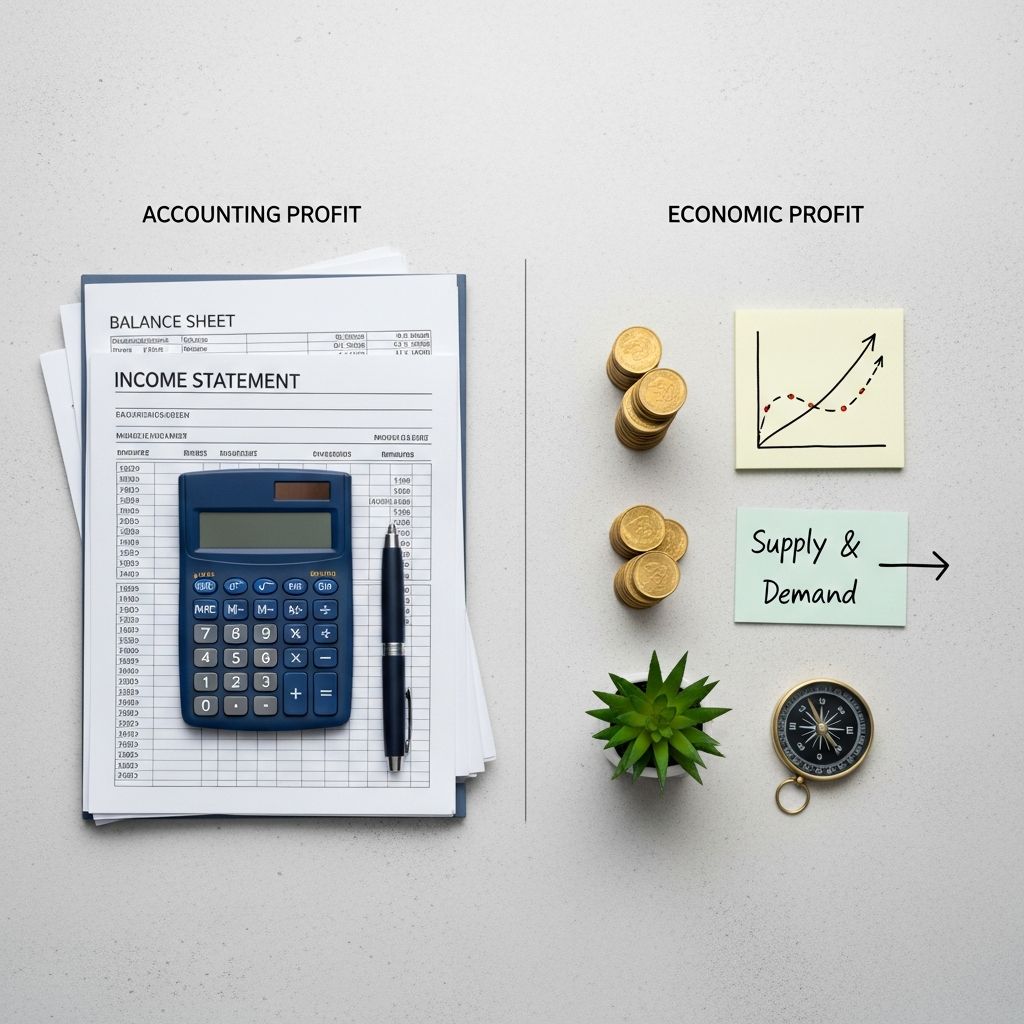
Accounting profit focuses on actual, documented financial transactions and is what appears on a company’s income statement. Economic profit, by contrast, incorporates theoretical opportunity costs and provides insight into whether a business is truly making optimal use of its resources. This comprehensive guide explores the critical differences between these two profit concepts, their formulas, practical applications, and why both matter for effective business management.
What Is Accounting Profit?
Accounting profit, also known as net income or net earnings, represents the financial profit of a business calculated according to Generally Accepted Accounting Principles (GAAP). It is derived by subtracting explicit costs—actual, documented expenses—from total revenue. These explicit costs include salaries, rent, utilities, cost of goods sold, depreciation, taxes, and other measurable operating expenses that a business must pay to generate revenue.
Accounting profit is the figure that appears on a company’s income statement and is what most people typically refer to when discussing a company’s profitability. This metric is critical for reporting to the Internal Revenue Service (IRS) and for communicating a company’s financial health to shareholders, investors, and creditors. Because it follows standardized accounting rules and is based on concrete, verifiable transactions, accounting profit provides a clear snapshot of a company’s financial performance during a specific period.
The primary strength of accounting profit is its objectivity. It relies on documented transactions and follows consistent, regulated principles. This makes it easy to audit, compare across periods, and use for tax purposes. However, accounting profit has limitations—it does not account for the value of what a company gives up when choosing one business path over another.
What Is Economic Profit?
Economic profit takes a broader, more theoretical approach to measuring profitability. It is calculated by subtracting both explicit costs and implicit costs (opportunity costs) from total revenue. Unlike accounting profit, which uses net income, economic profit is based on a company’s free cash flow—the actual amount of cash generated by the business after accounting for capital expenditures and investments.
Implicit costs, or opportunity costs, represent the potential earnings that a company forgoes when selecting one business alternative over another. For example, if a business owner invests $100,000 in their company but could have earned $12,000 annually by investing that money in the stock market, the opportunity cost is $12,000 per year. These costs do not appear on financial statements because they are theoretical estimates rather than actual transactions. Economic profit helps businesses evaluate whether their current use of resources is truly optimal compared to alternative uses.
Economic profit is based on economic principles rather than accounting rules and is primarily used for internal business analysis and strategic decision-making. It is not reported to the IRS and is not used for tax purposes. Instead, it serves as a management tool for evaluating investment decisions, determining when to enter or exit markets, and assessing whether a company is operating efficiently.
Key Differences Between Economic and Accounting Profit
While both types of profit measure financial performance, they differ in several important ways. Here are the fundamental distinctions:
Types of Costs Considered
The most significant difference between accounting profit and economic profit lies in the costs included in their calculations. Accounting profit considers only explicit costs—actual cash expenditures and documented expenses such as payroll, rent, utilities, and materials. Economic profit, conversely, includes both explicit costs and implicit costs (opportunity costs). This broader scope makes economic profit a more comprehensive measure of true profitability.
Calculation Method
The formulas for these two profit types reflect their different approaches:
Accounting Profit = Total Revenue − Explicit Costs
Economic Profit = Total Revenue − (Explicit Costs + Implicit Costs)
Because economic profit includes an additional cost component, it will always be equal to or less than accounting profit. A business can show positive accounting profit while having negative economic profit if the opportunity costs exceed the accounting profit.
Adherence to Standards
Accounting profit adheres to Generally Accepted Accounting Principles (GAAP), which are standardized rules that govern financial reporting. This ensures consistency and makes accounting profit comparable across companies and time periods. Economic profit, by contrast, follows general economic principles and theoretical frameworks. There is no standardized, regulated formula for calculating economic profit, which gives businesses flexibility but also introduces subjectivity.
Primary Uses
Accounting profit serves several official purposes: it determines a company’s tax liability, informs investors about financial performance, and helps analysts assess a company’s financial health. Accounting profit appears on the balance sheet and directly impacts shareholder value and return on investment. Economic profit, however, is used exclusively for internal business analysis. Managers use economic profit to make strategic decisions about resource allocation, capital investments, and market entry or exit strategies.
Reporting Requirements
Accounting profit must be reported to the IRS and appears on financial statements submitted to regulatory authorities and shareholders. Economic profit has no regulated reporting requirement and is used only for internal business planning and analysis. This distinction reflects the different purposes of each metric—accounting profit is about external compliance and communication, while economic profit is about internal optimization.
Formulas and Calculations
Understanding how to calculate each type of profit is essential for practical application:
Accounting Profit Formula
Accounting Profit = Total Revenue − Explicit Costs
To calculate accounting profit, gather your total revenue (all income from sales and services) and list all explicit costs. Explicit costs include cost of goods sold (COGS), employee salaries, rent, utilities, insurance, depreciation, interest on debt, and taxes. Subtract total explicit costs from revenue, and you have your accounting profit.
Economic Profit Formula
Economic Profit = Total Revenue − (Explicit Costs + Implicit Costs)
To calculate economic profit, start with total revenue and explicit costs as you would for accounting profit. Then identify and estimate all implicit costs. Implicit costs include the value of owner’s time and expertise, foregone interest on capital invested, potential rental income from owned property used in the business, and other opportunity costs. Add explicit costs and implicit costs together, then subtract this total from revenue.
Practical Example
Consider a small consulting business with annual revenue of $200,000. Explicit costs include office rent ($24,000), employee salaries ($90,000), supplies ($8,000), and utilities ($3,000), totaling $125,000 in explicit costs. The accounting profit would be $200,000 − $125,000 = $75,000.
However, the owner invested $150,000 of personal capital in the business. If that capital could have earned 8% annually in a conservative investment, the implicit cost would be $12,000. Additionally, the owner’s expertise could command a $50,000 annual salary if employed elsewhere, representing another implicit cost of $50,000. Total implicit costs = $62,000. Therefore, economic profit = $200,000 − ($125,000 + $62,000) = $13,000.
In this example, while the business shows strong accounting profit of $75,000, the economic profit of $13,000 suggests the owner might be better served by pursuing alternative opportunities with their capital and expertise.
When to Use Each Profit Measure
Use Accounting Profit When:
Assessing overall financial health and profitability in a given year; Reporting to the IRS and calculating tax liability; Communicating with shareholders and investors; Comparing financial performance across periods; Evaluating a company’s creditworthiness for lending purposes; Making decisions about dividend payments or share repurchases
Use Economic Profit When:
Evaluating whether current business strategies are truly optimal; Making long-term investment and capital allocation decisions; Determining whether to enter new markets or business lines; Assessing performance compared to competitors; Deciding when to exit a business or market; Analyzing whether the company’s returns justify the capital invested; Evaluating the efficiency of resource utilization
Advantages and Disadvantages
Advantages of Accounting Profit
Accounting profit offers several practical advantages. It is based on objective, documented transactions, making it easy to verify and audit. It follows standardized principles, ensuring consistency and comparability. It is required for official reporting and tax purposes, and it clearly communicates financial results to external stakeholders. Additionally, it is straightforward to calculate using data from financial statements.
Disadvantages of Accounting Profit
The primary limitation of accounting profit is that it ignores opportunity costs. It does not reflect what a company could have earned through alternative uses of its resources. This can mask inefficient business operations or poor investment decisions. Accounting profit also does not account for all non-cash expenses or changes in the value of assets over time that aren’t captured through depreciation.
Advantages of Economic Profit
Economic profit provides a more complete picture of true profitability by accounting for all costs, including opportunity costs. It helps managers identify whether they are maximizing the value of invested capital and whether current business strategies are truly optimal. It encourages long-term strategic thinking rather than short-term optimization. A positive economic profit indicates the business is outperforming alternatives and creating real value. Zero economic profit suggests the business is performing at a competitive equilibrium level.
Disadvantages of Economic Profit
Economic profit is based on estimates and assumptions about opportunity costs, making it more subjective and harder to verify objectively. There is no standardized calculation method, so different analysts may arrive at different results. It requires knowledge of alternative investment opportunities and their likely returns, which can be difficult to determine accurately. Additionally, it is not suitable for external reporting or tax purposes and may be misunderstood by stakeholders unfamiliar with the concept.
Relationship Between the Two Profit Types
Economic profit and accounting profit are intrinsically related through the concept of opportunity costs. Specifically, economic profit equals accounting profit minus opportunity costs. This relationship means that economic profit will always be less than or equal to accounting profit. When opportunity costs are zero, the two figures are identical. When opportunity costs are positive (which is typically the case), economic profit falls below accounting profit.
Understanding this relationship is crucial for interpreting financial performance. A company might report strong accounting profit but have minimal or even negative economic profit, signaling that the company’s resources could be better deployed elsewhere. Conversely, positive economic profit indicates the company is truly creating value above and beyond its documented expenses.
Implications for Business Decision-Making
The distinction between economic and accounting profit has significant implications for strategic decision-making. Managers who focus solely on accounting profit might make decisions that increase short-term financial results but destroy long-term value. For example, a company might invest in a project with positive accounting profit but negative economic profit, effectively wasting shareholder capital.
By considering economic profit, businesses can make more informed decisions about resource allocation. A manager might choose to exit a market that shows positive accounting profit if economic analysis reveals that the invested capital could earn better returns elsewhere. Similarly, they might invest in a lower-profit opportunity if economic analysis shows it has superior risk-adjusted returns compared to alternatives.
Economic profit also helps companies evaluate competitive positioning. Persistent positive economic profit indicates a competitive advantage—the company is earning returns above what the market would reward for the risk taken. Negative economic profit over time signals competitive disadvantage or misallocation of resources.
Frequently Asked Questions
Q: Why would a company have positive accounting profit but negative economic profit?
A: This occurs when opportunity costs exceed accounting profit. For example, a business owner might earn $50,000 in accounting profit but have invested $500,000 in personal capital. If that capital could have earned $80,000 annually elsewhere, the opportunity cost of $80,000 exceeds the accounting profit of $50,000, resulting in negative economic profit of -$30,000. This signals the owner’s resources would be better deployed elsewhere.
Q: Is economic profit used for tax purposes?
A: No. Only accounting profit is used for calculating tax liability and reporting to the IRS. Economic profit is strictly an internal management tool and has no regulatory reporting requirements or tax implications.
Q: How do I estimate implicit costs?
A: Implicit costs should be estimated based on what the resources could earn in the next best alternative use. For owner’s time and expertise, use market rates for similar positions. For capital, use expected returns from comparable investments. Research industry benchmarks and market data to make reasonable estimates.
Q: Can economic profit be negative?
A: Yes. Negative economic profit means the company is earning less than it could in alternative uses of its resources. This signals the business is destroying value and that resources should be reallocated or the business exited.
Q: Which profit measure is more important?
A: Both are important for different reasons. Accounting profit is essential for compliance, external reporting, and understanding actual financial results. Economic profit is essential for strategic decision-making and ensuring optimal use of resources. The best-informed managers use both together.
Q: How do venture capitalists use economic profit?
A: Venture capitalists use economic profit concepts to evaluate whether investments will generate returns above the required rate for the risk taken. They analyze whether a startup’s use of capital will create economic profit compared to alternative investments of similar risk profile.
Conclusion
The difference between economic profit and accounting profit reflects two distinct but complementary approaches to measuring business performance. Accounting profit provides a clear, objective measure of financial results based on actual transactions and standardized principles. It is essential for tax purposes, external reporting, and communicating financial performance to stakeholders. Economic profit, meanwhile, provides crucial insights into whether a business is truly optimizing its use of resources by accounting for opportunity costs and alternative uses of capital.
Neither measure is inherently superior—both serve important purposes. Effective business management requires understanding and using both metrics. Accounting profit tells you how much money your business made; economic profit tells you whether you made the best possible use of your resources. By considering both perspectives, business owners and managers can make more informed strategic decisions that create sustainable long-term value.
References
- Accounting Profit vs. Economic Profit: Formulas and Differences — Upwork. 2025. https://www.upwork.com/resources/accounting-profit-vs-economic-profit
- Accounting Profit vs Economic Profit: What’s the Difference? — Coastal Capital. 2025. https://coastalkapital.com/accounting-profit-vs-economic-profit-whats-the-difference/
- Economic Profit vs. Accounting Profit: Uses and Differences — Indeed. 2025. https://www.indeed.com/career-advice/career-development/economic-profit-vs-accounting-profit
- Accounting Profit vs. Economic Profit – Examples, Difference — Corporate Finance Institute. 2025. https://corporatefinanceinstitute.com/resources/accounting/accounting-profit-vs-economic-profit/
- Economic profit vs accounting profit — Khan Academy. 2025. https://www.khanacademy.org/economics-finance-domain/ap-microeconomics/production-cost-and-the-perfect-competition-model-temporary/types-of-profit/v/economic-profit-vs-accounting-profit
Similar Articles








Read full bio of medha deb