Economic Indicators: Key Metrics for Market Analysis
Understanding economic indicators: Essential tools for analyzing financial market trends and economic health.
What Are Economic Indicators?
Economic indicators are statistical measures used to assess the overall health of a national economy and evaluate its performance over specific time periods. These indicators represent quantifiable data that economists, policymakers, and investors analyze to understand economic trends, anticipate changes in market conditions, and make informed financial decisions. Economic indicators serve as the foundation for economic analysis, providing objective measurements of various aspects of economic activity including employment, inflation, consumer spending, and business investment.
The primary purpose of economic indicators is to provide a real-time snapshot of economic conditions that cannot be observed directly. By tracking these metrics, stakeholders can identify patterns, measure progress toward economic goals, and adjust policies or investment strategies accordingly. Economic indicators are released by government agencies, central banks, and private institutions on regular schedules, making them accessible to market participants and the general public.
Understanding the Three Types of Economic Indicators
Economic indicators are classified into three primary categories based on their timing relative to economic cycles. Understanding these classifications helps investors and analysts determine which indicators are most useful for their specific analytical purposes.
Leading Economic Indicators
Leading economic indicators are metrics that change before the overall economy enters a new phase of the business cycle. These indicators typically precede economic shifts by several months, making them invaluable for forecasting future economic conditions. Leading indicators help economists predict recessions or expansions and allow investors to adjust their portfolios proactively.
- Housing permits and building starts signal future construction activity and employment
- Stock market performance often reflects investor expectations about future economic growth
- Consumer confidence surveys measure household sentiment about economic prospects
- Initial jobless claims indicate potential changes in employment trends
- Manufacturing orders suggest future production levels and business expansion plans
Coincident Economic Indicators
Coincident economic indicators move in tandem with the overall economy, reflecting current economic conditions in real-time. These metrics provide immediate insights into the present state of economic activity and are useful for confirming whether the economy is currently in expansion or contraction.
- Gross Domestic Product (GDP) measures total economic output and income
- Employment levels directly reflect current labor market conditions
- Industrial production gauges current manufacturing activity
- Retail sales demonstrate current consumer spending patterns
- Personal income shows current earnings across the economy
Lagging Economic Indicators
Lagging economic indicators change after the economy has already entered a new phase of the business cycle. These metrics confirm economic trends that have already begun and help analysts understand the magnitude and duration of economic changes. While lagging indicators are less useful for prediction, they provide validation of economic trends and help measure the strength of economic shifts.
- Unemployment rates reflect job losses that occurred during recessions
- Corporate profits demonstrate past business performance
- Consumer debt levels show accumulated spending from previous periods
- Business spending indicates past investment decisions
- Inflation rates reflect cumulative price changes over time
Key Economic Indicators Explained
Gross Domestic Product (GDP)
GDP represents the total monetary value of all finished goods and services produced within a country’s borders during a specific period. This is arguably the most comprehensive economic indicator, as it encompasses all economic activity including consumer spending, business investment, government expenditure, and international trade. GDP growth rates indicate economic expansion, while declining GDP signals economic contraction or recession.
Employment Data
Employment indicators, including the unemployment rate, job creation numbers, and labor force participation, provide critical insights into the health of labor markets. The unemployment rate represents the percentage of the labor force actively seeking employment but unable to find work. Job reports released monthly by government agencies significantly influence market sentiment and monetary policy decisions.
Consumer Price Index (CPI)
The Consumer Price Index measures changes in prices paid by consumers for a basket of goods and services over time. CPI data is essential for understanding inflation trends, which affect purchasing power, investment returns, and monetary policy decisions. Rising CPI indicates inflationary pressure, while declining CPI may signal deflation or reduced price increases.
Producer Price Index (PPI)
The Producer Price Index tracks price changes from the perspective of sellers and manufacturers. PPI often precedes CPI changes, making it a leading indicator for consumer inflation. Rising PPI suggests that increased production costs may eventually translate into higher consumer prices.
Interest Rates
Central banks set benchmark interest rates that influence borrowing costs throughout the economy. Interest rates affect consumer spending, business investment, and overall economic growth. Changes in interest rates have immediate and significant impacts on financial markets, currency values, and investment returns.
Consumer Confidence Index
The Consumer Confidence Index measures household sentiment about current economic conditions and future prospects. High consumer confidence typically correlates with increased spending and economic expansion, while declining confidence may precede reduced consumer spending and economic slowdown.
How Investors Use Economic Indicators
Investors utilize economic indicators in multiple ways to inform investment decisions and manage portfolio risk. Understanding how different market participants interpret these metrics is essential for successful investing in dynamic economic environments.
Portfolio Allocation Decisions
Leading economic indicators help investors anticipate market movements and adjust asset allocation accordingly. When leading indicators suggest economic weakness, investors may shift away from equities toward bonds and defensive assets. Conversely, positive leading indicators may encourage increased equity exposure and growth-oriented investments.
Sector Selection
Different economic indicators influence various industry sectors differently. During periods of rising inflation, investors might favor inflation-resistant sectors like healthcare and utilities. During economic expansions, cyclical sectors like technology and consumer discretionary tend to outperform.
Timing Market Entries and Exits
By monitoring leading economic indicators, savvy investors attempt to enter markets before significant upward movements and exit before significant downturns. This requires careful analysis and understanding of historical correlations between specific indicators and market performance.
Risk Management
Economic indicators help investors assess systemic economic risks and adjust risk exposure accordingly. Rising unemployment or declining consumer confidence may signal increasing recession risk, prompting portfolio risk reduction through diversification or hedging strategies.
The Business Cycle and Economic Indicators
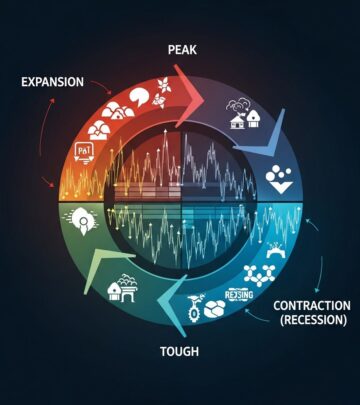
The business cycle describes the recurring pattern of economic expansion and contraction that characterizes modern economies. Economic indicators are essential tools for identifying where the economy currently stands within this cycle and predicting transitions to new phases.
| Business Cycle Phase | Economic Characteristics | Key Indicators |
|---|---|---|
| Expansion | Rising GDP, increasing employment, growing consumer spending | High consumer confidence, rising stock prices, low unemployment |
| Peak | Maximum economic growth, potential inflationary pressure, asset valuations at highs | Rising inflation, tightening credit conditions, yield curve flattening |
| Contraction | Declining GDP, rising unemployment, reduced consumer spending | Falling consumer confidence, declining corporate profits, rising jobless claims |
| Trough | Minimum economic activity, maximum unemployment, deepest pessimism | Low asset prices, high unemployment, minimal consumer spending |
Limitations and Considerations
While economic indicators provide valuable insights, investors and analysts must understand their limitations. Economic data is often revised significantly after initial release, potentially changing market interpretations. Additionally, historical relationships between specific indicators and market performance may not hold consistently across different economic environments or time periods.
Economic indicators measure aggregate trends across entire economies or populations, potentially obscuring significant disparities and distributional effects. For example, aggregate employment growth may mask job losses in certain sectors or regions. Furthermore, unexpected events or structural economic changes can render historical indicator relationships obsolete or unreliable.
Frequently Asked Questions
Q: What are the most important economic indicators for investors?
A: The most important indicators include GDP growth rates, unemployment data, inflation measures (CPI), consumer confidence, and interest rates. However, importance varies depending on investment strategy, time horizon, and economic environment.
Q: How often are economic indicators released?
A: Release schedules vary significantly. Employment data is typically released monthly, GDP quarterly, and inflation data monthly. Central banks announce interest rate decisions on predetermined schedules, often monthly or quarterly.
Q: Can economic indicators predict recessions?
A: Leading economic indicators can signal recession risk, but prediction is never certain. Multiple indicators showing weakness simultaneously provide stronger recession signals than individual indicators, though false signals do occur.
Q: Why do markets react strongly to economic data releases?
A: Markets react to economic data because it impacts future corporate earnings, interest rates, and monetary policy. Unexpected data that contradicts expectations typically produces larger market reactions than anticipated data.
Q: Should individual investors actively trade based on economic indicators?
A: Most financial experts recommend against frequent trading based on individual indicators. Long-term investors typically benefit more from consistent diversified portfolios than from frequent indicator-based trading decisions.
Q: How do different countries’ economic indicators compare?
A: Different countries track similar economic concepts but may use different methodologies or definitions. International investors must understand these differences when comparing economic health across nations and assessing global investment opportunities.
References
- Economic Indicators — U.S. Bureau of Economic Analysis. 2025. https://www.bea.gov/
- Leading Economic Indicators — The Conference Board. 2025. https://www.conference-board.org/
- Consumer Price Index — U.S. Bureau of Labor Statistics. 2025. https://www.bls.gov/cpi/
- Employment Data and Labor Statistics — U.S. Bureau of Labor Statistics. 2025. https://www.bls.gov/
- Federal Reserve Economic Data — Federal Reserve Bank of St. Louis. 2025. https://fred.stlouisfed.org/
- Understanding the Business Cycle — Federal Reserve Board. 2025. https://www.federalreserve.gov/
Similar Articles








Read full bio of medha deb