Economic Equilibrium: Definition, Examples, and Market Dynamics
Understanding how supply and demand create market balance and drive pricing decisions.

What Is Economic Equilibrium?
Economic equilibrium represents a state in which the economic forces of supply and demand are balanced within a market-based economy. At this theoretical state, economic variables such as prices and quantities stabilize at levels where the quantity of goods supplied exactly matches the quantity demanded by consumers. This equilibrium is not a permanent state but rather a dynamic point toward which market forces continuously gravitate.
In a market-based economy, prices function as the primary indicator of where equilibrium exists. When prices are too high, the quantity demanded decreases until suppliers lower prices in response. Conversely, when prices are too low, demand increases, prompting suppliers to either increase production or raise prices. This self-correcting mechanism reflects how markets attempt to reach equilibrium through the invisible hand of supply and demand.
Understanding Market-Based Economics
Modern economies are primarily structured as market-based systems because they demonstrate superior efficiency compared to alternative economic models. In these systems, capital allocation and consumption patterns are determined by the natural interplay of supply and demand rather than central planning or external organization. This decentralized approach allows resources to flow efficiently to where they are most valued by consumers and most profitably produced by suppliers.
The efficiency of market-based economies stems from the automatic coordination function of prices. Without requiring any central authority to direct economic activity, millions of individual decisions by producers and consumers aggregate to create orderly resource allocation. This self-organizing property represents one of the fundamental achievements of economic systems based on free markets.
The Role of Prices in Equilibrium
Prices serve as both a signal and an incentive mechanism in determining economic equilibrium. When a market is in disequilibrium—meaning supply and demand are unequal—prices adjust to restore balance. This price adjustment process operates in both directions:
- When prices are too high: Consumers respond by reducing the quantity they wish to purchase. Producers, observing lower demand, reduce prices to attract buyers and clear inventory.
- When prices are too low: Consumers want to purchase larger quantities, while producers find it less profitable to supply at reduced prices. The combination of increased demand and constrained supply pushes prices upward.
The equilibrium price represents the precise point where these opposing forces balance perfectly. At this price, there is no inherent pressure for further adjustment because the quantity supplied equals the quantity demanded.
Microeconomic vs. Macroeconomic Equilibrium
Microeconomic Equilibrium
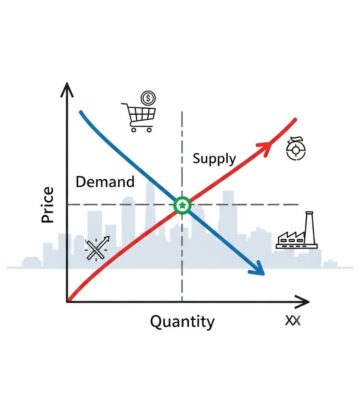
In microeconomics, which focuses on individual markets and economic agents, equilibrium occurs at the price where the supply curve and demand curve intersect on a price-quantity graph. This intersection point represents the market clearing price and quantity. At this price, the quantity supplied by producers precisely equals the quantity demanded by consumers, and no individual buyer or seller has an incentive to change their behavior.
Microeconomic equilibrium assumes that both consumers and producers are optimizing their decisions. Consumers maximize their utility at the prevailing price, choosing to buy exactly the quantity they desire without pressure to purchase more or less. Simultaneously, firms maximize profits at the equilibrium price, supplying exactly the quantity that generates the highest profit without motivation to expand or contract production.
Macroeconomic Equilibrium
In macroeconomics, which examines the economy as a whole, equilibrium manifests in various forms beyond simple supply and demand. Macroeconomic equilibrium can apply to:
- The money supply and its relationship to economic activity
- Aggregate demand and aggregate supply across the entire economy
- Interest rates and their effect on borrowing and investment
- Inflation rates and price level stability
- Overall production levels and economic output
These broader equilibria interact with one another. For instance, changes in the money supply can influence interest rates, which in turn affect aggregate demand and eventually price levels. Macroeconomic equilibrium represents a more complex balancing act involving numerous interconnected variables.
Types of Economic Equilibrium
Static Equilibrium
Static equilibrium occurs when market conditions remain unchanged at a particular point in time. At this state, prices and quantities do not fluctuate, and there are no endogenous forces pushing the market toward change. Static equilibrium persists until an external shock—such as a change in technology, consumer preferences, or production costs—disrupts the existing balance.
Dynamic Equilibrium
In contrast to static equilibrium, dynamic equilibrium allows for ongoing growth and change while maintaining a stable relationship between economic variables. In a dynamic equilibrium, output and physical capital stock may grow at consistent rates while the relationships between key economic variables remain proportional. For example, in models of steady economic growth, all nominal values (including wages and prices) may grow at a single common rate while real values remain constant.
Comparative dynamics involves analyzing how an economy transitions from one dynamic equilibrium to another when fundamental conditions change. For instance, an increase in the savings rate might lead to a new dynamic equilibrium with higher capital per worker and greater productivity per worker, even though the growth rate of output remains unchanged.
Why Markets Never Truly Reach Equilibrium
Although economic equilibrium serves as a crucial theoretical concept, markets never actually achieve a permanent state of equilibrium. Instead, markets exist in a constant state of dynamic adjustment toward an ever-shifting equilibrium point. Several factors contribute to this perpetual disequilibrium:
- Continuous change in preferences: Consumer tastes evolve constantly, shifting demand curves and disrupting previous equilibria.
- Technological innovation: New production methods alter supply conditions and cost structures, requiring market rebalancing.
- Information asymmetries: Market participants do not possess perfect information, leading to temporary misalignments between supply and demand.
- External shocks: Unexpected events such as natural disasters, pandemics, or policy changes can rapidly alter economic conditions.
- Time lags: The adjustment process requires time; prices and quantities cannot respond instantaneously to changing conditions.
This permanent state of disequilibrium is not a flaw in market systems but rather a natural characteristic of dynamic economies. Markets are continuously attempting to reach equilibrium while simultaneously facing new disruptions that alter the target equilibrium itself.
Disequilibrium and Market Adjustment
When markets fall out of equilibrium, specific adjustment mechanisms restore balance. Understanding these mechanisms is essential for comprehending how real markets function:
Excess Supply (Surplus): When the price is above the equilibrium level, the quantity supplied exceeds the quantity demanded. Unsold inventory accumulates, putting downward pressure on prices. As prices decline, the quantity demanded increases and the quantity supplied decreases until equilibrium is restored.
Excess Demand (Shortage): When the price is below the equilibrium level, the quantity demanded exceeds the quantity supplied. Shortages emerge as consumers compete for limited goods. These shortages create upward pressure on prices. As prices rise, the quantity demanded falls and the quantity supplied increases, moving the market back toward equilibrium.
These adjustment mechanisms demonstrate the self-correcting nature of free markets. Without any external intervention, price movements automatically guide markets toward equilibrium whenever disruptions occur.
Practical Example: The Market Equilibrium Process
Consider a farmer’s market scenario to illustrate how equilibrium operates in practice. A vendor arrives at the market with 100 bags of fresh vegetables priced at $6.00 each. If at this price, only 30 bags are purchased by mid-morning while demand remains modest, the vendor recognizes excess supply. Understanding that higher prices discourage sales, the vendor reduces the price to $5.00.
At the lower price point, demand increases. Perhaps 70 bags are sold by mid-afternoon. Yet supply continues to exceed demand. The vendor further reduces the price to $4.50, accelerating sales substantially. By late afternoon, with just 10 minutes until market closing, the final bags are sold at this lower price.
In this example, the equilibrium price emerged around $4.50, where supply and demand achieved approximate balance. This price was not predetermined but rather discovered through the vendor’s adjustment process responding to observed demand.
Equilibrium Across Different Market Levels
Economic equilibrium concepts apply at multiple analytical levels, from individual products to entire economies:
Product Level: Individual products reach equilibrium when their supply and demand balance at a specific price.
Industry Level: Multiple related products within an industry collectively reach equilibrium through interdependent price adjustments.
Market Level: Broader markets encompassing various industries experience equilibrium across multiple interrelated sectors.
National Level: Entire national economies achieve macroeconomic equilibrium through the balance of aggregate supply and aggregate demand.
These different levels interact significantly. A shift in equilibrium at the product level can ripple through industry and market levels, ultimately affecting national economic equilibrium.
Perfect Competition and Equilibrium
Economic equilibrium and perfect competition are closely related concepts. In perfect competition, numerous buyers and sellers trade identical products with perfect information and no barriers to entry or exit. Under these conditions, equilibrium prices emerge naturally through market forces, and individual firms cannot influence prices—they must accept the market price as given.
Perfect competition ensures that at equilibrium, resources are allocated efficiently and consumer surplus is maximized. However, perfect competition exists mainly as a theoretical ideal. Real markets feature imperfect competition, information asymmetries, product differentiation, and barriers to entry that prevent the achievement of perfect competitive equilibrium.
Frequently Asked Questions
Q: What is the difference between equilibrium and disequilibrium?
A: Equilibrium occurs when supply equals demand and there is no inherent pressure for change. Disequilibrium exists when supply and demand are unequal, creating pressure for price adjustment. Most real markets operate in disequilibrium, constantly trending toward equilibrium.
Q: Can an economy remain in equilibrium indefinitely?
A: No. Although equilibrium serves as an important theoretical concept, actual economies experience constant changes in preferences, technology, and external conditions that continuously shift the equilibrium point. Markets are perpetually in transition.
Q: How do prices help achieve equilibrium?
A: Prices adjust upward when demand exceeds supply and downward when supply exceeds demand. These price movements incentivize producers to adjust quantities supplied and consumers to adjust quantities demanded until balance is restored.
Q: Why is understanding equilibrium important?
A: Understanding equilibrium helps explain how prices are determined, how markets self-correct, and how external shocks affect economies. It provides the foundation for predicting market behavior and policy effects.
Q: How does technological change affect economic equilibrium?
A: Technological innovation shifts supply curves by changing production costs and capabilities. This disrupts existing equilibrium and requires markets to discover new equilibrium prices and quantities reflecting the improved production methods.
References
- Economic Equilibrium Overview — Corporate Finance Institute. 2024. https://corporatefinanceinstitute.com/resources/economics/economic-equilibrium/
- Economic Equilibrium — Wikipedia. 2025. https://en.wikipedia.org/wiki/Economic_equilibrium
- Principles of Economics — U.S. National Bureau of Economic Research. https://www.nber.org/
- Microeconomic Theory and Applications — American Economic Association. https://www.aeaweb.org/
Similar Articles








Read full bio of Sneha Tete