E-Business vs E-Commerce: Key Differences Explained
Understand the critical differences between e-business and e-commerce for your digital strategy.
E-Business vs E-Commerce: Understanding the Fundamental Difference
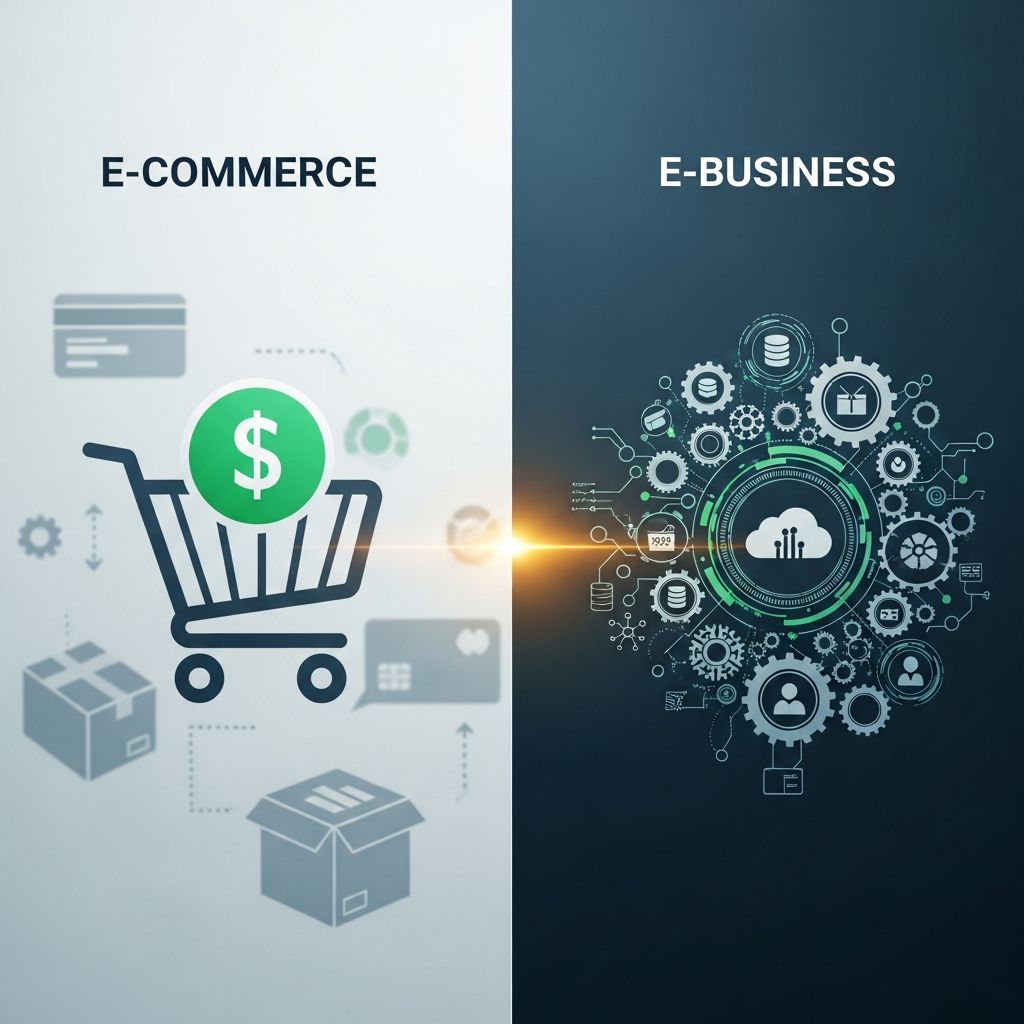
In today’s digital landscape, the terms e-business and e-commerce are often used interchangeably, leading to confusion about their actual meanings and applications. However, these two concepts represent distinct approaches to conducting business in the digital realm. Understanding the difference between e-business and e-commerce is essential for entrepreneurs, business leaders, and anyone seeking to establish or expand their online presence. While both involve leveraging digital technology, they differ significantly in scope, focus, and operational implications. E-commerce represents a subset of e-business, focusing specifically on online transactions and the buying and selling of goods and services. E-business, conversely, encompasses a broader spectrum of digital activities that extend beyond mere transactions to include internal operations, supply chain management, customer relationship management, and strategic communications.
The distinction between these two concepts carries substantial weight in determining how businesses structure their digital initiatives, allocate resources, and measure success. Companies that confuse these terms may find themselves implementing incomplete digital strategies that fail to maximize their operational efficiency or competitive advantage. By clearly understanding what each term encompasses, business leaders can make informed decisions about which approach best aligns with their organizational goals and market positioning.
What is E-Commerce?
E-commerce, short for electronic commerce, refers specifically to the buying and selling of goods and services through digital channels, primarily the internet. At its core, e-commerce involves financial transactions conducted online, where businesses and consumers exchange money for products or services in a virtual environment. This can include anything from purchasing physical products on websites like Amazon to buying digital services or subscriptions online.
E-commerce platforms provide customers with the ability to browse products, compare prices, read reviews, and complete purchases from the convenience of their homes or mobile devices. The primary focus of e-commerce is the customer-facing transactional experience, encompassing product display, payment processing, and order fulfillment. E-commerce businesses typically use dedicated websites or mobile applications to showcase their offerings and facilitate sales.
Types of E-Commerce Business Models
E-commerce operates through several distinct business models, each catering to different market segments and transaction types:
Business-to-Business (B2B) E-Commerce: This model involves transactions between two or more businesses, typically on a wholesale or bulk scale. Examples include manufacturers selling to retailers, or suppliers providing components to other businesses. B2B e-commerce often involves larger order quantities, negotiated pricing, and long-term supply relationships. These transactions can occur through specialized online marketplaces or direct business-to-business portals that facilitate bulk purchasing.
Business-to-Consumer (B2C) E-Commerce: This represents the most common and visible form of e-commerce, where businesses sell directly to individual consumers. Major platforms like Amazon, eBay, and Shopify exemplify this model. B2C e-commerce has revolutionized retail by enabling customers to shop across vast product catalogs, access competitive pricing, and enjoy convenient delivery options. This segment continues to grow as more consumers prefer the ease and selection offered by online shopping.
Consumer-to-Consumer (C2C) E-Commerce: This model facilitates transactions between individual consumers, often through third-party platforms. Examples include eBay, Etsy, and Facebook Marketplace, where individuals buy and sell pre-owned items, handmade crafts, or collectibles. C2C e-commerce has democratized entrepreneurship, allowing individuals to operate micro-businesses without significant capital investment.
Consumer-to-Business (C2B) E-Commerce: In this model, individuals provide goods or services to businesses. Common examples include freelance platforms where writers, designers, or programmers offer their services to companies, or influencer partnerships where content creators sell promotional services to brands.
What is E-Business?
E-business, or electronic business, encompasses a much broader scope than e-commerce. It refers to the conduct of all business activities and operations through digital technology and the internet. E-business includes not only buying and selling transactions but also internal processes, supply chain management, customer relationship management, financial operations, human resources functions, and strategic communications. Essentially, e-business represents the comprehensive digital transformation of an entire organization’s operations.
E-business extends beyond the internet to include operations conducted on intranets (internal company networks) and extranets (networks connecting a company with external partners). This flexibility means that a company can be classified as an e-business even if it utilizes digital technology primarily for internal operations, such as digital communication with employees or electronic inventory management systems. The primary beneficiaries of e-business include not only customers but also business partners, suppliers, employees, and other stakeholders in the business ecosystem.
Types of E-Business Models
E-business can be categorized into two main operational models:
Pure Play E-Business: This model describes companies that operate exclusively through digital channels without any physical presence. Pure play e-businesses are entirely dependent on digital platforms for all operations. Examples include Software-as-a-Service (SaaS) companies, digital marketing agencies, and online comparison platforms for hotels and flights. These businesses have invested wholly in their electronic presence and have no plans to establish brick-and-mortar locations.
Brick-and-Click E-Business: This hybrid model combines both online and offline operations, allowing companies to operate seamlessly across physical and digital channels. A clothing retailer with both physical stores and an e-commerce website exemplifies this approach. Customers can browse and try products in physical stores or shop online at their convenience. This model provides flexibility and allows businesses to leverage the strengths of both distribution channels to reach broader customer segments.
Key Differences Between E-Commerce and E-Business
| Aspect | E-Commerce | E-Business |
|---|---|---|
| Scope | Limited to online buying and selling transactions | Encompasses all digital business activities and operations |
| Focus | Customer-facing transactions and sales | Internal and external processes, strategy, and operations |
| Definition | Narrow concept; subset of e-business | Broad concept; superset that includes e-commerce |
| Primary Function | Revenue generation through online sales | Operational efficiency and strategic transformation |
| Technology Infrastructure | Single website or mobile application | Multiple systems including ERPs, CRMs, and communication platforms |
| Beneficiaries | Primarily customers | Customers, partners, suppliers, and employees |
| Operating Channels | Internet only | Internet, intranet, or extranet |
Scope of Activities
E-commerce predominantly deals with online commercial transactions, focusing specifically on the digital buying and selling of products and services. Its scope is narrower and more transactionally focused. E-commerce centers on providing customers with seamless and convenient platforms for making purchases, with activities concentrated on the customer experience during the transaction process.
E-business, by contrast, encompasses a much wider range of electronic interactions that extend to various stakeholders throughout the business ecosystem. E-business interactions facilitate communication, data sharing, and collaboration among suppliers, distributors, partners, and customers. These interactions can be carried out internally within the organization or externally with outside parties, utilizing multiple systems and platforms to connect diverse business processes.
Focus and Objectives
E-commerce is fundamentally about selling. The primary objective is to generate revenue by completing online transactions with customers. Success in e-commerce is typically measured by metrics such as conversion rates, average order value, customer acquisition cost, and sales volume. E-commerce activities focus on optimizing the customer journey from product discovery through checkout and delivery.
E-business, however, is about strategy and comprehensive digital transformation. The objectives extend beyond revenue generation to include operational efficiency, improved communication, better decision-making through data integration, and competitive advantage through digital innovation. E-business success is measured through broader metrics including operational efficiency, employee productivity, partner satisfaction, supply chain optimization, and overall organizational performance.
Technology Infrastructure
E-commerce typically relies on a single platform or website through which all transactions occur. Whether it’s a dedicated e-commerce site like Shopify or Amazon, or a custom-built platform, the focus is on creating an optimal customer purchasing experience within that single channel.
E-business requires a more complex technological infrastructure incorporating multiple interconnected systems. This may include Enterprise Resource Planning (ERP) systems for managing business resources, Customer Relationship Management (CRM) platforms for managing customer interactions, Supply Chain Management (SCM) systems, Human Resource Management (HRM) systems, accounting software, and internal communication platforms. These systems work together to integrate various business functions and provide comprehensive visibility into organizational operations.
Benefits and Advantages
E-Commerce Advantages
Personalized Customer Experience: E-commerce platforms analyze customer behavior and purchase history to deliver customized product recommendations, enhancing user experience and increasing sales potential. Machine learning algorithms can predict customer preferences and suggest relevant products, improving customer satisfaction and loyalty.
Convenient Transactions: Secure payment gateways and multiple payment options provide customers with safe and convenient ways to make purchases. This convenience reduces friction in the buying process and boosts customer confidence in online transactions. Features like one-click checkout and saved payment methods further streamline the purchasing experience.
Efficient Inventory Management: E-commerce systems provide real-time tracking of inventory levels, automatically updating stock information as purchases are made. This reduces overstocking and understocking issues, minimizing carrying costs and preventing lost sales due to stock-outs.
Data-Driven Insights: E-commerce platforms generate valuable data on customer behavior, preferences, and purchasing patterns. Businesses can analyze this data to optimize product offerings, refine marketing strategies, and make informed decisions about inventory and pricing.
E-Business Advantages
Operational Efficiency: E-business automation reduces manual processes and human error, streamlining operations across all business functions. This leads to cost savings, faster processing times, and improved service delivery.
Enhanced Communication: Digital platforms enable seamless communication among employees, partners, and suppliers, regardless of geographic location. This facilitates collaboration, faster decision-making, and better coordination across the organization.
Improved Decision-Making: Integrated systems provide comprehensive data visibility, enabling managers to access real-time information for strategic decision-making. Data analytics capabilities support predictive analysis and business intelligence functions.
Better Supplier and Partner Integration: E-business systems connect suppliers and partners into the business ecosystem, facilitating automated ordering, real-time communication, and performance tracking. This improves supply chain efficiency and relationship management.
Scalability: Digital infrastructure allows businesses to scale operations more easily without proportionally increasing overhead costs. As business grows, systems can be expanded to accommodate increased transaction volumes and operational complexity.
Strategic Considerations for Businesses
Organizations must carefully evaluate their business goals and operational needs to determine the appropriate digital strategy. Some businesses may prioritize e-commerce to streamline online sales and maximize revenue from direct customer transactions. This approach works well for retail companies, digital products, and services aimed at consumer audiences.
Other organizations may benefit more from adopting comprehensive e-business strategies that transform their entire operational model. This is particularly relevant for larger enterprises, B2B companies, and organizations operating in complex supply chains where operational efficiency and partner integration are critical success factors.
Many businesses adopt a hybrid approach, implementing robust e-commerce capabilities for customer-facing transactions while simultaneously building e-business infrastructure to optimize internal operations and partner relationships. This balanced approach allows organizations to capture revenue opportunities through e-commerce while improving efficiency and strategic positioning through e-business implementations.
Real-World Examples
A clothing brand exemplifies the difference clearly: the e-commerce component involves customers browsing the online store, selecting products, and completing purchases through the website. The e-business component extends to inventory management systems tracking stock levels across multiple warehouses, supplier communication platforms managing product orders, customer relationship management systems tracking customer interactions and preferences, and data analytics tools analyzing sales trends and customer behavior patterns.
Similarly, a SaaS company represents a pure play e-business. While it generates revenue through online transactions (the e-commerce element), its primary operations involve delivering digital services, managing customer accounts, supporting ongoing customer success, maintaining infrastructure, and continuously improving its software platform—all fundamentally e-business activities.
Future Trends and Evolution
The digital landscape continues evolving rapidly, with e-commerce and e-business capabilities becoming increasingly sophisticated. Artificial intelligence and machine learning are enhancing personalization in e-commerce while automating complex business processes in e-business systems. Mobile commerce is expanding e-commerce beyond traditional websites. Social commerce is integrating shopping experiences directly into social media platforms. Meanwhile, e-business is expanding to encompass emerging technologies like blockchain for supply chain transparency and Internet of Things (IoT) for real-time operational monitoring.
As digital transformation accelerates, the line between e-commerce and e-business continues to blur, with many organizations implementing integrated digital ecosystems that seamlessly combine customer-facing commerce with comprehensive back-office operations and partner integration.
Frequently Asked Questions
Q: Is e-commerce a part of e-business?
A: Yes, e-commerce is a subset of e-business. While e-commerce focuses specifically on online buying and selling transactions, e-business encompasses all digital business activities, including but not limited to commerce transactions. E-business includes internal operations, supply chain management, employee communications, and strategic processes that extend beyond customer transactions.
Q: Can a company be e-business without being e-commerce?
A: Yes, a company can operate as e-business without having an e-commerce component. For example, a consulting firm might use digital tools for internal operations, client communication, and project management without selling products or services through online transactions. However, most modern businesses incorporate both elements to maximize their digital potential.
Q: Which is more important for my business: e-commerce or e-business?
A: The importance depends on your business model and goals. If your primary revenue comes from direct sales to customers, e-commerce capabilities are critical. If your operations involve complex supply chains, multiple partners, or significant internal processes, e-business infrastructure is essential. Most businesses benefit from implementing both strategically integrated approaches.
Q: What technology platforms support e-business?
A: E-business typically relies on integrated platforms including Enterprise Resource Planning (ERP) systems, Customer Relationship Management (CRM) software, Supply Chain Management (SCM) systems, and communication platforms. These work together to integrate various business functions and provide comprehensive operational visibility.
Q: How does e-business improve operational efficiency?
A: E-business improves efficiency by automating manual processes, integrating disparate systems for seamless data flow, enabling real-time communication across departments and partners, and providing data analytics capabilities for informed decision-making. These improvements reduce costs, accelerate processes, and minimize errors throughout the organization.
References
- E-commerce vs. E-business: What’s the Difference? — Paradigm Marketing and Design. https://www.paradigmmarketinganddesign.com/e-commerce-vs-e-business-whats-the-difference/
- E-Business vs E-Commerce—Understanding the Difference — Influencer Marketing Hub. https://influencermarketinghub.com/e-business-vs-e-commerce/
- E-Commerce vs E-Business – Definitions, Differences & Real-World Examples — Weston Online. https://www.westfordonline.com/blogs/differences-between-e-commerce-and-e-business/
- Difference between E-Commerce and E-Business — BYJU’S. https://byjus.com/gate/difference-between-e-commerce-and-e-business/
- 4.2: E-Business and E-Commerce – The Difference — LibreTexts Business. https://biz.libretexts.org/Bookshelves/Management/Small_Business_Management_in_the_21st_Century/04:_E-Business_and_E-Commerce/4.02:_E-Business_and_E-Commerce_-_The_Difference
Similar Articles








Read full bio of medha deb