Earnings Per Share Explained: A Complete Guide For Investors
Unlock the power of EPS: Master this essential profitability metric to evaluate stocks and make smarter investment choices.

Earnings per share (EPS) measures a company’s profit allocated to each outstanding common share, serving as a fundamental indicator of financial health and shareholder value.
Understanding the Fundamentals of EPS
At its core, EPS quantifies how much profit a business generates for every share of its common stock. This metric strips away the total scale of a company to focus on per-unit performance, making it easier for investors to compare firms of varying sizes. Unlike overall revenue or net income, which can be skewed by company size, EPS provides a standardized view of profitability directly tied to equity ownership.
Public companies must disclose EPS in their financial filings with regulators like the U.S. Securities and Exchange Commission (SEC). Investors find it in quarterly 10-Q reports and annual 10-K statements, typically on the income statement or accompanying notes. This transparency ensures that market participants have consistent data to evaluate performance over time or against peers.
How to Calculate Earnings Per Share
The basic EPS formula is straightforward: subtract preferred dividends from net income, then divide by the weighted average number of common shares outstanding during the period.
Basic EPS Formula:
EPS = (Net Income – Preferred Dividends) / Weighted Average Common Shares Outstanding
- Net Income: Total profit after all expenses, taxes, and interest.
- Preferred Dividends: Payments to preferred shareholders, excluded since EPS focuses on common stock.
- Weighted Average Shares: Accounts for changes in shares outstanding over the period, weighted by time (e.g., new issuances or buybacks).
To compute weighted average shares, companies track changes throughout the year. For instance, if shares increase mid-year due to a stock issuance, earlier months use the lower count, later ones the higher, averaged proportionally. This method aligns share count with the timing of earnings generation.
| Period | Shares Outstanding | Weeks | Weighted Shares |
|---|---|---|---|
| Jan-Mar | 10,000,000 | 13 | 3,461,538 |
| Apr-Jun | 10,500,000 | 13 | 3,634,615 |
| Jul-Dec | 11,000,000 | 26 | 7,384,615 |
| Total | – | 52 | 14,480,769 |
Example table: Weighted average calculation assuming quarterly changes over 52 weeks.
Basic EPS vs. Diluted EPS: Key Distinctions
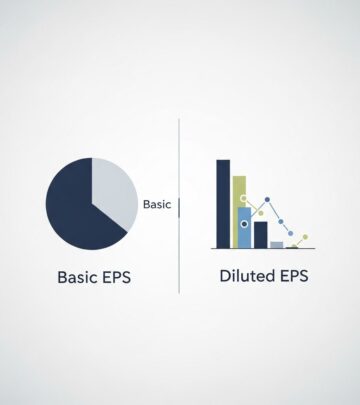
Companies report two EPS figures: basic and diluted. Basic EPS uses actual shares outstanding, ignoring potential dilutions.
Diluted EPS factors in ‘what-if’ scenarios for convertible securities like stock options, warrants, or bonds that could increase shares if exercised. This provides a conservative profitability view, assuming full dilution.
Diluted EPS Formula:
Diluted EPS = (Net Income – Preferred Dividends + Adjustments for Dilutives) / (Weighted Average Shares + Potential Dilutive Shares)
The Financial Accounting Standards Board (FASB) mandates both in U.S. financial statements for comprehensive reporting across income categories like continuing operations and net income.
Why EPS Matters to Investors
EPS is a cornerstone of stock analysis because it directly influences share prices. Strong EPS growth signals efficient profit generation, often boosting investor confidence and valuations.
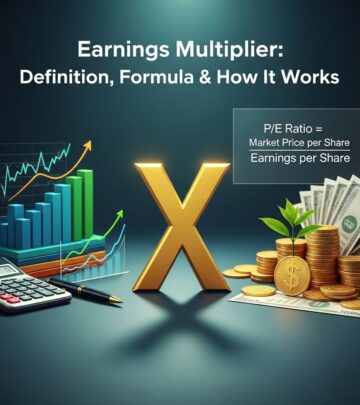
It’s integral to the price-to-earnings (P/E) ratio: P/E = Share Price / EPS. A low P/E might indicate an undervalued stock, while a high one suggests growth expectations. Investors use EPS trends to spot improving operations or red flags like stagnation.
Comparing EPS across industries reveals relative strength. For example, tech firms might have higher EPS growth than utilities due to scalability, but context matters.
Real-World Examples of EPS in Action
Consider a hypothetical firm with $100 million net income, $5 million preferred dividends, and 50 million weighted shares. Basic EPS = ($100M – $5M) / 50M = $1.90 per share.
If dilutive options add 5 million shares, diluted EPS drops to $95M / 55M ≈ $1.73, highlighting potential future dilution.
Historical data, like Apple’s 2018 basic EPS of $12.01 ($59.5B income / 4.955B shares), shows how giants leverage scale for robust figures.
Limitations and Pitfalls of Relying on EPS
EPS isn’t flawless. It can be manipulated via share buybacks, inflating per-share earnings without true profit growth. One-time gains, like asset sales, can distort ongoing profitability.
Industry differences matter; capital-intensive sectors may have lower EPS than asset-light ones. Always pair EPS with revenue growth, margins, debt levels, and cash flow.
Negative EPS signals losses, but context—like R&D investments in biotech—can make it temporary.
Incorporating EPS into Your Investment Strategy
Track EPS quarterly to gauge execution against guidance. Positive surprises often spark rallies; misses trigger sell-offs.
Use forward EPS estimates from analysts for growth projections. Combine with P/E for relative value assessments.
- Look for consistent EPS growth over 3-5 years.
- Compare diluted to basic EPS for dilution risk.
- Benchmark against sector medians.
Advanced EPS Considerations for Seasoned Investors
Adjusted EPS excludes non-recurring items for a cleaner view. Core EPS focuses on ongoing operations.
Stock splits or dividends don’t alter total earnings but adjust historical EPS for comparability. Post-split, past EPS is restated proportionally.
Global firms report under standards like IFRS, which align closely with U.S. GAAP on EPS but differ in details.
Frequently Asked Questions (FAQs)
What does a high EPS indicate?
A high EPS suggests strong profitability per share, but compare it to peers and historical trends for context.
Does EPS include preferred stock dividends?
No, they are subtracted to focus on common shareholders’ portion.
Why use weighted average shares?
It accurately reflects earnings timing amid share changes like issuances or repurchases.
Can EPS be negative?
Yes, during losses, signaling unprofitability until recovery.
How does EPS affect stock price?
Strong EPS growth typically lifts prices; it’s a driver of P/E multiples.
Conclusion
Mastering EPS equips investors to pierce corporate financials, enabling sharper comparisons and decisions. Integrate it with broader analysis for robust portfolios.
References
- Earnings per share – Wikipedia — Wikipedia. 2023-10-01. https://en.wikipedia.org/wiki/Earnings_per_share
- What is Earnings per share (EPS) – Training The Street — Training The Street. 2023-05-15. https://trainingthestreet.com/resources/earnings-per-share-eps/
- Earnings Per Share Formula – Examples, How to Calculate EPS — Corporate Finance Institute. 2024-01-20. https://corporatefinanceinstitute.com/resources/valuation/earnings-per-share-eps-formula/
- Earnings per Share (EPS): How to calculate and use it — Guinness Global Investors. 2023-11-10. https://www.guinnessgi.com/insights/earnings-per-share
- What Is EPS (Earnings Per Share)? – Chase Bank — Chase. 2024-02-01. https://www.chase.com/personal/investments/learning-and-insights/article/what-is-eps
Similar Articles








Read full bio of medha deb