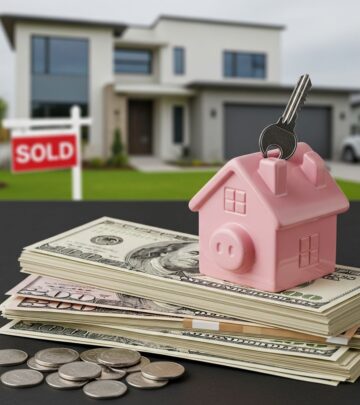
Earnest Money Vs Down Payment: How Much To Budget
Discover the essential differences between earnest money and down payments to confidently navigate home buying with clear financial steps.

Navigating the home buying process requires understanding key financial commitments like
earnest money
anddown payment
. These two payments play distinct roles: earnest money demonstrates buyer seriousness to the seller early on, while the down payment contributes directly to the property’s purchase price at closing. Grasping their differences helps buyers prepare effectively and avoid costly mistakes.What Is Earnest Money in Real Estate?
Earnest money acts as a good faith deposit submitted with a home purchase offer. It signals to the seller that the buyer is committed and financially capable of proceeding. Typically held in an escrow account by a neutral third party, such as a title company, this deposit protects the seller if the buyer backs out without valid reasons.
The standard amount ranges from
1% to 3%
of the home’s purchase price, though it can reach 5% or more in competitive markets. For a $400,000 home, this might mean $4,000 to $12,000. Local customs, market conditions, and negotiation influence the figure—hot seller’s markets often demand higher sums to strengthen offers.- Submitted upon offer acceptance.
- Held until closing or deal cancellation.
- Credited toward closing costs or down payment if the sale proceeds.
Defining the Down Payment
A
down payment
represents the buyer’s initial equity in the property, paid at closing to reduce the mortgage loan amount. Lenders require it to mitigate risk, with minimums varying by loan type: 3% for conventional loans, 3.5% for FHA, 0% for VA, or 20% to avoid private mortgage insurance (PMI).For the same $400,000 home, a 10% down payment equals $40,000, significantly lowering monthly payments and interest over time. Larger down payments improve loan terms and appeal to sellers by showing financial strength.
- Paid directly at settlement.
- Non-refundable in most cases once closing occurs.
- Directly reduces the principal borrowed.
Core Differences: A Side-by-Side Comparison
Earnest money and down payments differ fundamentally in timing, purpose, and risk. The table below highlights these distinctions for quick reference.
| Aspect | Earnest Money | Down Payment |
|---|---|---|
| **Timing** | With offer submission | At closing |
| **Purpose** | Prove buyer commitment to seller | Fund portion of purchase price for lender/seller |
| **Typical Amount** | 1-3% of price (up to 10% in hot markets) | 3-20% of price |
| **Refundable?** | Yes, under contingencies like inspection or financing failure | Generally no, but financing contingencies may apply pre-closing |
| **Held By** | Escrow agent or title company | Paid to seller/lender at settlement |
| **Impact on Loan** | None directly | Lowers loan-to-value ratio |
When and How Earnest Money Is Paid
Buyers submit earnest money shortly after offer acceptance, often within 1-3 days via check or wire transfer. It’s placed in escrow, remaining neutral until conditions are met. If the deal advances, it applies to the buyer’s total financial obligations at closing.
In 2025-2026, rising home prices in high-demand areas push earnest money higher—3-5% is common to stand out. Buyers should review contracts carefully, as amounts are negotiable but non-binding until accepted.
Down Payment Requirements by Loan Type
Down payment sizes depend on financing. Conventional loans start at 3%, FHA at 3.5%, USDA at 0% for eligible rural buyers, and VA at 0% for veterans. Jumbo loans for high-value homes often require 10-20%.
Calculate your target: For a $500,000 home with a 5% down payment ($25,000), add earnest money (e.g., $10,000 at 2%)—you’d bring $15,000 more to closing, plus fees. Tools like mortgage calculators help project affordability.
Risks and Refund Rules for Earnest Money
Earnest money is at risk if buyers breach contract terms without invoking contingencies (e.g., failed appraisal, poor inspection, or financing denial). Sellers may claim it as compensation for lost time on market.
Common contingencies protect buyers:
- Financing contingency: Allows exit if loan approval fails.
- Inspection contingency: Covers major home defects.
- Appraisal contingency: If value falls short of offer.
Without these, forfeiture is likely. Always consult a real estate attorney for state-specific rules.
Strategic Tips to Strengthen Your Offer
In competitive markets, boost competitiveness:
- Increase earnest money to 3-5% for seller confidence.
- Offer a higher down payment to signal stability.
- Waive non-essential contingencies (with lender advice).
- Get pre-approved for a mortgage upfront.
First-time buyers can leverage low-down-payment programs like FHA or VA loans to minimize upfront costs while maintaining strong offers.
Real-World Example: Putting It Together
Consider a $350,000 home. You offer with $7,000 earnest money (2%), held in escrow. Your planned 10% down payment is $35,000. At closing, the $7,000 credits toward it, so you pay $28,000 cash plus 2-5% closing costs ($7,000-$17,500). Total out-of-pocket: around $35,000-$45,500, financing the rest.
This scenario shows how earnest money reduces closing burdens, streamlining the process.
Common Myths Debunked
Myth 1: Earnest money is the full down payment. Reality: It’s a small precursor, credited later.
Myth 2: Earnest money is always non-refundable. Reality: Contingencies often allow refunds.
Myth 3: Bigger down payments guarantee approval. Reality: Credit, debt-to-income, and employment matter more.
Frequently Asked Questions (FAQs)
Is earnest money applied to the down payment?
Yes, if the deal closes, it’s typically credited toward your down payment or closing costs.
How much earnest money should I offer?
1-3% is standard; 3-5% in competitive areas. Consult your agent for local norms.
Can I get my earnest money back?
Often yes, if contingencies like financing or inspection fail. Check your contract.
What if I can’t afford a large down payment?
Explore FHA (3.5%), VA (0%), or USDA (0%) loans for lower requirements.
Who holds the earnest money deposit?
A neutral escrow agent, title company, or attorney.
Preparing Financially for Home Purchase
Build savings for both payments plus closing costs (2-5% of price). Improve credit for better rates, and shop lenders. Real estate agents and loan officers provide personalized guidance.
Understanding these elements empowers informed decisions, reducing stress in this major investment.
References
- The Difference Between Earnest Money and Down Payment — The Home Loan Expert. 2023. https://thehomeloanexpert.com/the-difference-between-earnest-money-and-down-payment/
- Earnest Money vs. Down Payment: Key Differences — Club 720. 2025. https://club720.org/earnest-money-vs-down-payment-key-differences/
- Is Earnest Money Part of Down Payment? — Zillow. 2024. https://www.zillow.com/learn/earnest-money-vs-down-payment/
- What is the Difference Between Earnest Money and Down Payment? — Sacramento Attorneys. 2023. https://www.sacattorneys.com/articles/what-is-the-difference-between-earnest-money-and-down-payment/
- Earnest Money vs Down Payment: What’s the Difference? — Capital Bank MD. 2024. https://capitalbankmd.com/home-loans-101/earnest-money-vs-down-payment-whats-the-difference/
- The Difference Between Down Payment and Earnest Money — LTAAG. 2023. https://ltaag.com/residential-real-estate/down-payment-vs-earnest-money/
- Earnest Money vs. Down Payment: Tips for Educating Clients — Richmond American. 2024. https://www.richmondamerican.com/agent-blog/earnest-money-versus-down-payment/
Similar Articles








Read full bio of medha deb