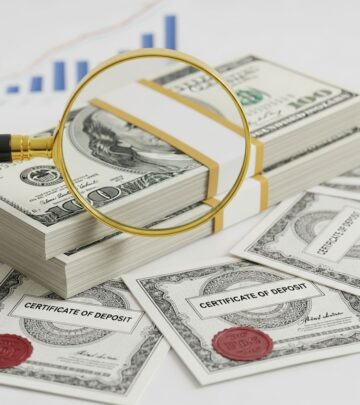
Earn $10,000 in CD Interest
Unlock strategies to generate $10,000 in certificate of deposit earnings through smart principal choices, optimal rates, and term lengths.

Certificates of deposit (CDs) provide a reliable path to generating significant interest income, such as $10,000, by committing funds for a fixed period at a predetermined rate. This approach suits conservative savers seeking guaranteed growth over volatile investments.
Understanding the Fundamentals of CDs
A certificate of deposit is essentially a timed savings vehicle where you deposit a lump sum into a bank or credit union account for a set duration, earning a fixed interest rate higher than typical savings accounts. In return for this commitment, institutions reward you with predictable yields, insured up to $250,000 per depositor by the FDIC for bank CDs or NCUA for credit unions.
Key elements include the principal (your initial deposit), the annual percentage yield (APY) which accounts for compounding, and the term length ranging from months to years. Interest compounds periodically—often daily, monthly, or quarterly—accelerating growth over time.
- Principal: The base amount you invest, directly impacting total earnings.
- APY: The effective yearly return, incorporating compounding effects.
- Term: Lock-in period; longer terms often yield higher rates but reduce liquidity.
Calculating the Deposit Needed for $10,000 in Interest
To reach exactly $10,000 in interest, use the formula for compound interest: A = P(1 + r/n)^(nt), where A is the total at maturity, P is principal, r is nominal rate, n is compounding frequency, and t is years. Interest earned = A – P.
For simplicity, approximate with I = P * r * t for single-period interest, adjusting for compounding. Current top CD rates hover around 4-5% APY as of recent data, influenced by Federal Reserve policies.
| APY | Term (Years) | Principal Needed for $10K Interest |
|---|---|---|
| 4% | 1 | $250,000 |
| 4% | 5 | $49,130 |
| 5% | 1 | $200,000 |
| 5% | 5 | $39,200 |
These figures assume annual compounding; more frequent compounding slightly reduces required principal. For a 5-year CD at 5% APY with monthly compounding, approximately $39,200 yields $10,000.
Current CD Rate Landscape and Influences
CD rates fluctuate with the broader interest rate environment. In high-rate periods, savers benefit from yields surpassing 5%, while low-rate eras demand larger principals. Shop online banks and credit unions for competitive offers, often exceeding brick-and-mortar rates.
Longer terms typically command higher APYs, though inversions occur during uncertain economies. Ladder strategies—dividing funds across staggered maturities—balance yield and access.
Types of CDs to Maximize Your $10,000 Goal
Beyond standard CDs, specialized variants offer flexibility or enhanced returns tailored to different needs.
- High-Yield CDs: Feature top-tier APYs, ideal for lump-sum deposits from online institutions with minimal fees.
- No-Penalty CDs: Allow early access without fees after an initial lock period, though rates may be lower.
- Bump-Up CDs: Permit one rate increase if market rates rise, hedging against rate drops.
- Jumbo CDs: Require $100,000+ deposits for premium rates, suitable for high-net-worth pursuits of $10K.
- Equity-Linked CDs: Tie returns to market indices like S&P 500, offering principal protection with variable upside over long terms (e.g., 5 years).
Match the type to your liquidity needs and rate outlook for optimal $10,000 accumulation.
Strategies to Accelerate Earnings Toward $10,000
CD Laddering Technique
Distribute principal across multiple CDs with varying maturities (e.g., 1-5 years). As each matures, reinvest at prevailing rates, mitigating reinvestment risk while averaging higher yields. Example: $50,000 split into five $10,000 CDs could generate compounded growth nearing $10K over 5 years at 4.5% average APY.
Combining with High-Yield Savings
Park short-term funds in HYSA for liquidity, rolling into CDs as rates peak. This hybrid captures flexibility and locked-in gains.
Reinvestment at Maturity
Automatically renew into similar or longer terms to harness compounding. Over decades, this snowballs smaller principals toward ambitious targets like $10K annually.
Risks and Penalties to Avoid
CDs boast low risk due to FDIC insurance, but early withdrawals trigger penalties—often 3-12 months’ interest—eroding gains. Inflation can outpace fixed rates, reducing real returns. Opportunity cost arises if stocks surge post-lock-in.
- Penalty example: Withdrawing from a 1-year 5% CD after 6 months might forfeit 90-180 days’ interest.
- Inflation hedge: Opt for shorter terms in rising-rate environments.
Tax Implications on Your CD Earnings
Interest is taxed as ordinary income annually via Form 1099-INT, even if not withdrawn. For $10K earnings, expect a tax hit of 22-37% based on brackets. Consider tax-advantaged accounts like IRAs for deferred growth, though contribution limits apply.
Step-by-Step Guide to Opening a CD for Maximum Interest
- Assess Goals: Determine timeline and liquidity needs for $10K target.
- Compare Rates: Use aggregators for current APYs across institutions.
- Verify Insurance: Confirm FDIC/NCUA coverage.
- Select Type/Term: Balance yield and access.
- Fund Account:
- Monitor: Track maturity and reinvest.
Transfer principal electronically.
Real-World Scenarios for Hitting $10,000
Conservative Path: $200,000 at 5% for 1 year = ~$10,200 interest.
Balanced Ladder: $100,000 across 2-5 year CDs at 4.5% average = $10K over 4 years via reinvestment.
Aggressive Long-Term: $40,000 at 5% for 5 years with quarterly compounding ≈ $10,500.
Adjust for personal circumstances; consult advisors for precision.
Frequently Asked Questions
What is the top CD rate available today?
Rates vary; check current listings, often 4.5-5.5% for competitive terms.
Are CDs safe for large deposits targeting $10K?
Yes, up to $250K per depositor per bank via FDIC.
Can I lose money in a CD?
No, principal is protected if held to maturity and insured, barring bank failure beyond limits.
How does compounding affect $10K earnings?
Frequent compounding (daily/monthly) boosts effective yield, reducing needed principal.
Should I choose short or long terms for best returns?
Longer often higher, but ladder for flexibility.
References
- How does a CD work? | CD rates explained — Fidelity Investments. 2023. https://www.fidelity.com/learning-center/smart-money/how-does-a-cd-work
- What is a Certificate of Deposit (CD) & How Does It Work — Bank of America. 2024. https://bettermoneyhabits.bankofamerica.com/en/personal-banking/what-is-a-cd-investment
- What is a certificate of deposit (CD)? — Consumer Financial Protection Bureau. 2024-03-01. https://www.consumerfinance.gov/ask-cfpb/what-is-a-certificate-of-deposit-cd-en-917/
- What Is a Certificate of Deposit (CD) and How Does It Work? — Synchrony Bank. 2024. https://www.synchrony.com/blog/bank/what-is-a-cd-account
- What is a Certificate of Deposit (CD)? — Popular Direct. 2025-03-20. https://www.populardirect.com/articles/2025/03/20/certificates-deposit-cd/
- What Is A CD (Certificate Of Deposit)? — Bankrate. 2024. https://www.bankrate.com/banking/cds/what-is-a-cd/
- How Do CDs Work? — Central Bank. 2024. https://www.mycentral.bank/personal/savings/how-do-cds-work
Similar Articles








Read full bio of Sneha Tete