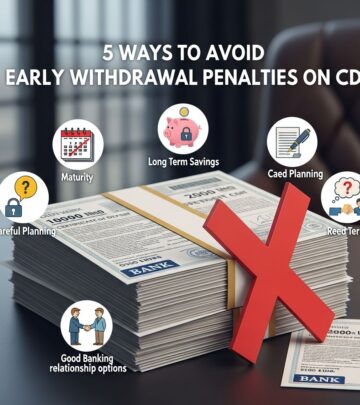
Early CD Withdrawal: When Breaking Your Contract Makes Sense
Understand CD early withdrawal penalties and discover when breaking your certificate of deposit contract may be financially justified.

A certificate of deposit represents a commitment between you and your financial institution. You agree to leave your money untouched for a specific period, and in return, the bank guarantees you a fixed interest rate. However, life circumstances change. Job losses, medical emergencies, investment opportunities, or shifting financial priorities may force you to reconsider that locked-away cash. The question then becomes: Is breaking your CD contract worth the penalty?
Understanding CD Early Withdrawal Penalties
When you withdraw funds from a CD before maturity, financial institutions impose a penalty to compensate for the disruption to their planned cash flows and lost revenue opportunities. Federal law establishes a minimum penalty but does not cap the maximum, meaning individual banks can set their own withdrawal fees within this framework.
The penalty structure varies considerably across institutions and depends primarily on your CD’s term length. Shorter-term CDs typically carry lighter penalties, while longer commitments incur steeper costs. Understanding these penalties before signing your CD agreement is essential for making informed decisions.
How Banks Calculate Penalties
Most financial institutions calculate early withdrawal penalties based on days or months of interest rather than flat fees. The penalty is expressed as a certain number of days of simple interest, meaning banks multiply your daily interest earnings by the penalty period specified in your agreement.
To understand your potential penalty, calculate your daily interest by dividing your CD’s annual percentage yield by 365, then multiply by the number of penalty days. For instance, a $10,000 CD earning 4% APY with a 90-day penalty would result in approximately $98.63 in fees.
Minimum Early Withdrawal Requirements
Federal regulations require banks to impose at least seven days of simple interest as a penalty if you withdraw within six days of deposit. This ensures a universal baseline protection for financial institutions regardless of CD term length.
Penalty Structure by CD Term Length
Penalty amounts escalate based on your CD’s maturity timeline. Here’s how major financial institutions typically structure these fees:
| CD Term Length | Typical Penalty Range | Example Institution |
|---|---|---|
| Less than 12 months | 60-90 days of interest | American Express: 90 days |
| 12-48 months | 90-180 days of interest | American Express: 270 days |
| 48-60 months | 180-365 days of interest | American Express: 365 days |
| 60+ months | 365-540 days of interest | American Express: 540 days |
Different banks apply different penalty calculations. For CD terms of one year or less, many institutions charge 90 days of interest, while longer terms typically carry 180-day or even 12-month interest penalties. Some credit unions, like Alliant and Navy Federal, take a more lenient approach by only charging actual dividends earned rather than projected interest.
When Early Withdrawal Might Be Justified
Despite the financial cost, certain circumstances can make breaking your CD contract a sensible decision. Evaluating these scenarios requires comparing the penalty against the benefit you’ll receive.
Avoiding High-Interest Debt
If you’re facing credit card debt or payday loans with interest rates exceeding 15-25% annually, breaking your CD may be worthwhile. The penalty from early withdrawal is typically far less than the ongoing cost of carrying high-interest debt. Even a $1,000 penalty is reasonable if it prevents several months of compounding credit card interest on thousands of dollars.
Capitalizing on Significantly Higher Rates
CD rates fluctuate with market conditions and Federal Reserve policy. If prevailing rates have risen substantially since you purchased your CD—say from 2% to 4% or higher—the opportunity cost of remaining locked into the lower rate might exceed your withdrawal penalty. Calculate whether reinvesting your funds at a dramatically higher rate would offset the penalty cost over the remaining CD term.
Funding Critical Life Expenses
Medical emergencies, home repairs, or other urgent expenses that drain your accessible savings may justify CD withdrawal. When your emergency fund is exhausted and you face expensive financial obligations, your CD becomes a legitimate backup resource. The penalty is simply the cost of accessing emergency liquidity.
Making Strategic Investment Moves
A time-sensitive investment opportunity with strong growth potential might justify the penalty cost. However, exercise caution here—many people overestimate investment returns. Only pursue this strategy if you’ve thoroughly analyzed the opportunity and have confidence in its potential.
Financial Circumstances That Don’t Justify Withdrawal
Conversely, several situations do not warrant breaking your CD early. Distinguishing between wants and legitimate needs protects your financial discipline:
- Purchasing discretionary items like luxury goods or vacation experiences
- Paying off low-interest debt where your CD rate exceeds your loan rate
- Funding non-urgent upgrades to vehicles or appliances
- Covering routine expenses you should have budgeted for separately
- Taking advantage of temporary market rallies without a long-term strategy
Tax Implications of Early Withdrawal
An important financial benefit often overlooked: CD early withdrawal penalties are tax-deductible. This means you can deduct the penalty amount from your taxable income, which partially offsets the cost if you’re in the 22% tax bracket or higher. Consult with a tax professional to ensure you claim this deduction properly on your tax return.
Penalty Variations Across Financial Institutions
Your specific penalty depends largely on which bank holds your CD. Here’s how several major institutions structure their fees:
- Ally Bank: Charges 60 days of interest for 3-month to 2-year CDs, escalating to 150 days for 5-year CDs
- Wells Fargo: Charges 3 months of interest for 3-month to 1-year CDs, with higher penalties for longer terms
- EverBank: Uses granular penalty tiers, ranging from 22 days for 3-month CDs to 456 days for 5-year CDs
- Citi: Generally charges 90 days’ interest for terms of one year or less, with 180-day penalties for longer terms
- PenFed Credit Union: Uses expected dividends rather than earned interest, which can occasionally dip into your principal
Before opening any CD, compare penalty structures across institutions. A bank offering 0.1% higher APY might impose penalties that make early withdrawal extremely costly compared to competitors with more reasonable fee structures.
Calculating Your Real Cost
Understanding how to calculate your specific penalty empowers you to make informed decisions. Here’s the methodology:
- Locate your CD’s stated annual percentage yield (APY)
- Divide the APY by 365 to find your daily interest rate
- Multiply daily interest by the number of penalty days specified in your agreement
- Compare this penalty to the financial benefit you’ll receive
For example, if you hold a $25,000 CD earning 3.5% APY with a 180-day penalty, your calculation would be: ($25,000 × 0.035 ÷ 365) × 180 = approximately $430. This is your actual cost to access the funds early.
Strategies to Minimize CD Withdrawal Costs
If you anticipate needing early access, several approaches can reduce your exposure to penalties:
Ladder Your CDs
Instead of placing all funds in one 5-year CD, divide your investment across multiple CDs with staggered maturity dates. This strategy provides periodic access to portions of your money without triggering penalties on your entire balance.
Choose No-Penalty CDs
Some banks offer specialized CDs that allow early withdrawal without penalties, though these typically offer lower interest rates. If flexibility is important, this tradeoff may be worthwhile.
Research Withdrawal Policies Before Purchasing
Compare penalty structures across institutions before committing your money. Banks with gentler penalty policies might save you hundreds of dollars if you need early access.
Special Circumstances and Exceptions
Financial institutions may waive early withdrawal penalties under specific circumstances, including account holder death or legal incompetence. Some banks also make exceptions for qualifying military members under the Servicemembers Civil Relief Act. Contact your bank directly to inquire whether your situation qualifies for penalty waiver consideration.
Frequently Asked Questions
What happens if the penalty exceeds my earned interest?
Banks will deduct the difference from your principal balance, meaning you receive less than your original deposit. This makes early withdrawal particularly costly if you’re breaking your CD soon after opening it.
Can I withdraw partial amounts from my CD early?
Most CDs penalize the withdrawal of the full principal. However, some banks allow partial withdrawals with reduced penalties. Check your specific agreement or contact your bank for clarification.
Do I pay taxes on the penalty?
No, the penalty itself is not taxable, but you do owe income tax on the interest earned. The penalty is deductible against your taxable income.
What’s the shortest CD available to minimize penalty risk?
The shortest CDs typically mature in 3 months. These carry lower penalties but also earn less interest, so you’ll need to weigh the tradeoff based on your specific needs.
Making Your Decision
Breaking a CD contract is never an ideal situation, but it’s sometimes the right financial move. Carefully weigh the penalty cost against the benefit you’ll receive. If the benefit clearly outweighs the penalty and you’ve exhausted other options, breaking your CD might make financial sense.
However, if you’re considering early withdrawal primarily for discretionary spending or minor financial goals, the penalty typically isn’t justified. Respect the commitment you made to yourself by locking funds away for future growth.
References
- Withdrawing Funds from CD Before the Maturity Date — American Express. 2024. https://www.americanexpress.com/en-us/banking/online-savings/faq/early-withdrawal-from-cd/
- What to Know about CD Early Withdrawal Penalties — Citi Banking. 2024. https://www.citi.com/banking/personal-banking-guide/basic-finance/cd-early-withdrawal-penalty
- CD Early Withdrawal Penalty by Bank — NerdWallet. 2024. https://www.nerdwallet.com/banking/learn/cd-early-withdrawal-penalty-by-bank
- Here’s When An Early Withdrawal From A CD Is Worth It — Bankrate. 2024. https://www.bankrate.com/banking/cds/cd-early-withdrawal-can-come-at-a-high-price/
- What are the Penalties for Withdrawing Money Early from a CD? — Help with My Bank (Consumer Financial Protection Bureau). 2024. https://www.helpwithmybank.gov/help-topics/bank-accounts/certificates-of-deposit/cd-penalties.html
Similar Articles








Read full bio of medha deb