DuPont Analysis: Breaking Down Return on Equity
Master DuPont Analysis to understand ROE components and company financial performance.
Understanding DuPont Analysis
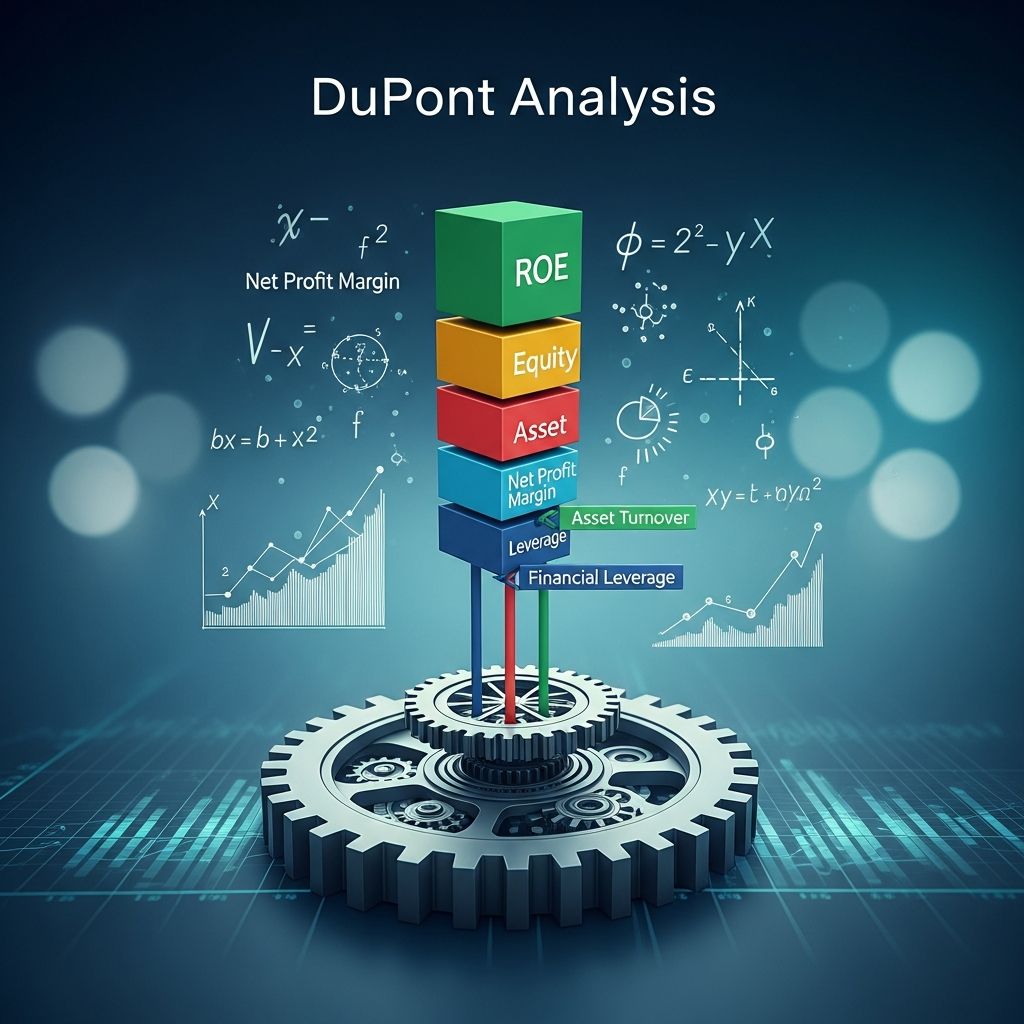
DuPont Analysis, also known as the DuPont Model or DuPont Identity, is a comprehensive financial framework that deconstructs Return on Equity (ROE) into its fundamental components. This analytical methodology enables investors and financial managers to gain deeper insights into what drives a company’s profitability and operational efficiency. Rather than relying on a single ROE figure, DuPont Analysis reveals the specific factors contributing to financial performance, allowing for more informed investment decisions and strategic management planning.
The fundamental principle behind DuPont Analysis is that ROE is not simply a standalone metric but rather the product of three distinct elements: profitability, asset efficiency, and financial leverage. By isolating these components, analysts can identify whether improvements or declines in ROE stem from operational performance, asset management, or capital structure decisions. This decomposition transforms a seemingly simple financial metric into a sophisticated analytical tool that provides actionable insights.
The Three Components of DuPont Analysis
DuPont Analysis breaks down ROE into three core components, each representing a different dimension of business performance:
1. Net Profit Margin (Operating Efficiency)
Net Profit Margin measures profitability by calculating the percentage of revenue that translates into net income. This component reveals how efficiently a company manages its costs relative to sales, reflecting operational effectiveness. A higher net profit margin indicates that the company retains more income from each dollar of sales after accounting for all expenses, including cost of goods sold, operating expenses, and taxes. This metric is particularly useful for comparing profitability across companies in the same industry, as it normalizes for different revenue sizes.
The net profit margin is expressed as: Net Profit Margin = Net Income ÷ Revenue
2. Asset Turnover (Asset Efficiency)
Asset Turnover measures how efficiently a company utilizes its assets to generate revenue. This ratio indicates the dollars of revenue produced for every dollar invested in assets. A higher asset turnover ratio suggests that the company generates more sales from its asset base, indicating effective asset utilization. This component is crucial for understanding how productively a business deploys its capital investments. Companies with high asset turnover ratios use their resources more efficiently to create sales, while those with lower ratios may be asset-intensive or struggling to generate sufficient revenue from their asset base.
The asset turnover ratio is calculated as: Asset Turnover = Revenue ÷ Average Total Assets
3. Financial Leverage (Equity Multiplier)
Financial Leverage, also known as the Equity Multiplier, measures the degree to which a company uses debt financing relative to equity. This ratio indicates how much of a company’s assets are financed through borrowed funds versus shareholder equity. Financial leverage amplifies returns to shareholders, as debt financing is often cheaper than equity capital and interest payments are tax-deductible. However, increased leverage also increases financial risk, as higher debt obligations require adequate cash flows to service. This component connects the company’s capital structure to its overall return on equity.
Financial Leverage is expressed as: Financial Leverage (Equity Multiplier) = Average Total Assets ÷ Average Shareholders’ Equity
The DuPont Formula
The basic three-step DuPont formula is the most widely used version of this analytical framework:
Return on Equity (ROE) = Net Profit Margin × Asset Turnover × Financial Leverage
Or in expanded form:
ROE = (Net Income ÷ Revenue) × (Revenue ÷ Average Total Assets) × (Average Total Assets ÷ Average Shareholders’ Equity)
When simplified, this formula reduces to the basic ROE calculation: Net Income ÷ Average Shareholders’ Equity. However, by maintaining the three-component breakdown, analysts can understand the specific drivers of ROE changes and identify where performance improvements or deteriorations originate within the organization.
Basic DuPont Analysis vs. Five-Step Analysis
While the three-step DuPont model provides valuable insights, a more advanced five-step model offers additional analytical depth by separating operating activities from financing activities. This extended approach provides greater granularity in understanding ROE drivers.
The Five-Step DuPont Model Components
The five-step approach further decomposes the three-step model into five distinct ratios:
– Tax Burden: Net Income ÷ Pre-Tax Income (measures the impact of taxes on profitability)- Interest Burden: Pre-Tax Income ÷ Operating Income (isolates the effect of financing costs)- Operating Margin: Operating Income ÷ Revenue (reflects core operational profitability)- Asset Turnover: Revenue ÷ Average Total Assets (unchanged from the basic model)- Financial Leverage: Average Total Assets ÷ Average Shareholders’ Equity (unchanged from the basic model)
The five-step formula is expressed as:
ROE = Tax Burden × Interest Burden × Operating Margin × Asset Turnover × Financial Leverage
Why Use DuPont Analysis?
DuPont Analysis serves several critical functions in financial analysis and decision-making. First, it transforms a single ROE figure into actionable insights by revealing the specific performance drivers. Rather than simply noting that ROE increased or decreased, analysts can determine whether the change resulted from improved profitability, better asset utilization, or increased leverage. This specificity enables more targeted strategic responses and identifies areas requiring management attention.
Second, DuPont Analysis facilitates peer comparison by allowing investors to compare how different companies achieve similar or different ROE levels. Two companies might have identical ROE figures but achieve them through entirely different strategies—one through high profit margins and another through efficient asset turnover. Understanding these differences helps investors assess which company’s business model aligns better with their investment objectives and risk tolerance.
Third, the framework provides early warning signals of potential weaknesses. A declining net profit margin might signal rising costs or competitive pricing pressure, while deteriorating asset turnover could indicate operational challenges or asset underutilization. Identifying these issues early allows management to implement corrective measures before they significantly impact overall financial performance.
Industry Considerations and Trade-offs
Different industries naturally exhibit varying DuPont component profiles. Capital-intensive industries, such as machinery manufacturing and utilities, typically feature lower asset turnover ratios but compensate with higher profit margins. Conversely, retail and consumer goods companies often operate with higher asset turnover but lower profit margins due to competitive pressures and volume-based business models.
Understanding these industry-specific patterns is crucial for meaningful analysis. Comparing a capital-intensive manufacturer with high profit margins to a fast-moving consumer goods company with lower margins but higher turnover would be misleading without considering industry norms. Effective DuPont Analysis requires benchmarking against industry peers and historical company performance rather than applying absolute standards across diverse business sectors.
Practical Applications of DuPont Analysis
DuPont Analysis serves multiple stakeholders with distinct needs. For investors, the framework enables more sophisticated equity valuation by revealing the quality and sustainability of ROE. An ROE driven by operational excellence and efficient asset utilization suggests a more sustainable business model than one primarily dependent on financial leverage. For corporate managers, DuPont Analysis identifies performance management priorities and helps allocate resources to areas offering the greatest improvement potential.
Financial analysts utilize DuPont Analysis to construct detailed financial models that project future ROE under various scenarios. By modeling changes in individual components, analysts can forecast how strategic decisions—such as pursuing operational efficiency improvements, expanding asset investments, or adjusting capital structure—will impact overall shareholder returns.
Limitations and Considerations
While DuPont Analysis provides valuable insights, it has notable limitations. The analysis is only as reliable as the underlying financial data, and accounting treatments can vary across companies and time periods. Additionally, the component ratios may not be meaningful in isolation and should always be interpreted in context with industry benchmarks and historical trends.
Furthermore, DuPont Analysis is a backward-looking tool that reflects past performance. While historical analysis provides useful context, it does not guarantee future results. External factors such as market conditions, competitive dynamics, and regulatory changes can significantly impact future component performance in ways that historical analysis may not capture.
DuPont Analysis Example
Consider a hypothetical company with the following financial metrics:
– Net Income: $50 million
– Revenue: $500 million
– Average Total Assets: $400 million
– Average Shareholders’ Equity: $200 million
The DuPont Analysis would calculate as follows:
– Net Profit Margin: $50M ÷ $500M = 10%
– Asset Turnover: $500M ÷ $400M = 1.25x
– Financial Leverage: $400M ÷ $200M = 2.0x
– ROE: 10% × 1.25 × 2.0 = 25%
This breakdown reveals that the company’s 25% ROE is generated through a combination of modest profitability (10% margin), efficient asset utilization (1.25x turnover), and moderate financial leverage (2.0x multiplier). Management or investors can then evaluate whether this component mix represents an optimal capital allocation strategy and whether improvements in any area could enhance shareholder returns.
Frequently Asked Questions
What is the main purpose of DuPont Analysis?
The primary purpose of DuPont Analysis is to break down Return on Equity (ROE) into its component parts—profitability, asset efficiency, and financial leverage—enabling investors and managers to identify the specific drivers of shareholder returns and assess company performance more comprehensively than using ROE alone.
How does the five-step DuPont model differ from the three-step model?
The five-step model provides greater analytical depth by further decomposing the three main components to isolate the effects of operating performance, tax burden, and interest expenses. This additional granularity helps analysts distinguish between operating and financing influences on ROE, providing more detailed insights into performance drivers.
Can DuPont Analysis be used to compare companies across different industries?
While DuPont Analysis can be applied across industries, meaningful comparison requires understanding industry-specific norms. Different industries naturally have different component profiles due to business model characteristics, so comparisons are most useful within industry peer groups or by tracking individual companies over time.
What does a high financial leverage ratio indicate?
A high financial leverage ratio indicates that a company has a larger proportion of debt in its capital structure relative to equity. While leverage can amplify returns to shareholders, it also increases financial risk, as the company has greater obligations to service debt regardless of operational performance.
How should investors interpret declining asset turnover?
Declining asset turnover suggests the company is generating fewer sales dollars from its asset base. This could indicate operational challenges, asset underutilization, recent significant capital investments not yet generating full revenue potential, or deteriorating competitive market conditions. Further investigation into the causes is warranted.
References
- What Are The Three Components Of The Dupont Identity — Financial Modeling Prep. https://site.financialmodelingprep.com/education/what-are-the-three-components-of-the-dupont-Identity
- Learn How To Create A DuPont Analysis Model — Corporate Finance Institute. https://corporatefinanceinstitute.com/resources/accounting/dupont-analysis/
- DuPont Analysis: Formula + Ratio Calculator — Wall Street Prep. https://www.wallstreetprep.com/knowledge/dupont-analysis-template/
- DuPont Analysis — Wikipedia. https://en.wikipedia.org/wiki/DuPont_analysis
Similar Articles








Read full bio of medha deb