DUNS Numbers and Business Loans Explained
Understand what a DUNS number is, how it works, and how it can help your business access credit, contracts, and growth opportunities.
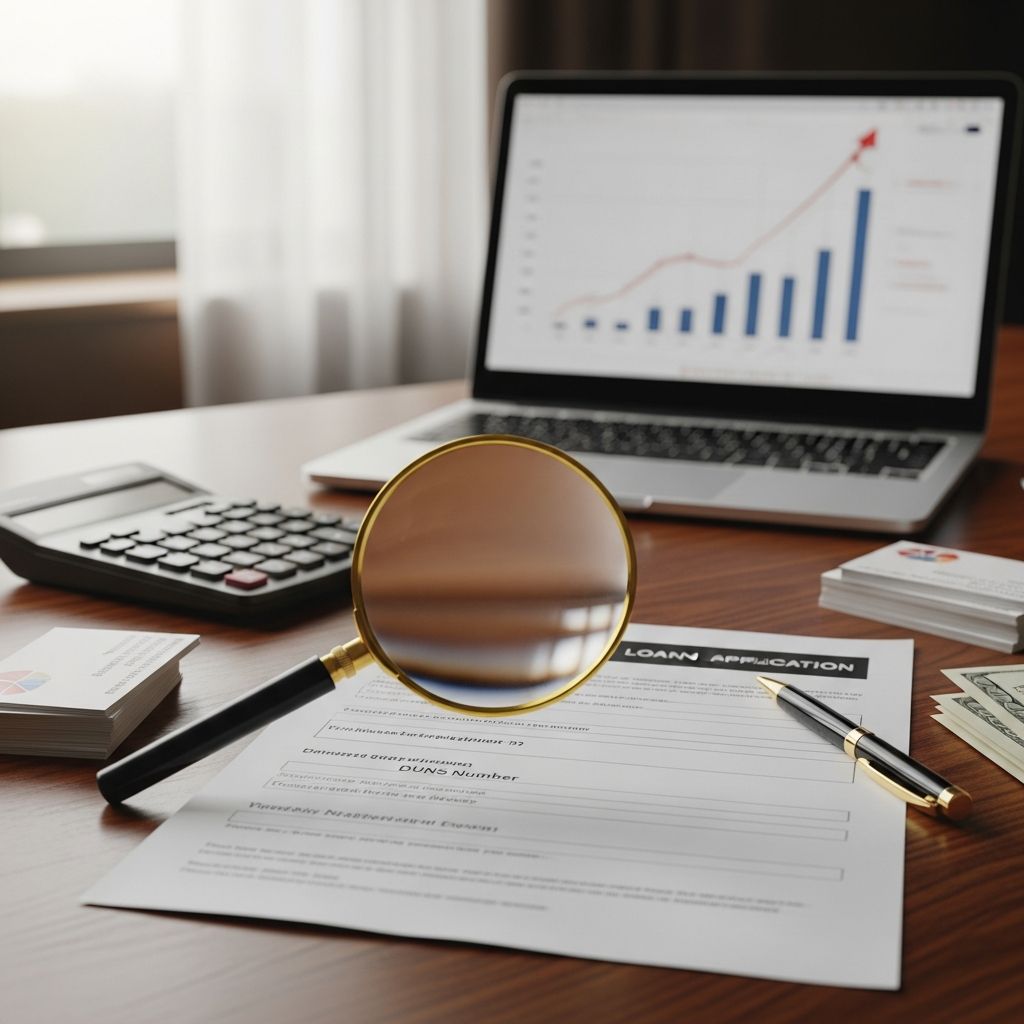
A DUNS number (Data Universal Numbering System number) is a unique nine-digit identifier issued by Dun & Bradstreet (D&B) that helps lenders, suppliers, and government agencies evaluate a company’s credit profile and financial reliability. Although it is not a replacement for your Social Security number (SSN) or Employer Identification Number (EIN), it can be a powerful tool when you apply for business loans, contracts, and other forms of financing.
This guide explains what a DUNS number is, why it matters for business funding, how it compares with other IDs, and how to get and use one strategically.
What Is a DUNS Number?
A DUNS number is a nine-digit numeric code that uniquely identifies a specific business location in Dun & Bradstreet’s global commercial database. Each physical business location gets its own DUNS number, which allows lenders and partners to see a separate credit file for each site.
Dun & Bradstreet uses the DUNS number to create and track a company’s business credit file, including payment history with vendors, public records, and risk scores. This file is used widely by banks, trade creditors, large corporations, and many government entities to assess creditworthiness and potential risk.
Key characteristics of a DUNS number
- Nine-digit identifier tied to a single business location, not to an individual owner.
- Issued and maintained by Dun & Bradstreet, a private business credit bureau.
- Used for business credit reporting, risk assessment, and verifying a company’s existence and identity.
- Recognized globally in many countries and by multinational corporations.
Why a DUNS Number Matters for Business Loans
When you apply for a business loan, lenders want to understand how your company manages its obligations. A DUNS number gives them direct access to your D&B business credit report, which contains information such as payment timeliness, outstanding obligations, and risk indicators.
For many small businesses, lenders still rely heavily on the owner’s personal credit and SSN, especially when the business is young. However, building a strong D&B profile using your DUNS number can help you:
- Demonstrate business credit history separate from your personal credit.
- Qualify for better loan terms as your business track record improves.
- Access larger credit lines or trade credit from suppliers who use D&B data.
- Reduce reliance on personal guarantees over time, once the business is stronger.
How lenders use DUNS data
Dun & Bradstreet compiles multiple scores and indicators that lenders and partners review, including:
- PAYDEX score: measures payment timeliness to suppliers and creditors.
- Delinquency and failure risk scores: estimate the likelihood of late payments or business closure.
- Maximum credit recommendation: a guideline for how much credit might be considered prudent for a given company.
Strong scores in these areas can help your business appear less risky, leading to more favorable financing decisions.
DUNS vs. SSN vs. EIN vs. UEI
Your business may be identified by several different numbers. Each serves a unique purpose, and none fully replaces the others.
| Identifier | Issued by | Primary purpose | Typical uses |
|---|---|---|---|
| DUNS | Dun & Bradstreet | Business credit reporting and verification | Loans, supplier terms, some grants and contracts |
| SSN | U.S. Social Security Administration | Personal identification and credit tracking | Consumer credit, personal guarantees on small business loans |
| EIN | Internal Revenue Service | Federal tax identification for businesses | Tax filing, payroll, business bank accounts |
| UEI | U.S. federal government (SAM.gov) | Entity identification for federal awards | Federal contracts and grants (replaced DUNS in 2022) |
Why your SSN still matters for loans
Even if you have a DUNS number and established business credit, most small-business lenders still require the owner’s SSN for identity verification and personal credit checks. Regulations such as the USA PATRIOT Act require financial institutions to confirm the identity of borrowers, which is one reason SSNs are requested. For new or smaller firms, lenders often require a personal guarantee, tying your SSN-based credit history directly to the credit decision and loan terms.
Who Needs a DUNS Number?
Not every business is legally required to obtain a DUNS number. However, many organizations find it either highly beneficial or effectively mandatory, depending on their goals.
Businesses that benefit most
- Startups and young businesses that want to build business credit separate from the owner’s personal profile.
- Growing companies seeking bank loans, lines of credit, or expanded trade credit with suppliers.
- Firms targeting large corporate buyers such as major retailers or technology companies that reference D&B data.
- Businesses planning international expansion, since DUNS is recognized worldwide and aids cross-border due diligence.
When a DUNS number may be required
- State and local contracts, grants, and loans where agencies still use DUNS in their vendor or grantee checks.
- Working with certain corporations such as major retailers or technology platforms that require suppliers or developers to have a DUNS number.
- Some nongovernmental grants or loan programs that use D&B data for screening.
- Registration with certain regulators, such as facilities registering with the U.S. Food and Drug Administration that may use DUNS-based identification.
Pros and Cons of Having a DUNS Number
Advantages
- Helps establish business credit: A DUNS number is often the first step to building a formal business credit profile with D&B.
- Improves perceived credibility: Lenders, suppliers, and potential partners can verify your existence and review your track record, which can signal professionalism and stability.
- Supports access to financing: Strong D&B scores can translate into higher approval odds and better terms for loans and trade credit.
- Facilitates large contracts and global trade: Many large enterprises and foreign governments rely on DUNS-based data to screen vendors.
Potential drawbacks
- Not a guarantee of funding: Having a DUNS number alone does not qualify you for a loan; lenders still review your financials, time in business, revenue, and personal credit.
- Ongoing responsibility: To keep your D&B profile strong, you must monitor it for accuracy and maintain good payment habits, which takes discipline and attention.
- Still need other IDs: You will still use your SSN for personal credit checks and your EIN or other tax IDs for regulatory purposes.
How to Get a DUNS Number
Obtaining a DUNS number is a free process in most cases and can usually be completed online or by phone through Dun & Bradstreet.
Information you typically need
- Legal name of your business
- Business address and phone number
- Name of the business owner or principal
- Legal structure (e.g., LLC, corporation, partnership, nonprofit)
- Year the business was started or incorporated
- Number of full- and part-time employees
General steps to apply
- Check if you already have a DUNS number by searching Dun & Bradstreet’s database, especially if you have worked with larger suppliers or lenders before, as they may have created a file for you.
- Gather accurate business information to ensure that your legal name, address, and contact details match what appears on official records and tax documents.
- Submit your application via D&B’s website or phone line, following the prompts for new business registration.
- Watch for confirmation from D&B; it can take several business days or longer to receive your DUNS number.
Tips for a smooth application
- Use consistent information across state registrations, bank accounts, and tax filings to avoid duplicate or fragmented profiles.
- Request only one DUNS per location to prevent confusion and potential delays in credit reporting.
- Keep documentation handy, such as incorporation papers and operating agreements, in case D&B requests verification.
Using Your DUNS Number to Build Business Credit
Once you have a DUNS number, the next step is to build a positive credit history that lenders and partners can rely on.
Practical ways to strengthen your D&B profile
- Open trade lines with suppliers that report payment history to Dun & Bradstreet, and pay those invoices on or before the due date.
- Use business credit accounts responsibly, keeping balances manageable and avoiding chronic overextension.
- Monitor your D&B report to check for errors, outdated information, or missing accounts, and dispute inaccuracies as needed.
- Maintain good financial records so that your internal performance aligns with the picture presented in third-party credit data.
Over time: shifting from personal to business credit
As your business matures, generates consistent revenue, and builds strong business credit, some lenders may rely less on your personal credit and more on the company’s standalone profile. That shift usually does not happen overnight; it is the result of years of disciplined management and favorable payment trends.
Common Myths About DUNS Numbers and Business Loans
Because business credit can be confusing, a number of misconceptions circulate about what a DUNS number can do.
Myth 1: A DUNS number replaces your SSN for loans
In reality, most lenders still require your SSN for identity verification and personal credit checks, especially for small or closely held businesses. A DUNS number supplements, but does not replace, personal credit in most lending decisions.
Myth 2: Having a DUNS number guarantees loan approval
A DUNS number simply enables lenders to review your business credit file. Approval still depends on your revenue, profitability, time in business, collateral, and the quality of your personal and business credit histories.
Myth 3: Only large corporations need a DUNS number
While large enterprises frequently rely on DUNS numbers for government contracting and complex supply chains, small businesses can also benefit significantly, especially when they want to build credit or work with larger partners.
FAQs About DUNS Numbers and Business Loans
Q: Is a DUNS number required to apply for a small business loan?
A: Many lenders do not strictly require a DUNS number for standard small business loans, relying instead on your SSN, EIN, financial statements, and bank data. However, having a DUNS number and an established D&B profile can strengthen your application and sometimes speed up underwriting.
Q: Does a DUNS number cost money?
A: Dun & Bradstreet typically provides DUNS numbers at no cost for standard business identification, although it may sell optional credit-building or monitoring services. The basic identifier itself is generally free to obtain.
Q: Can I get a DUNS number if my business is very new?
A: Yes. You can usually apply for a DUNS number soon after forming your business, as long as you have a legal name, address, and basic company details. The credit file may initially be thin, but it can grow as you establish trade lines and payment history.
Q: Do sole proprietors need a DUNS number?
A: Sole proprietors are not generally required to have a DUNS number, but it can still help if you want to build business credit or work with larger buyers or government entities that reference D&B data.
Q: What happens if my business moves?
A: Because each DUNS number is tied to a specific business location, you should update your address with Dun & Bradstreet if you relocate. Keeping your profile current helps avoid confusion and ensures that lenders and partners see accurate information.
References
- Establish business credit — U.S. Small Business Administration. 2024-03-15. https://www.sba.gov/business-guide/plan-your-business/establish-business-credit
- DUNS Number: What It Is and How to Get One — NerdWallet. 2023-10-05. https://www.nerdwallet.com/business/credit-cards/learn/duns-number
- DUNS Number: What Business Owners Need to Know — LendingTree. 2024-02-20. https://www.lendingtree.com/business/what-is-a-duns-number/
- D-U-N-S Number: What It Is and How to Get One — Ramp. 2023-09-12. https://ramp.com/blog/what-is-a-duns-number
- Which Number Really Matters for Your Business Loan: SSN, FEIN, or D-U-N-S? — Florida SBDC at USF. 2025-12-31. https://sbdctampabay.com/which-number-really-matters-for-your-business-loan-ssn-fein-or-d-u-n-s/
- What is a DUNS Number? Definition and Uses — RangeMe. 2022-08-18. https://www.rangeme.com/blog/what-is-a-duns-number-and-what-is-it-used-for/
Similar Articles








Read full bio of Sneha Tete