Driver’s Ed Requirements By State: Teen Guide
Navigate state-specific driver's education mandates for teens and new drivers to ensure safe licensing and lower insurance costs.
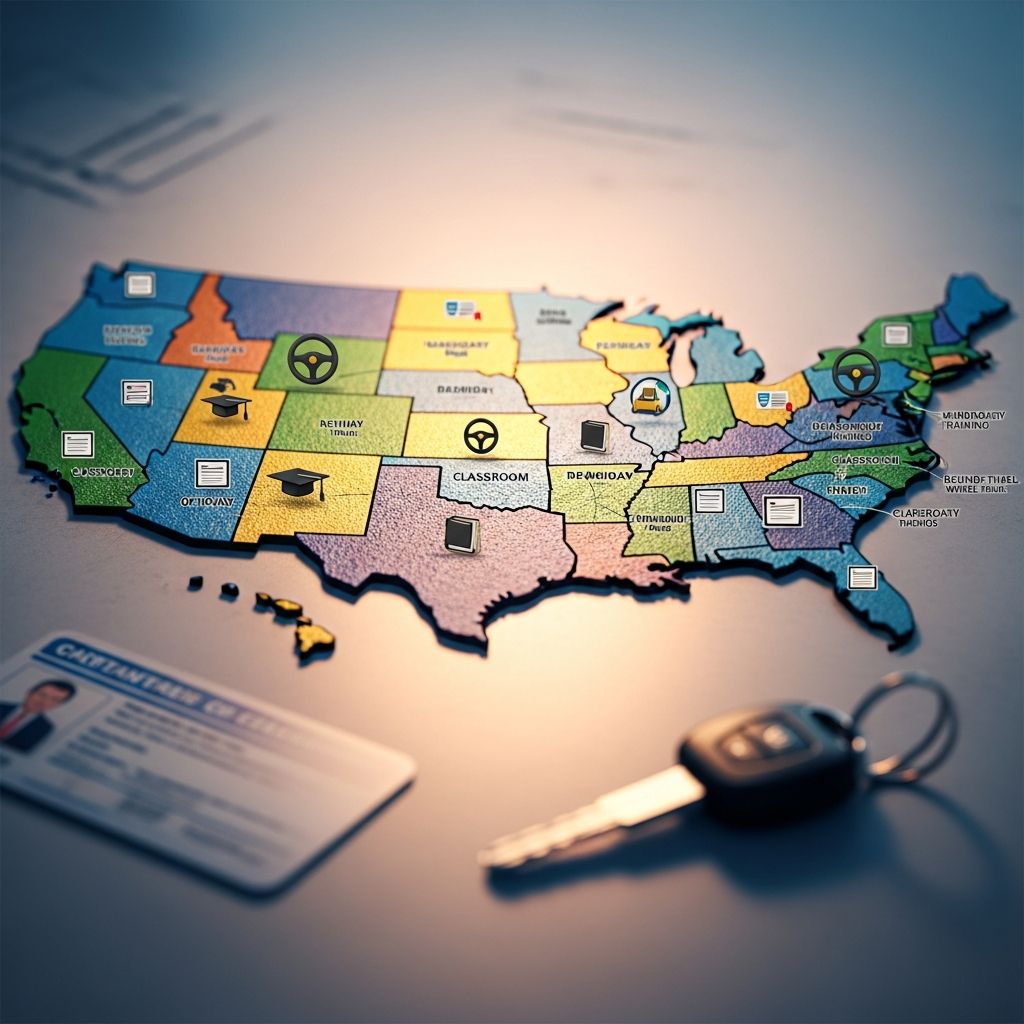
Obtaining a driver’s license in the United States involves navigating a patchwork of state-specific regulations, particularly regarding driver’s education. While not every state mandates formal classroom or behind-the-wheel training, many do—especially for younger applicants—to promote road safety amid high teen crash rates. This guide breaks down requirements, exceptions, and advantages of completing these programs.
Overview of National Trends in Driver Training
Driver’s education aims to equip novices with essential skills before independent driving. As of recent data, approximately 37 states enforce some form of mandatory training for teens under 18, often tied to graduated driver licensing (GDL) systems that phase in privileges. These programs typically blend classroom theory, simulation, and practical driving, reducing early accident risks. States without strict mandates frequently substitute with supervised practice hours, reflecting a balance between accessibility and safety.
GDL frameworks, endorsed by safety organizations, delay full licensure and impose restrictions like passenger limits and curfews. Incentives for driver’s ed include shortened practice periods or test waivers, making it a practical choice even where optional.
States Mandating Driver’s Education
A majority of states require structured driver’s ed for minors, with variations in hours and delivery (in-person, online, or hybrid). Below is a detailed look at key examples.
| State | Age Group | Course Requirements | Additional Notes |
|---|---|---|---|
| California | Under 17.5 | 30-hour DMV-approved course | Required for instruction permit |
| Texas | 14-17; 18-24 new drivers | 32 hours classroom + behind-wheel for teens; 6 hours for adults | TDLR-approved; mandatory for all under 18 |
| Maryland | All new drivers | 30 hours classroom + 6 hours behind-wheel | No age exemption |
| Connecticut | Teens | 8-hour safe driving + 30 hours classroom | Full teen mandate |
| Ohio | Under 18 | 24 hours classroom + 8 hours driving | For probationary license |
Other mandating states like Colorado (30+ hours for 15-21), Hawaii (30 hours + 6 behind-wheel under 18), and New Jersey (required for 16-year-old learner’s permit) follow similar patterns, emphasizing comprehensive preparation.
- Illinois: High school driver’s ed for under 18.
- Minnesota: 30-hour course + 6 hours training under 18.
- Virginia: Proof of state-approved course under 18.
- Washington: 30-hour course under 18.
States Without Mandatory Driver’s Ed
About 13-15 states skip formal courses, opting for practice logs instead. This flexibility aids rural areas but raises safety concerns, as unsupervised novices face steeper learning curves.
- Tennessee and West Virginia: No course required; first-time applicants log supervised hours.
- Nebraska: No mandate, though classes available nationwide.
- Alabama: 30 hours behind-wheel or approved course for unrestricted license under 18.
- Alaska: Proof of 40 supervised hours under 18.
- Kentucky: 60 hours practice (10 night) instead.
In Oregon, teens choose 50 supervised hours + ed course or 100 hours alone. South Dakota shortens learner periods with training.
Age-Specific Rules and Exceptions
Requirements often hinge on age. Teens bear the brunt, with adults sometimes exempt or facing lighter courses.
| Category | Typical Requirement | Examples |
|---|---|---|
| Under 18 | Full course (24-33 hours classroom + driving) | FL, ID, IN, IA, LA, ME, MI, NV, NH, NM, PA, RI, SC, UT, VT, WI |
| 18-25 New Drivers | Short course or awareness class | TX (6 hours), NM (DWI class) |
| Over 25 | Often none; just tests | Most states |
Rural exceptions exist, like Nevada’s 100-hour substitute for remote teens. Mississippi ties it to school programs for 14-year-olds.
Components of a Standard Driver’s Ed Program
Courses cover traffic laws, hazard recognition, defensive driving, and substance avoidance. Hands-on elements include:
- Classroom: 24-33 hours on rules, signage, physics of crashes.
- Behind-the-wheel: 6-12 hours supervised practice.
- Simulation/lab: Observation or virtual scenarios (e.g., DE’s 7 hours).
Online options proliferate in states like Iowa, blending convenience with certification.
Benefits Beyond Compliance
Even optional ed yields perks:
- Insurance Discounts: Completion often nets 10-25% lower premiums via good student or safe driver status.
- Safety Gains: Trained drivers show fewer violations; GDL + ed cuts crashes.
- Time Savings: Waives road tests or halves practice hours (e.g., PA, OR).
Federal data underscores pre-licensure training’s role in countermeasures, though evaluation continues.
Graduated Driver Licensing Integration
GDL stages—learner’s permit, intermediate, full—mesh with ed. IIHS data reveals:
| State | Learner Age | Supervised Hours | Min Full Age |
|---|---|---|---|
| NE | 15 | 50 (10 night) | 17 |
| OR | 15 | 50 (100 sans ed) | 17 |
| PA | 16 | 65 (10 night, 5 weather) | 17 w/ ed |
| SD | 14 | 50 (w/ ed shorter) | 16 |
Restrictions like night curfews (e.g., OR midnight-5am) and passenger caps enhance protection.
How to Enroll and Prepare
- Check your state’s DMV site for approved providers.
- Gather ID, parental consent if minor.
- Select format: online for flexibility, in-person for practice.
- Log post-course hours meticulously.
- Schedule permit/road tests promptly.
Costs range $50-500, often offset by insurance savings.
Frequently Asked Questions
Is driver’s ed required everywhere?
No, but 37 states mandate it for teens; others require practice hours.
Can I do driver’s ed online?
Yes, in states like Iowa, Texas—ensure state-approved.
What if I miss the age cutoff?
Adults 18+ often skip full courses, but check for new-driver rules (e.g., TX 18-24).
Does driver’s ed lower insurance?
Typically yes, via discounts for completion.
How many hours of supervised driving?
Varies: 40-100, reduced with ed (e.g., OR 100 to 50).
State Comparison Tool
Use this overview to compare:
- Mandatory Heavy: CA, TX, MD, CT (30+ hours).
- Practice-Focused: KY, TN, WV (no course).
- Hybrid: NV, OR (options).
Always verify with local DMV, as laws evolve.
References
- Which States Require Driver’s Education to Get a License? — driversed.com. 2024. https://driversed.com/trending/which-states-require-drivers-ed
- Is Driving School Mandatory to Get a Driver’s License? — Capital One. 2024. https://www.capitalone.com/cars/learn/finding-the-right-car/is-driving-school-mandatory-to-get-a-drivers-license/3400
- Is Driver’s Ed Required in Texas? — TicketSchool. 2024. https://ticketschool.com/blog/is-drivers-ed-required-in-texas/
- The State of Driver’s Education, in 4 Charts — Education Week. 2023-01-11. https://www.edweek.org/teaching-learning/the-state-of-drivers-education-in-4-charts/2023/01
- Graduated licensing laws – IIHS — Insurance Institute for Highway Safety. 2024. https://www.iihs.org/research-areas/teenagers/graduated-licensing-laws-table
- What States Have No Drivers Ed? — Coastline Academy. 2024. https://coastlineacademy.com/article/what-states-have-no-drivers-ed
- Pre-Licensure Driver Education | NHTSA — National Highway Traffic Safety Administration. 2024. https://www.nhtsa.gov/book/countermeasures-that-work/young-drivers/countermeasures/unproven-further-evaluation/pre-licensure
Similar Articles








Read full bio of medha deb