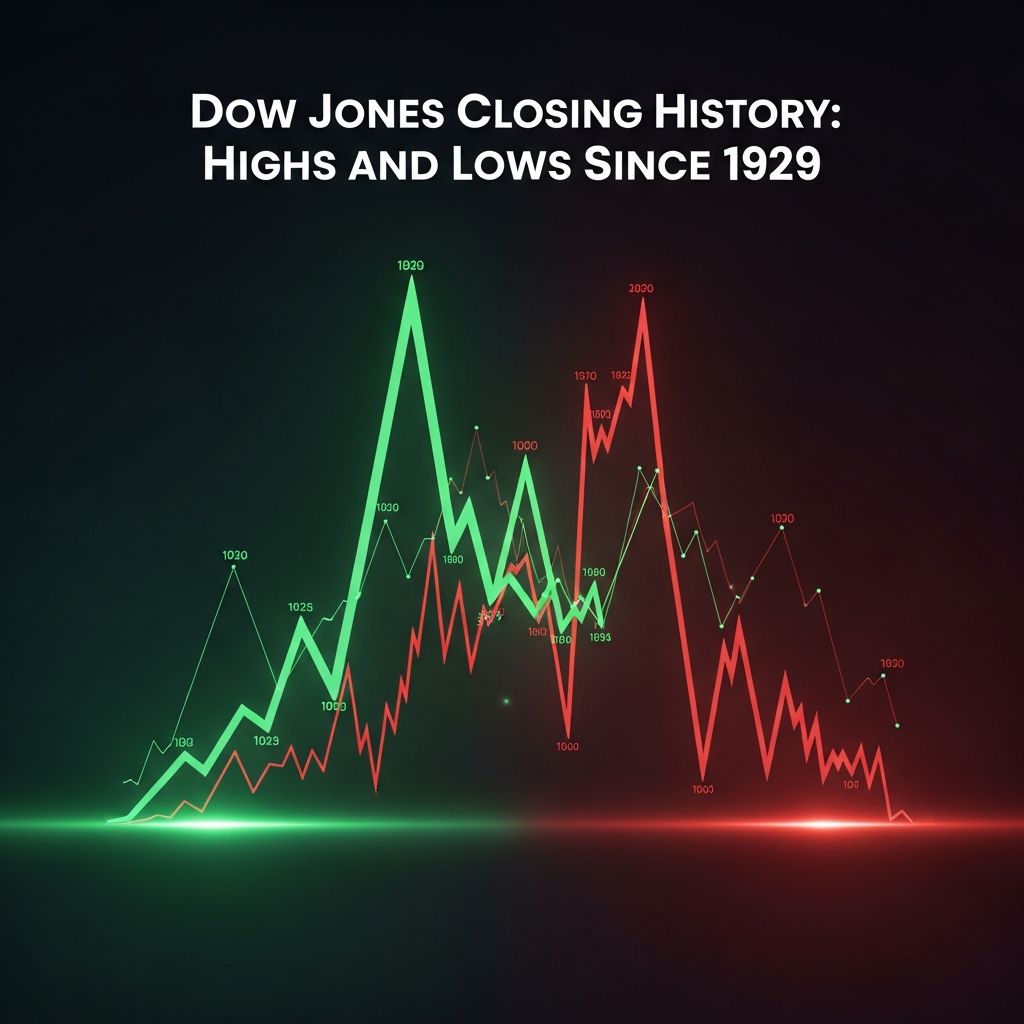
Dow Jones Closing History: Highs and Lows Since 1929
Explore the complete history of Dow Jones highs and lows from 1929 to present day.
Understanding the Dow Jones Industrial Average
The Dow Jones Industrial Average (DJIA) stands as one of the most recognized stock market indices in the world, serving as a barometer for the health of the American economy and global financial markets. Comprised of 30 large-cap companies representing various sectors of the economy, the Dow Jones has been tracking market performance for well over a century. Its history reveals the dramatic ups and downs of the financial markets, from unprecedented growth periods to devastating crashes that reshaped the economic landscape.
Understanding the historical performance of the Dow Jones provides valuable insights into market cycles, economic trends, and the long-term resilience of equity markets. By examining closing prices, record highs, and historic lows, investors and financial professionals can better comprehend market dynamics and make informed decisions about their portfolios.
Early Market History and Formation
The Dow Jones Industrial Average originated in 1896 with just 12 stocks, establishing what would become the world’s most famous stock market index. The index has undergone several transformations throughout its history, reflecting the changing nature of American industry and business.
In 1916, the index was expanded to include 20 stocks, and in 1928, it was further expanded to its current composition of 30 stocks. These structural changes were implemented to better represent the broader American economy and maintain the index’s relevance as major industries emerged and evolved.
The Roaring Twenties: Unprecedented Growth
The period from 1921 to 1929 represented one of the most spectacular bull markets in history. Following a bear market from 1919 to 1921, during which the Dow lost 46.6% of its value, the index experienced extraordinary growth over the subsequent eight years. The Dow increased nearly 500% during this period, climbing from approximately 63 in August 1921 to a peak of 381.17 on September 3, 1929.
This era, known as the Roaring Twenties, was characterized by widespread optimism about the American economy. Share prices rose to unprecedented heights as investors became increasingly confident in perpetual growth. The renowned economist Irving Fisher famously declared that stock prices had reached “what looks like a permanently high plateau,” a statement that would prove tragically mistaken just weeks later.
The Great Crash of 1929 and Its Aftermath
The euphoria of the 1920s came to an abrupt and devastating end in October 1929. On Black Monday, October 28, 1929, the Dow Jones Industrial Average declined nearly 13 percent in a single trading session. The following day, Black Tuesday, the market dropped an additional nearly 12 percent, signaling the beginning of a historic bear market.
The collapse was swift and severe. By mid-November 1929, the Dow had lost almost half of its value from its September peak. However, the worst was yet to come. The market continued its relentless decline through the summer of 1932, when the index closed at 41.22 on July 8, 1932, representing an 89 percent decline from its peak. This catastrophic loss erased 33 years of gains in less than three years, fundamentally altering the financial landscape and contributing to the onset of the Great Depression.
The Impact on Average Investors
The 1929 crash had devastating consequences far beyond Wall Street. By 1932, average Dow values had fallen to just one-fifth of their 1929 levels, from roughly 314 to 65. Millions of Americans lost their life savings, and the resulting economic devastation led to widespread unemployment, homelessness, and social upheaval that persisted throughout the 1930s.
Recovery and the Long Road Back
While cyclical bull markets occurred during the 1930s and 1940s, the Dow Jones faced an extraordinarily long recovery period. It took 22 years for the index to finally surpass its pre-1929 crash levels. The Dow did not return to its pre-crash heights until November 1954, a quarter-century after the initial collapse.
This extended recovery period underscores the severity of the 1929 crash and the subsequent Great Depression. Even as the American economy gradually rebuilt itself and World War II stimulated industrial growth, investor confidence remained cautious for many years following the devastating losses of the early 1930s.
Record Closing Prices and Milestones
Throughout its history, the Dow Jones has achieved numerous milestone closing prices as the economy has grown and evolved. From the earliest records showing closing prices in the double digits during the 1890s and early 1900s, the index has climbed to unprecedented levels in modern times.
During the 1916-1919 period, the Dow set record closing prices around 105-112 levels. The bull market of the 1920s saw the index reach 150 by February 1936, representing continued recovery and growth. Each successive decade brought new record highs as American industry expanded and the economy modernized.
In recent years, the Dow has achieved closing records far exceeding anything from earlier periods. The all-time closing high reached 48,254.82 on Wednesday, November 12, 2025, reflecting more than a century of economic growth and compounding returns.
Understanding Intraday Highs and Lows
It is important to note that the Dow Jones’ intraday highs and lows can differ slightly from closing prices. The all-time intraday high reached 48,431.57 on November 12, 2025, while the all-time intraday low was 40.56 on July 8, 1932, during the depths of the Great Depression.
These intraday movements represent the highest and lowest points reached during a trading day, regardless of where the market ultimately closed. Understanding these distinctions helps investors appreciate the full range of market volatility throughout any given session.
Key Market Cycles and Trends
Bull Markets
The Dow has experienced numerous bull markets throughout its history, characterized by sustained periods of rising prices and investor optimism. The 1921-1929 bull market represents the most dramatic in terms of percentage gains, with the index increasing nearly 500%. More recent bull markets, such as those following major recessions, have demonstrated the market’s resilience and long-term growth trajectory.
Bear Markets
Bear markets, characterized by prolonged periods of declining prices, have also shaped the Dow’s history. The 1929-1949 bear market was particularly severe, lasting approximately 20 years when measuring from peak to recovery. More recent bear markets, such as those during the 2000-2002 dot-com bubble burst and the 2008 financial crisis, have been shorter and less severe in percentage terms, reflecting changes in market structure and regulatory oversight.
The Role of World War I and World War II
Major historical events significantly impacted Dow Jones performance. During World War I, the New York Stock Exchange closed for four months starting July 30, 1914. When markets reopened on December 12, 1914, the index closed at 74.56, indicating that wartime concerns did not produce the predicted market collapse.
World War II similarly influenced market dynamics during the 1930s and 1940s, though government spending and industrial mobilization for the war effort ultimately stimulated economic growth that aided the market’s recovery from Great Depression lows.
Structural Changes to the Index
The Dow Jones has undergone several important structural modifications throughout its history. The original index consisted of 12 stocks when it debuted in 1896. In 1916, it expanded to 20 stocks, and in 1928, it grew to its current 30-stock composition. Each expansion reflected the need to maintain representation across the evolving American economy and ensure the index remained a reliable barometer of market health.
Significance of Historical Records
The all-time low of 41.22 from 1932 represents a critical marker in financial history, symbolizing the depths of financial despair during the Great Depression. Conversely, modern record highs in the 48,000+ range demonstrate the extraordinary wealth creation that has occurred over more than a century of economic development and growth.
These records are not merely academic curiosities; they provide context for understanding market valuation, economic cycles, and the importance of long-term investing strategies that weather temporary downturns while capturing the market’s underlying growth potential.
Frequently Asked Questions
Q: What was the worst day in Dow Jones history?
A: Black Monday, October 28, 1929, saw the Dow decline nearly 13 percent, followed by Black Tuesday with an additional nearly 12 percent decline. The extended bear market through mid-1932 resulted in an 89 percent total decline from peak levels.
Q: When did the Dow recover from the 1929 crash?
A: The Dow did not return to its pre-crash levels until November 1954, approximately 25 years after the initial crash in September 1929.
Q: What is the current all-time high for the Dow Jones?
A: The all-time closing high for the Dow Jones Industrial Average is 48,254.82, achieved on November 12, 2025, with an intraday high of 48,431.57 on the same date.
Q: How many stocks comprise the Dow Jones Industrial Average?
A: The Dow Jones Industrial Average consists of 30 large-cap stocks representing various sectors of the American economy. This composition has been in place since 1928.
Q: What percentage did the Dow lose during the Great Depression?
A: From its September 1929 peak of 381.17 to its July 1932 low of 41.22, the Dow lost 89 percent of its value, erasing 33 years of gains in less than three years.
Q: How does the Dow’s historical performance inform modern investing?
A: Historical analysis reveals that despite periodic crashes and bear markets, the Dow and broader equity markets have demonstrated long-term growth potential. Understanding historical cycles helps investors maintain perspective during market downturns and avoid emotional decision-making.
References
- Closing milestones of the Dow Jones Industrial Average — Wikipedia. 2025. https://en.wikipedia.org/wiki/Closing_milestones_of_the_Dow_Jones_Industrial_Average
- Stock Market Crash of 1929 — Federal Reserve History. 2013. https://www.federalreservehistory.org/essays/stock-market-crash-of-1929
- Dow Jones: average and yearly closing prices 1915-2021 — Statista. 2022. https://www.statista.com/statistics/1316908/dow-jones-average-and-yearly-closing-prices-historical
- Daily Closing Values of the Dow Jones Average — Measuring Worth. 2025. https://www.measuringworth.com/datasets/DJA/index.php
Similar Articles








Read full bio of medha deb