Double Declining Balance Depreciation Method
Master accelerated depreciation with the double declining balance method for optimal tax benefits.
Understanding the Double Declining Balance Depreciation Method
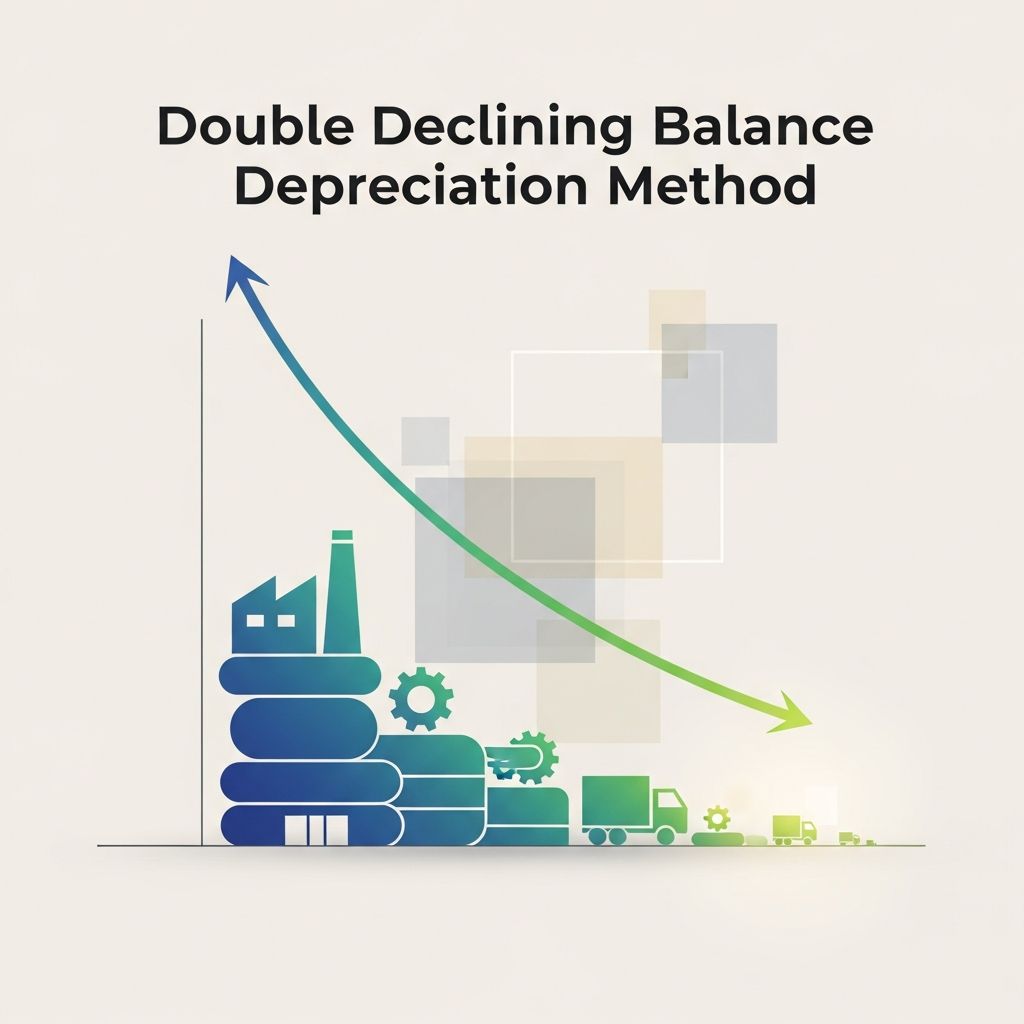
The double declining balance (DDB) method is a form of accelerated depreciation that allows businesses to write off more of an asset’s value in the early years of its useful life.1 This accounting approach is particularly valuable for companies seeking to maximize tax deductions immediately after purchasing significant fixed assets, thereby improving their near-term cash flow and reducing taxable income when they need the tax savings most.
Unlike the straight-line depreciation method, which distributes depreciation expense equally across an asset’s useful life, the double declining balance method front-loads depreciation expenses. This means that as an asset ages, the depreciation expense decreases each year, creating a declining pattern that accelerates the write-off of the asset’s cost early in its service life.
What Is the Double Declining Balance Method?
The double declining balance method is one of several accelerated depreciation techniques used in accounting and financial reporting. The term “double declining” refers to two key characteristics of this depreciation approach: it declines at double the rate of straight-line depreciation, and the balance (book value) of the asset declines each year as depreciation expense is recorded.
This method is particularly suitable for assets that lose their value most rapidly during their initial years of use. Technology equipment, machinery, vehicles, and other assets subject to rapid obsolescence are ideal candidates for the double declining balance method.2 By recognizing higher depreciation expenses early, companies can more accurately reflect the actual decline in asset value and achieve better matching of expenses to the periods when assets generate revenue.
The Double Declining Balance Method Formula
Understanding how to calculate depreciation using the double declining balance method requires knowledge of a specific formula and several sequential steps. The core formula for DDB depreciation is:
Annual DDB Depreciation = (2 × Straight-Line Depreciation Rate) × Beginning Book Value
This formula demonstrates why the method is called “double” declining balance: the straight-line depreciation rate is multiplied by two, effectively doubling the normal depreciation rate. The resulting percentage is then applied to the asset’s book value at the beginning of each accounting period.
It’s important to note that the double declining balance method does not incorporate salvage value into its annual depreciation calculations, unlike some other depreciation methods. The salvage value only becomes relevant at the end of the asset’s useful life to ensure the book value doesn’t decline below the estimated residual value.
Step-by-Step Calculation Process
Step 1: Calculate the Straight-Line Depreciation Rate
The first step in using the double declining balance method is to determine the straight-line depreciation rate. This is calculated by dividing one by the asset’s useful life in years. For example, an asset with a five-year useful life would have a straight-line depreciation rate of 1 ÷ 5 = 20% per year.1
Step 2: Calculate the Double Declining Balance Depreciation Rate
Once you have the straight-line depreciation rate, multiply it by two to determine the double declining balance depreciation rate. Continuing with our five-year example, 20% × 2 = 40%. This 40% rate is what you’ll apply to the asset’s book value each year.
Step 3: Apply the Rate to Beginning Book Value
To calculate your annual depreciation expense, multiply the DDB depreciation rate by the asset’s book value at the start of each year. For an asset purchased for $10,000 with a 40% DDB rate, Year 1 depreciation would be 40% × $10,000 = $4,000. This reduces the book value to $6,000 at the end of Year 1.
In Year 2, you would apply the 40% rate to the new book value: 40% × $6,000 = $2,400. The book value would then be $3,600. This pattern continues, with each year’s depreciation calculated based on the reduced book value from the previous year.
Step 4: Account for Salvage Value
As you approach the end of an asset’s useful life, you must ensure the book value doesn’t depreciate below the estimated salvage value.2 If the calculated depreciation would reduce the book value below the salvage value estimate, you should stop depreciating the asset or reduce the final year’s depreciation accordingly. For instance, if your calculated depreciation in Year 5 would result in a book value of $777.60, but the salvage value is estimated at $1,000, you would only claim depreciation to reduce the book value to the $1,000 salvage value.
Practical Example of Double Declining Balance Depreciation
Consider a company that purchases manufacturing equipment for $20,000 with an estimated useful life of five years and a salvage value of $2,000. Using the double declining balance method:
Year 1: Straight-line rate = 1 ÷ 5 = 20%; DDB rate = 20% × 2 = 40%; Depreciation = 40% × $20,000 = $8,000; Ending book value = $12,000
Year 2: Depreciation = 40% × $12,000 = $4,800; Ending book value = $7,200
Year 3: Depreciation = 40% × $7,200 = $2,880; Ending book value = $4,320
Year 4: Depreciation = 40% × $4,320 = $1,728; Ending book value = $2,592
Year 5: To prevent book value from falling below the $2,000 salvage value, depreciation = $592; Ending book value = $2,000
This example illustrates how the double declining balance method front-loads depreciation, with the largest expense in Year 1 and progressively smaller amounts in subsequent years.
Double Declining Balance vs. Other Depreciation Methods
| Depreciation Method | Calculation Approach | Expense Pattern | Best Use Case |
|---|---|---|---|
| Double Declining Balance (DDB) | 2 × Straight-line rate × Beginning book value | High early expenses, declining over time | Assets with rapid obsolescence or high early value loss |
| Straight-Line Depreciation | (Cost – Salvage value) ÷ Useful life | Equal expense each year | Most common method; assets with consistent value decline |
| 150% Declining Balance | 1.5 × Straight-line rate × Beginning book value | Moderate early acceleration | Middle ground between straight-line and DDB acceleration |
| Units of Production | Cost per unit × Units produced in period | Variable based on usage | Assets whose value declines based on usage, not time |
Advantages of the Double Declining Balance Method
The double declining balance method offers several significant benefits to businesses using it for their depreciation accounting:
Maximized Early Tax Deductions – The primary advantage is the ability to claim substantial tax deductions in the early years following asset purchase. This improves cash flow precisely when a company may have made a significant capital investment.
Improved Financial Metrics – By reducing expenses in later years, the DDB method can improve profitability metrics in those periods, which may be advantageous for financial reporting and investor relations.
Better Matching of Expenses – For many assets, the double declining balance method more accurately reflects the actual decline in asset value. Technology, vehicles, and machinery often lose value most rapidly in their first few years of service.3
Cash Flow Benefits – Front-loading depreciation reduces taxable income early, which can result in lower tax payments when the company needs to preserve cash for operations or expansion.
Disadvantages and Limitations
While the double declining balance method offers advantages, it also has certain drawbacks that businesses should consider:
Complexity – The DDB method requires more calculation steps than straight-line depreciation, particularly when adjusting for salvage value at the end of an asset’s life.
Lower Later-Year Deductions – Because depreciation is front-loaded, the tax deductions in later years are substantially lower, which may not align with some companies’ financial planning needs.
Impact on Financial Statements – For reporting purposes, accelerated depreciation results in lower profit margins in early periods, which might negatively affect financial ratios and investor perceptions during the asset’s initial years.2
Salvage Value Complications – The method requires adjustment as the asset approaches its salvage value, adding complexity to the depreciation schedule, particularly in the final year of the asset’s useful life.
When to Use the Double Declining Balance Method
The double declining balance method is most appropriate for specific types of assets and business situations:
High-Tech Equipment – Technology assets such as computers, servers, and software systems often become obsolete quickly. The DDB method appropriately reflects their rapid value decline.
Vehicles and Transportation Equipment – Vehicles typically depreciate significantly in their first few years, making DDB an excellent fit for this asset class.
Machinery and Manufacturing Equipment – Industrial equipment often experiences greatest wear and reduced efficiency in its early years of operation, supporting the use of accelerated depreciation.
Tax Planning Objectives – When a company needs substantial tax deductions immediately following a significant capital purchase, the DDB method delivers maximum benefit.
Cash Flow Preservation – Startups and growing companies requiring tax relief to preserve operating cash flow benefit from the method’s front-loaded deductions.
Double Declining Balance in Financial Reporting
For financial statement purposes, the double declining balance method can have significant implications. Under accelerated depreciation, reported earnings in early years will be lower than under straight-line methods, as depreciation expenses are higher. This impacts key financial metrics including net income, return on assets, and asset turnover ratios.
Companies using the DDB method must disclose this in their financial statement notes and ensure consistency with prior periods. The method should align with the company’s asset depreciation policy as outlined in its accounting principles.
Switching Depreciation Methods
Some companies employing the double declining balance method eventually switch to the straight-line method in later years. This “switching” typically occurs when the calculated DDB depreciation in later years becomes less than what straight-line depreciation would produce. Making this switch allows companies to ensure salvage value assumptions are met while optimizing the total depreciation recognized.
Any change in depreciation method is considered a change in accounting estimate and must be accounted for prospectively, with appropriate disclosure in financial statements.
Frequently Asked Questions
What is the main difference between double declining balance and straight-line depreciation?
The primary difference is the expense pattern. Straight-line depreciation spreads equal depreciation expense across each year of an asset’s useful life, while double declining balance records significantly higher depreciation in early years that declines over time. Double declining balance uses a rate double that of straight-line depreciation, applied to the declining book value each year.
Why is salvage value ignored in the DDB depreciation calculation?
The double declining balance method applies a fixed percentage to the remaining book value, which would never fully reach zero mathematically. Salvage value only becomes relevant at the end of the asset’s life to prevent the book value from depreciating below the estimated residual value. This is why adjustments are necessary in the final depreciation period.
Can I use the double declining balance method for all my assets?
While technically possible, the DDB method is most appropriate for assets that lose value rapidly in early years. For assets with consistent depreciation patterns, straight-line depreciation may be more suitable. Additionally, tax regulations may restrict which assets qualify for accelerated depreciation methods.
How does switching from DDB to straight-line depreciation work?
To switch methods, calculate what straight-line depreciation would be on the remaining book value and useful life. Once straight-line depreciation exceeds the DDB amount, switch to straight-line for that year and all subsequent years. This ensures maximum total deductions while respecting salvage value constraints.
Is the double declining balance method accepted by tax authorities?
Yes, the double declining balance method is an acceptable depreciation method for tax purposes in most jurisdictions, though specific regulations vary. Businesses should consult with tax professionals to ensure compliance with applicable tax regulations regarding depreciation methods for their specific assets and circumstances.
References
- Double Declining Balance Method: A Complete Guide for SMBs — Paro. 2025. https://paro.ai/blog/double-declining-balance-method/
- Double Declining Balance Method (DDB) | Formula + Calculator — Wall Street Prep. 2025. https://www.wallstreetprep.com/knowledge/double-declining-balance-method/
- How to Calculate Depreciation Using the Double Declining Balance Method — Corporate Finance Institute. 2025. https://corporatefinanceinstitute.com/resources/financial-modeling/double-declining-balance-depreciation-template/
- Double Declining Balance: A Simple Depreciation Guide — Bench. 2025. https://www.bench.co/blog/tax-tips/double-declining-balance
- Double Declining Balance Depreciation: Formula & Calculation — HighRadius. 2025. https://www.highradius.com/resources/Blog/double-declining-balance-depreciation/
- Double Declining Balance Method: Calculating DDB Depreciation — MasterClass. 2025. https://www.masterclass.com/articles/double-declining-balance-method
Similar Articles








Read full bio of Sneha Tete