Dollar-Cost Averaging: 5 Practical Steps To Start Investing
Master dollar-cost averaging to invest smarter, reduce risks, and build wealth steadily over time without timing the market.
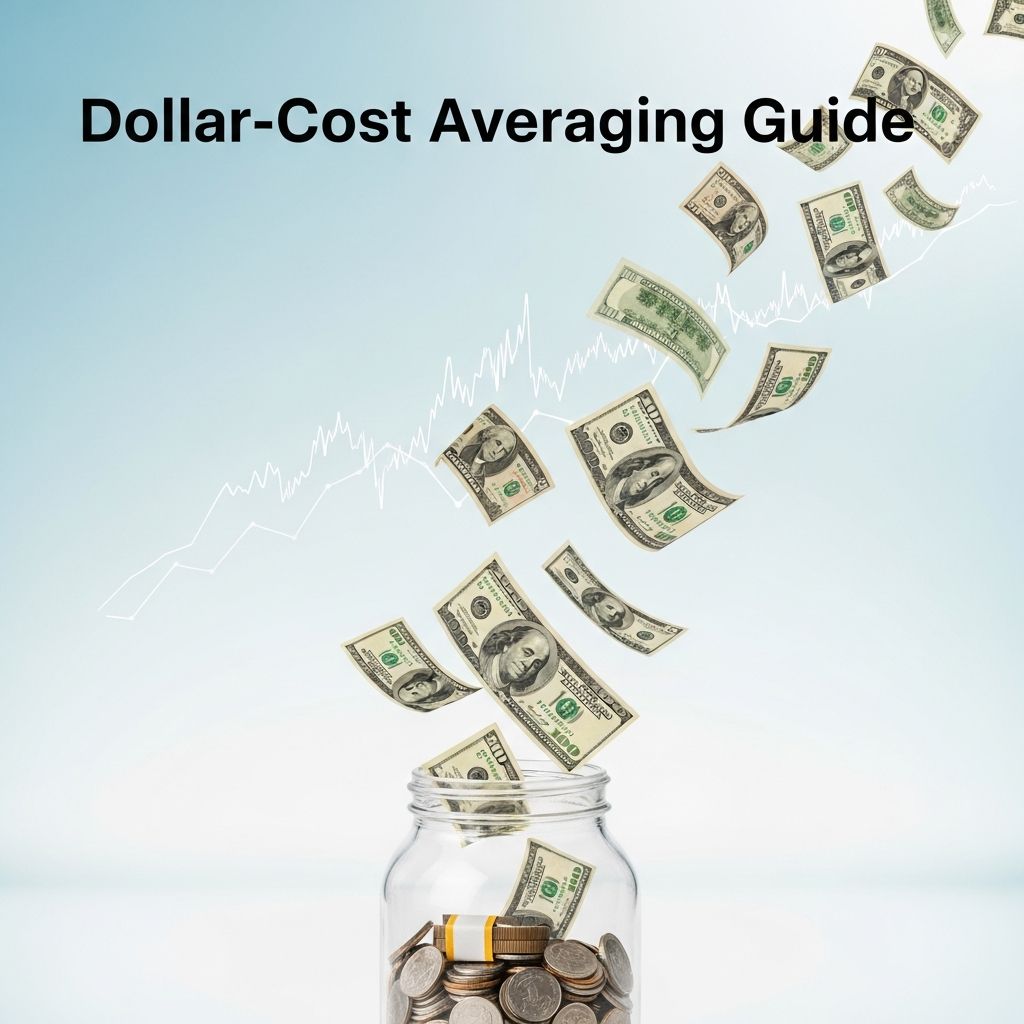
Dollar-Cost Averaging Guide
Dollar-cost averaging (DCA) involves committing a fixed amount to investments at set intervals, irrespective of price fluctuations, to mitigate volatility’s impact and potentially secure a favorable average cost basis over time.
Understanding the Fundamentals of DCA
This disciplined approach counters the pitfalls of market timing by spreading investments across periods, buying more units during dips and fewer at peaks, which mathematically leverages the harmonic mean for a lower effective price per share compared to arithmetic averages.
Unlike one-time lump-sum deployments, DCA suits those wary of immediate downturns, fostering gradual market exposure while curbing emotional decisions driven by short-term noise.
Why DCA Appeals to Diverse Investors
Investors favor DCA for its risk-reduction properties, particularly in volatile assets, as evidenced by studies showing diminished loss probabilities over investment horizons.
It instills behavioral discipline, transforming investing into a habitual practice akin to routine savings, which sustains participation even in bearish phases.
Practical Steps to Implement DCA
- Determine your fixed sum: Select an affordable amount, such as $500 monthly, aligned with income without straining finances.
- Select intervals: Opt for weekly, bi-weekly, or monthly cadences; monthly suits most due to payroll cycles.
- Choose assets: Prioritize diversified ETFs tracking indices like the S&P 500 or established blue-chip stocks for stability.
- Automate execution: Leverage brokerage auto-invest tools to enforce consistency effortlessly.
- Monitor sparingly: Review quarterly to avoid impulsive adjustments based on transient market moves.
Illustrative DCA Example with Table
Consider investing $1,000 monthly for six months in a stock amid price swings:
| Month | Investment | Price/Share | Shares Bought |
|---|---|---|---|
| 1 | $1,000 | $20 | 50 |
| 2 | $1,000 | $15 | 66.67 |
| 3 | $1,000 | $18 | 55.56 |
| 4 | $1,000 | $12 | 83.33 |
| 5 | $1,000 | $10.50 | 95.24 |
| 6 | $1,000 | $11 | 90.91 |
| Total | $6,000 | $10.03 avg | 441.71 |
This yields an average cost of $13.58 per share ($6,000 / 441.71), far below the $16.58 arithmetic mean, demonstrating DCA’s cost-smoothing power.
Core Advantages of Adopting DCA
- Eliminates timing guesswork, sidestepping regrets from peak purchases.
- Lowers effective acquisition costs via inverse price-share relationship.
- Promotes psychological resilience, reducing panic selling in downturns.
- Enhances share accumulation during corrections for compounded gains.
Potential Shortcomings and Mitigations
In relentless bull markets, DCA lags lump-sum by delaying full exposure, acquiring fewer shares as prices climb.
Historical analyses confirm lump-sum outperforms ~68% of the time in rising equities, yet DCA shines for risk-averse profiles or uncertain outlooks.
Transaction fees can erode small periodic buys; counter this with commission-free platforms.
DCA Versus Lump-Sum: A Comparative Analysis
| Aspect | DCA | Lump-Sum |
|---|---|---|
| Risk Profile | Lower volatility exposure | Higher immediate risk |
| Performance in Bulls | Often underperforms | Typically superior |
| Behavioral Fit | Ideal for discipline seekers | Suits confident timers |
| Math Edge | Harmonic mean benefit | Time-in-market advantage |
Per mean-variance frameworks, DCA optimizes for elevated risk aversion, balancing return potential against drawdown fears.
Advanced DCA Tactics for Optimization
For seasoned users, blend DCA with value thresholds: amplify buys below moving averages or sector undervaluations.
Diversify across asset classes—equities, bonds, crypto—via multi-ETF DCA to fortify portfolios.
Incorporate tax-advantaged vehicles like IRAs or 401(k)s, where employer matches supercharge periodic contributions.
Seasonal and Mean-Reversion Influences
Empirical work reveals DCA edges in non-winter initiations, capitalizing on equity seasonality.
Mean reversion bolsters DCA in diversified additions, as short-term dips revert, rewarding patient accumulators.
Real-World Applications Across Markets
Beyond stocks, DCA applies to crypto’s wild swings, enabling steady Bitcoin or Ethereum builds without FOMO peaks.
Retirement plans thrive on DCA via automatic payroll deductions, compounding over decades.
Frequently Asked Questions
What if markets keep rising during my DCA period?
You may forgo some gains versus immediate full investment, but the strategy prioritizes risk control over maximization.
Is DCA suitable for short-term goals?
No; it’s designed for horizons exceeding 3-5 years to weather volatility.
How does DCA handle fees?
Minimize via zero-commission brokers; scale investment size if fees apply.
Can DCA beat buy-and-hold?
Rarely on raw returns, but excels in risk-adjusted metrics for conservatives.
Should I adjust DCA amounts dynamically?
Maintain fixed sums for purity; tweaks risk undisciplined timing.
Building a Robust DCA Framework
Assess risk tolerance first: conservatives favor broad indices, aggressives tilt growth.
Simulate scenarios using historical data to visualize outcomes, reinforcing conviction.
Pair with rebalancing annually to sustain allocation targets amid drifts.
Track progress via apps logging contributions, shares, and internal rate of return for motivation.
Psychological and Long-Term Benefits
DCA curbs recency bias, preventing exodus post-dips by mandating buys.
Over decades, it harnesses compounding: modest monthly inputs swell substantially, outpacing sporadic efforts.
Studies affirm its role in portfolio longevity, especially amid sequence-of-returns risks in withdrawals.
References
- Dollar-Cost Averaging: The Trade-Off Between Risk and Return — NSUWorks Nova Southeastern University. 2017. https://nsuworks.nova.edu/hcbe_facarticles/769/
- Dollar Cost Averaging (DCA) Meaning: A Simple Strategy to Build — HeyGoTrade. 2023-10-15. https://heygotrade.com/en/blog/dollar-cost-averaging-dca-strategy
- Dollar-cost averaging explained: How consistent investing may — Thrivent. 2024-05-20. https://www.thrivent.com/insights/investing/dollar-cost-averaging-explained-with-examples
- Dollar cost averaging — Wikipedia. 2025-01-15. https://en.wikipedia.org/wiki/Dollar_cost_averaging
- Dollar cost averaging — Fidelity. 2024-11-10. https://www.fidelity.com/learning-center/trading-investing/dollar-cost-averaging
- Dollar Cost Averaging — Investor.gov (SEC). 2023. https://www.investor.gov/introduction-investing/investing-basics/glossary/dollar-cost-averaging
- What Is Dollar-Cost Averaging? — Charles Schwab. 2024-08-05. https://www.schwab.com/learn/story/what-is-dollar-cost-averaging
Similar Articles





Read full bio of medha deb