Dogecoin: The Meme Cryptocurrency Explained
Understand Dogecoin's origins, technology, and role in the crypto market today.
What is Dogecoin?
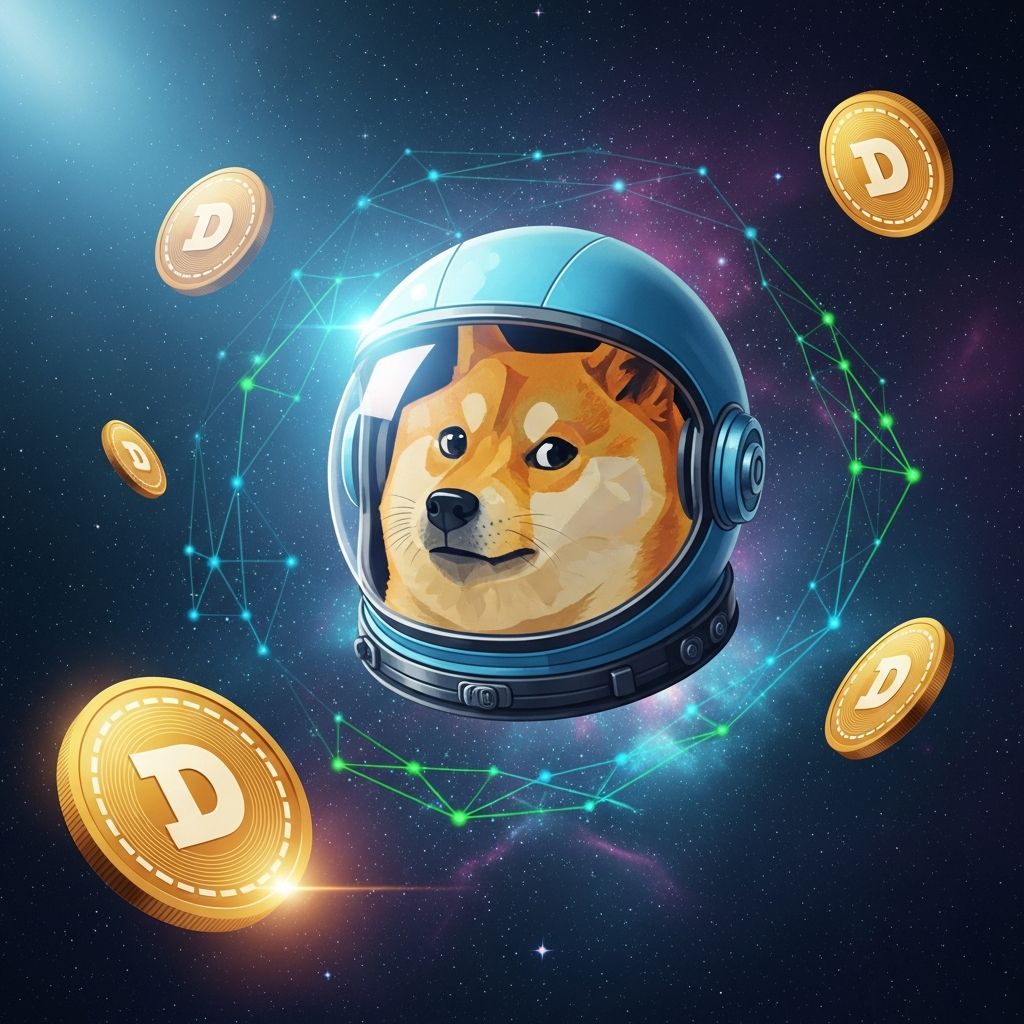
Dogecoin is a peer-to-peer, open-source cryptocurrency that was created in December 2013 by Jackson Palmer and Billy Markus. Unlike many cryptocurrencies that were designed with serious financial intentions, Dogecoin emerged as a lighthearted alternative to Bitcoin, inspired by the popular Shiba Inu dog meme that was prevalent on social media at the time. Despite its humorous origins, Dogecoin has developed into a legitimate digital currency with a substantial market capitalization and an active community of users and developers.
The cryptocurrency operates on a blockchain technology similar to Bitcoin, allowing users to send and receive digital currency peer-to-peer without intermediaries. The Dogecoin network is maintained by thousands of nodes worldwide, ensuring decentralization and security. The distinctive branding featuring the Shiba Inu dog has made Dogecoin one of the most recognizable cryptocurrencies globally, transcending its meme origins to establish itself in the broader cryptocurrency ecosystem.
Key Characteristics of Dogecoin
- Supply: Dogecoin has an unlimited supply, unlike Bitcoin which is capped at 21 million coins. New Dogecoins are created through a mining process that rewards miners with coins for validating transactions on the network.
- Block Time: Dogecoin’s block time is approximately one minute, meaning new blocks are added to the blockchain roughly every 60 seconds. This is faster than Bitcoin’s 10-minute block time, enabling quicker transaction confirmations.
- Mining Algorithm: Dogecoin uses the Scrypt proof-of-work algorithm for mining, which is also used by Litecoin. This algorithm is ASIC-resistant to some degree, making it more accessible to casual miners compared to Bitcoin’s SHA-256 algorithm.
- Transaction Fees: Dogecoin typically has lower transaction fees compared to Bitcoin and Ethereum, making it attractive for small to medium-sized transactions.
- Community-Driven: The Dogecoin community is known for its charitable initiatives and generous tipping culture, often using the cryptocurrency for charitable donations and community-driven projects.
History and Development of Dogecoin
Jackson Palmer, an Adobe product manager, and Billy Markus, a programmer, created Dogecoin as a joke to satirize the proliferation of altcoins in the cryptocurrency space during late 2013. Palmer registered the dogecoin.com domain and Markus developed the actual cryptocurrency by modifying the Litecoin source code. The launch occurred on December 6, 2013, with initial mining rewards set at 0-1 million Dogecoins per block.
What began as a humorous experiment quickly gained traction due to its approachable branding and the active community it attracted. In 2014, Dogecoin experienced significant growth in value and adoption, particularly following community fundraising efforts such as sponsoring the Jamaican Bobsled Team’s participation in the Winter Olympics. The cryptocurrency has since weathered multiple market cycles, regulatory challenges, and technological updates, emerging as one of the top cryptocurrencies by market capitalization.
Technical Specifications
| Specification | Details |
|---|---|
| Ticker Symbol | DOGE |
| Launch Date | December 6, 2013 |
| Consensus Mechanism | Proof of Work (Scrypt) |
| Block Time | ~1 minute |
| Maximum Supply | Unlimited |
| Annual Inflation Rate | Approximately 3.8% |
| Mining Difficulty Adjustment | Every 4 blocks |
How Dogecoin Works
Dogecoin operates on a decentralized blockchain network where transactions are verified by miners using the Scrypt proof-of-work algorithm. When a user initiates a transaction, it is broadcast to the network and collected by miners into a memory pool. Miners then compete to solve complex mathematical puzzles to validate these transactions and create new blocks.
The first miner to successfully solve the puzzle broadcasts the new block to the network, and other nodes verify its validity. If the block is valid, it is added to the blockchain, and the miner receives a reward consisting of newly created Dogecoins plus transaction fees. This process repeats approximately every minute, resulting in faster transaction confirmations compared to Bitcoin.
Users interact with Dogecoin through digital wallets, which store their private and public keys. The private key allows users to spend their Dogecoins, while the public key serves as their address for receiving funds. Wallets can be hosted online (web wallets), stored locally on a computer (desktop wallets), or kept offline on hardware devices (hardware wallets) for enhanced security.
Dogecoin vs. Bitcoin: Key Differences
- Supply Model: Bitcoin has a fixed maximum supply of 21 million coins, creating scarcity and potential deflationary pressure. Dogecoin has unlimited supply with continuous inflation, designed to facilitate spending rather than hoarding.
- Transaction Speed: Dogecoin’s one-minute block time enables faster transaction confirmations than Bitcoin’s 10-minute average, making it more suitable for frequent transactions.
- Mining Algorithm: Bitcoin uses SHA-256, while Dogecoin uses Scrypt. Dogecoin’s algorithm is generally considered more accessible to individual miners.
- Transaction Costs: Dogecoin typically offers significantly lower transaction fees, making microtransactions more economical.
- Community Focus: Dogecoin emphasizes community and social causes, while Bitcoin is primarily viewed as digital gold or a store of value.
Dogecoin’s Market Performance
Dogecoin has experienced considerable volatility since its launch. The cryptocurrency began trading at fractions of a cent and remained relatively obscure until 2014, when community support and charitable initiatives drove increased adoption. The cryptocurrency has experienced several bull markets, with notable price increases in 2017-2018, 2020-2021, and 2021, driven by factors including increased mainstream media attention, celebrity endorsements, and broader cryptocurrency market rallies.
The most significant price surge occurred in early 2021 when Dogecoin reached an all-time high of approximately $0.73 per coin, driven substantially by social media hype and retail investor enthusiasm. Despite subsequent price corrections, Dogecoin has maintained a position among the top ten cryptocurrencies by market capitalization, demonstrating sustained interest and adoption despite its meme origins.
Use Cases and Adoption
Payment Processing
Dogecoin has been adopted by various merchants and service providers as a payment method, particularly among businesses catering to cryptocurrency-enthusiastic communities. Its low transaction fees and fast confirmation times make it suitable for retail payments and online transactions.
Charitable Donations
The Dogecoin community has established a strong tradition of using the cryptocurrency for charitable purposes. Notable examples include fundraising for the Jamaican Bobsled Team, donations to water well projects in Kenya, and various COVID-19 relief initiatives.
Tipping and Rewards
Dogecoin’s community employs the cryptocurrency as a tipping mechanism on social media platforms and online forums, rewarding content creators and community contributors. This use case leverages Dogecoin’s low transaction costs and accessible branding.
Speculative Investment
Like most cryptocurrencies, Dogecoin serves as an investment asset for individuals seeking exposure to cryptocurrency markets. Its volatility presents both opportunities and risks for traders and investors.
Risks and Considerations
- Price Volatility: Dogecoin exhibits extreme price volatility, with significant percentage swings occurring over short time periods. This volatility creates substantial risk for investors unable to tolerate rapid value fluctuations.
- Regulatory Uncertainty: The regulatory environment for cryptocurrencies remains uncertain in many jurisdictions. Unfavorable regulatory developments could negatively impact Dogecoin’s adoption and value.
- Unlimited Supply: The unlimited supply of Dogecoin creates inherent inflationary pressure, potentially limiting long-term value appreciation compared to fixed-supply cryptocurrencies.
- Security Risks: Users face risks including exchange hacks, wallet theft, phishing attacks, and user error. Proper security practices are essential for protecting Dogecoin holdings.
- Market Manipulation: The cryptocurrency market is susceptible to price manipulation through pump-and-dump schemes, particularly affecting lower-market-cap coins like Dogecoin.
How to Buy and Store Dogecoin
Purchasing Dogecoin
Dogecoin can be purchased through various cryptocurrency exchanges, including major platforms such as Coinbase, Kraken, and Binance. Users must create an account, verify their identity, and connect a payment method such as a bank account or credit card. After funding their account, users can place buy orders for Dogecoin at current market prices.
Storage Options
Proper storage is critical for securing Dogecoin holdings. Available options include:
- Hardware Wallets: Devices like Ledger and Trezor provide offline storage for maximum security.
- Desktop Wallets: Applications like the official Dogecoin Core wallet offer local storage on personal computers.
- Mobile Wallets: Smartphone applications provide convenient access and transaction capabilities.
- Exchange Wallets: While convenient, storing coins on exchanges introduces custodial risk if the exchange experiences security breaches.
Frequently Asked Questions (FAQs)
Q: Is Dogecoin a good investment?
A: Dogecoin’s investment suitability depends on individual risk tolerance, investment goals, and financial circumstances. Its extreme volatility and unlimited supply present significant risks. Investors should only invest amounts they can afford to lose and conduct thorough research before investing.
Q: Can Dogecoin reach $1?
A: While Dogecoin reached approximately $0.73 in 2021, whether it reaches $1 depends on market conditions, adoption rates, and broader cryptocurrency sentiment. Price predictions are speculative, and no guarantees exist regarding future performance.
Q: How many Dogecoins are in circulation?
A: As of 2025, over 140 billion Dogecoins are in circulation, with approximately 10,000 new coins created daily through mining. The unlimited supply continuously increases the total circulation.
Q: What makes Dogecoin different from other altcoins?
A: Dogecoin differentiates itself through its strong community, charitable focus, approachable branding, and established market presence. Its faster block time and lower transaction fees also distinguish it from many alternatives.
Q: Is Dogecoin secure?
A: Dogecoin uses proven cryptographic technology and a decentralized network of nodes, making the network itself secure. However, users must implement proper security practices to protect their private keys and wallet access.
Q: Can I mine Dogecoin?
A: Yes, Dogecoin can be mined using specialized hardware. However, profitability depends on hardware costs, electricity prices, and current mining difficulty. Many users join mining pools to share resources and rewards.
References
- Bitcoin: A Peer-to-Peer Electronic Cash System — Satoshi Nakamoto. 2008. https://bitcoin.org/bitcoin.pdf
- Dogecoin Official Project Repository — Dogecoin Foundation. 2024. https://github.com/dogecoin/dogecoin
- Cryptocurrency Market Data and Analytics — CoinMarketCap. 2025. https://coinmarktcap.com
- An Analysis of Bitcoin’s Growth, Adoption, and Economics — Rogojanu, A., & Badea, L. Journal of Alternative Investments. 2014. https://doi.org/10.3905/jai.2014.17.5.066
- Blockchain Technology: Beyond Bitcoin — U.S. National Institute of Standards and Technology (NIST). 2023. https://csrc.nist.gov
Similar Articles








Read full bio of medha deb