Does New Credit Hurt Your Score?
Discover how opening new accounts affects your credit score, the short-term risks, and long-term benefits of smart credit management.
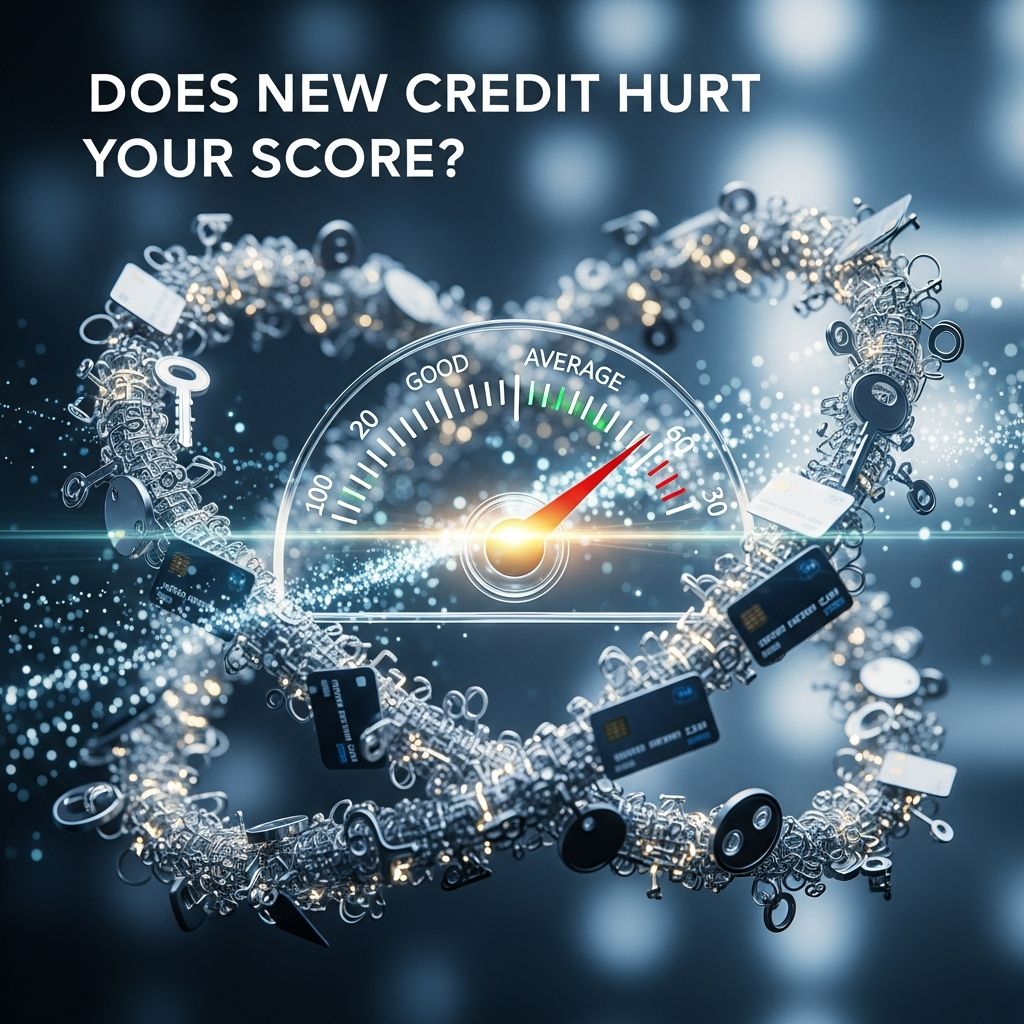
Opening a new credit account, such as a credit card or loan, can have both immediate negative effects and potential long-term positives on your credit score. While it often causes a small, temporary drop, responsible management can lead to improvements through better utilization ratios and expanded payment history.
Understanding the Core Components of Your Credit Score
Your credit score reflects your creditworthiness based on several key factors. FICO scores, used by most lenders, weigh payment history at 35%, amounts owed at 30%, length of credit history at 15%, new credit at 10%, and credit mix at 10%. VantageScore adjusts these slightly, with payment history at 40% and recent credit at 5-11%. New accounts primarily influence the ‘new credit’ category, but ripple into others like history length and utilization.
The Immediate Downsides of New Accounts
Seeking new credit triggers several mechanisms that can lower your score right away.
Hard Inquiries Explained
A hard inquiry happens when a lender reviews your full credit report during an application. This signals to other lenders potential risk-taking, potentially dropping your score by 5 points or less per inquiry. Multiple inquiries in a short time amplify the effect, as they suggest financial distress. Inquiries remain visible for two years but impact scores for only one year in FICO models.
- Single inquiry: Minor, often negligible impact.
- Multiple inquiries: Can signal desperation, leading to larger drops.
- Pre-approvals use soft inquiries, which don’t affect scores.
Shorter Average Account Age
The length of your credit history measures how long you’ve managed credit. New accounts reduce the average age of all accounts, which comprises 15% of FICO scores and up to 21% in VantageScore as ‘depth of credit’. For those with thin files, this hit is more pronounced.
| Scenario | Before New Account | After New Account | Impact |
|---|---|---|---|
| Average Age (Years) | 10 | 9.5 (with 0-year new account) | Decreases |
| Thin File (2 years avg) | 2 | 1.3 | Significant drop |
Positive Effects That Can Offset the Damage
Not all impacts are negative; new credit can boost your score in key areas if handled wisely.
Boosting Credit Utilization Ratios
Credit utilization—the ratio of balances to limits—is 30% of FICO scores. A new account raises your total limits without increasing debt, lowering utilization automatically if spending stays the same. Aim for under 30% overall and per card.
Example: $2,000 limit, $1,000 balance (50% utilization). Add $3,000 limit card with $0 balance: New total utilization = $1,000 / $5,000 = 20%.
Diversifying Your Credit Mix
Having both revolving (cards) and installment (loans) accounts shows versatility, aiding the 10% credit mix factor. If your profile lacks variety, a new type helps.
Building Stronger Payment History
Payment history is the largest factor (35-40%). Each new account offers more chances to demonstrate on-time payments, gradually strengthening your profile.
FICO vs. VantageScore: Key Differences in New Credit Weighting
| Factor | FICO Weight | VantageScore 3.0/4.0 |
|---|---|---|
| New/Recent Credit | 10% | 5-11% |
| Length/Depth of History | 15% | 21% |
| Payment History | 35% | 40% |
FICO emphasizes recent inquiries and new accounts more evenly, while VantageScore prioritizes history depth.
When New Credit Helps Most
- High utilization: New limits dilute ratios quickly.
- Thin mix: Adding variety without excess inquiries.
- Building credit: Young profiles benefit from payment history growth.
Risks to Avoid with New Accounts
Pitfalls can turn positives into negatives.
- Overspending: High balances spike utilization above 30%, hurting scores more than gains.
- Too many applications: Rate shopping (e.g., mortgages) counts as one inquiry if within 14-45 days, but unrelated apps add up.
- Closing old accounts: Avoids utilization spikes but worsens average age.
Strategies to Minimize Negative Impact
- Check pre-approvals first to avoid unnecessary hard pulls.
- Space applications 3-6 months apart.
- Pay balances in full monthly to keep utilization low.
- Monitor scores via free weekly reports from AnnualCreditReport.com or services like Credit Karma.
- Consider authorized user status on established cards for history without inquiries.
Real-World Scenarios: Tables of Impact
| Profile | New Account Action | Likely Score Change | Reason |
|---|---|---|---|
| Excellent Credit (750+) | Open 1 card | -5 to +10 pts | Minimal inquiry hit; utilization drops |
| Fair Credit (600-700) | Multiple apps | -20+ pts | Compounded inquiries, age drop |
| Building Credit (<2 yrs history) | Secured card | +20-50 pts long-term | Payment history builds |
Frequently Asked Questions
Will one new credit card ruin my score?
No, a single responsible card typically causes a tiny dip that rebounds fast, often improving scores via utilization.
How long does a hard inquiry stay on my report?
Two years, but FICO ignores after 12 months for scoring.
Can opening a card actually raise my score?
Yes, if it lowers utilization below 30% and you pay on time.
Is it better to have many cards or few?
Fewer cards with low utilization and long history is ideal; too many new ones hurt.
Do store cards count the same as major cards?
Yes, but high fees and low limits can lead to poor utilization.
Long-Term Credit Building with New Accounts
View new credit as a tool, not a quick fix. Consistent on-time payments across accounts build the strongest foundation. Over 6-12 months, positives like utilization and history outweigh inquiry dings. Those with established profiles see minimal disruption, while beginners gain most from gradual expansion.
Track progress monthly. If scores stagnate, reassess spending and applications. Responsible new credit enhances financial flexibility for loans, rates, and rentals.
References
- Opening New Accounts May Impact Your Credit Score — Community Choice CU. 2023. https://www.communitychoicecu.com/financial-education/opening-new-accounts-may-impact-your-credit-score/
- How New Credit Impacts Your Credit Score — Bankrate. 2024-03-15. https://www.bankrate.com/credit-cards/building-credit/new-credit/
- Does opening a new credit card hurt your credit? — Capital One. 2024. https://www.capitalone.com/learn-grow/money-management/opening-a-new-credit-card-credit-score-impact/
- Does Applying for Credit Cards Hurt Your Credit? — Experian. 2024. https://www.experian.com/blogs/ask-experian/does-applying-credit-cards-hurt-credit/
- How New Credit Accounts Impact Your Credit Score — Academy Bank. 2023. https://www.academybank.com/article/how-new-credit-accounts-impact-your-credit-score
- Does Opening a New Credit Card Hurt Your Credit Score? — NerdWallet. 2024-02-20. https://www.nerdwallet.com/finance/learn/will-new-credit-card-hurt-credit-score
- How New Credit Impacts Your Credit Score — myFICO. 2024. https://www.myfico.com/credit-education/credit-scores/new-credit
Similar Articles








Read full bio of Sneha Tete