Do Lower Rates Impact Credit Scores?
Discover how falling interest rates influence your financial health and credit profile without directly altering your score.

Declining interest rates do not directly influence credit scores, as scoring models ignore rate data entirely. However, they create favorable conditions for managing debt, potentially leading to positive indirect effects on key score factors like payment history and credit utilization.
Understanding the Core Mechanics of Credit Scoring
Credit scores, such as FICO and VantageScore, rely solely on credit report data from bureaus like Experian, TransUnion, and Equifax. This data includes payment records, account ages, balances versus limits, and credit types—but never the interest rates charged on accounts. A drop in benchmark rates from the Federal Reserve thus bypasses scoring algorithms directly.
Indirect pathways emerge because lower rates often reduce borrowing costs. For variable-rate products, this means slower balance growth and smaller minimum payments, freeing up cash flow. Over time, proactive borrowers can leverage this to strengthen score-building behaviors.
Key Ways Lower Rates Indirectly Boost Credit Health
While scores remain unchanged at the moment of a rate cut, sustained lower rates ripple through finances in score-relevant ways:
- Reduced Credit Utilization: Credit cards and lines of credit with variable rates accrue less interest, allowing faster principal reduction. Utilization—the balance-to-limit ratio, worth 30% of FICO scores—drops as balances shrink relative to limits.
- Simplified Payment Management: Lower minimums on cards, adjustable-rate mortgages (ARMs), and home equity lines ease budgeting. On-time payments (35% of scores) become more achievable, avoiding derogatory marks.
- Lower Debt-to-Income (DTI) Ratios: Though not a score factor, DTI influences lender approvals. Cheaper payments improve DTI, enhancing new credit access and potentially diversifying credit mix (10% of scores).
- Accelerated Debt Payoff: Extra disposable income from savings on interest supports aggressive repayment, shortening debt lifespans and building positive history.
These effects compound: A 2023-2026 rate decline cycle, for instance, could save thousands on revolving debt, indirectly elevating scores through behavioral improvements.
Types of Accounts Most Responsive to Rate Drops
Not all debts react equally. Fixed-rate loans like most auto, student, and traditional mortgages lock in terms unaffected by market shifts. Variable-rate accounts, however, adjust dynamically:
| Account Type | Rate Adjustment Mechanism | Credit Impact Potential |
|---|---|---|
| Credit Cards | Tied to prime rate + margin; resets monthly | High: Faster balance drops lower utilization |
| ARMs | Index (e.g., SOFR) + margin; annual resets | Medium: Payment relief aids mortgage history |
| HELOCs | Variable benchmark + margin | High: Easier payoff improves mix |
| Fixed Mortgages | No adjustment | None directly |
Credit cards lead in responsiveness, as issuers often pass through Fed cuts quickly. ARMs and HELOCs follow, with caps limiting drops but enabling relief.
Your Credit Score Sets Your Borrowing Rates
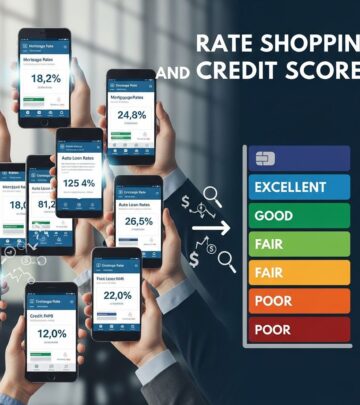
The relationship flows both ways: Strong scores secure lower rates initially. Lenders assess risk via scores—higher scores (740+) signal reliability, yielding prime terms. A 760 scorer might pay 0.5-1% less on a mortgage than a 650 holder, per industry data.
Improving scores before rates fall maximizes gains. For example, on a $300,000 30-year mortgage:
| Credit Score | Sample Rate (2026) | Monthly Payment | Total Interest Savings |
|---|---|---|---|
| 760+ | 5.5% | $1,703 | Baseline |
| 700-759 | 5.75% | $1,751 | $17,760 more |
| 660-699 | 6.25% | $1,847 | $51,360 more |
Source-derived estimates highlight score-rate sensitivity. Low rates amplify this: Better scores compound savings.
Strategic Actions to Capitalize on Low Rates
Lower rates offer a window for optimization:
- Refinance Variable Debts: Swap high-rate cards via balance transfers (0% intro APRs) or new low-APR cards.
- Pay Down Revolving Balances: Target utilization under 30%; aim for 10% or less for peak scores.
- Explore New Credit: Easier approvals with improved DTI; avoid hard inquiries by spacing applications.
- Build Emergency Funds: Interest savings bolster buffers, preventing future delinquencies.
- Monitor Reports: Free weekly checks via AnnualCreditReport.com ensure accuracy.
These steps turn macroeconomic shifts into personal credit wins without score risk.
Potential Pitfalls in a Low-Rate Environment
Optimism can breed overextension. Low rates tempt borrowing, inflating utilization if undisciplined. New debt inquiries (10% of scores) ding temporarily. Fixed-rate refinances lock in savings but weigh closing costs against benefits—break-even typically 2-3 years.
Market reversals loom: Rates could rise post-2026, hiking variable payments. Maintain flexibility with hybrid fixed-variable mixes.
FAQs: Lower Rates and Credit Scores
Do interest rate changes appear on my credit report?
No, reports omit rates, focusing on balances, payments, and limits.
Can lower rates improve my score overnight?
No direct effect; benefits accrue via payment/utilization improvements over 1-3 months.
How much does utilization matter?
30% of FICO; keep under 30% for optimal impact.
Should I refinance everything in low rates?
Only if costs align with long-term savings and credit health.
What’s the best score for lowest rates?
740+ unlocks prime terms across lenders.
Long-Term Financial Planning in Fluctuating Rate Cycles
Rate environments evolve—2026’s lows follow prior hikes. Diversify: Blend fixed protections with variable opportunities. Track Fed signals via official releases. Pair credit vigilance with budgeting tools for resilience.
Ultimately, low rates empower but demand discipline. Consistent habits—timely payments, low utilization—sustain scores regardless of macro trends, positioning you for any shift.
References
- Do Rising Interest Rates Affect Your Credit Score? — Experian. 2023-10-15. https://www.experian.com/blogs/ask-experian/do-rising-interest-rates-affect-credit-score/
- Does a Lower Interest Rate Affect Your Credit Score? — Experian. 2023-10-15. https://www.experian.com/blogs/ask-experian/do-lower-interest-rates-affect-your-credit-score/
- Current Mortgage Rates by Credit Score | 2026 — The Mortgage Reports. 2026-01-20. https://themortgagereports.com/87625/mortgage-rates-by-credit-score
- Does credit score affect mortgage rate? — Rocket Mortgage. 2025-11-10. https://www.rocketmortgage.com/learn/how-credit-score-affects-mortgage-rate
- Understanding Your Credit — Federal Trade Commission (FTC.gov). 2024-05-01. https://consumer.ftc.gov/articles/understanding-your-credit
Similar Articles








Read full bio of Sneha Tete