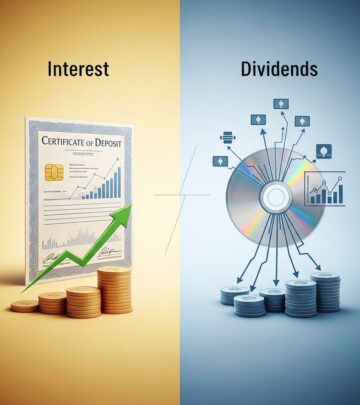
Undefined: Do CDs Compound Interest? 5 Ways To Boost Returns
Unlock the power of compound growth in certificates of deposit: explore how interest compounding boosts your savings over fixed terms.

Certificates of deposit (CDs) typically compound interest daily, allowing earnings to generate additional interest over the account’s term, which enhances overall returns compared to simple interest options. This feature makes CDs a compelling choice for savers seeking predictable growth on locked-in funds.
Understanding the Fundamentals of Certificates of Deposit
CDs represent time-bound savings vehicles issued by banks and credit unions, where depositors commit funds for a predetermined period in exchange for a fixed interest rate higher than standard savings accounts. Terms range from a few days to several years, with minimum deposits often starting at $1,000. Upon maturity, the principal plus accrued interest becomes accessible, though options like renewal exist.
The appeal lies in their security—backed by FDIC insurance up to $250,000 per depositor—and fixed rates that shield against market volatility. Unlike flexible savings accounts, CDs penalize early withdrawals to enforce the time commitment, typically deducting several months’ interest.
The Mechanics of Interest Compounding in CDs
Compounding refers to interest calculated not only on the initial principal but also on previously accumulated interest, creating exponential growth over time. In CDs, this process usually occurs daily, with credits applied monthly, quarterly, or at maturity, depending on the institution.
For instance, a $10,000 CD at 4% APY compounded daily over one year yields more than simple interest due to reinvestment of daily earnings. The formula for compound interest is A = P(1 + r/n)^(nt), where A is the amount, P principal, r annual rate, n compounding frequency, and t time in years. Daily compounding (n=365) maximizes this effect within fixed terms.
| Term Length | Typical Compounding | Interest Payment Frequency | Example Penalty for Early Withdrawal |
|---|---|---|---|
| <90 days | Daily | At maturity | 1 month’s interest |
| 3-12 months | Daily | Monthly/Quarterly | 3 months’ interest |
| 12-24 months | Daily | Monthly/Annually | 6 months’ interest |
| >24 months | Daily | Annually/At maturity | 12 months’ interest |
This table illustrates common structures; actual terms vary by provider.
Factors Influencing CD Rates and Compounding
CD rates are shaped by the Federal Funds Rate set by the Federal Reserve, market conditions, term length, and deposit size. Longer terms often command higher rates to compensate for opportunity costs, though promotional short-term CDs can outperform during rising rate environments.
- Federal Funds Rate Impact: Banks adjust CD offerings based on this benchmark, ensuring competitiveness.
- Term Length: Shorter terms may offer higher yields if rates are expected to rise.
- Deposit Minimums: Larger balances like $5,000+ unlock special rates.
- Institution Type: Online banks frequently provide superior APYs due to lower overhead.
As of early 2026, top rates hover around 4.10% APY for select terms, significantly outpacing traditional savings yields of 0.45%-0.75%.
Daily vs. Other Compounding Frequencies: A Comparison
While daily compounding is standard for CDs, variations exist. Daily method calculates interest on the evolving balance each day, credited periodically. Monthly compounding applies interest once per month, slightly reducing growth compared to daily.
Consider a $5,000 deposit at 3.5% over 12 months:
- Daily: Approximately $179.30 earned.
- Monthly: About $178.50 earned.
- Simple (no compounding): $175.00 earned.
The difference compounds over longer terms, underscoring daily’s advantage. Most providers like Wells Fargo specify daily compounding with flexible payout options.
Early Withdrawal Rules and Their Impact on Earnings
Accessing funds before maturity triggers penalties, eroding compounded gains. Regulation D imposes a 7-day simple interest penalty for very early withdrawals. Standard penalties scale with term length, potentially dipping into principal if interest accrued is insufficient.
Exceptions include no-penalty CDs or grace periods post-maturity (typically 7-10 days) for adjustments without fees. Planning around these is crucial for liquidity needs.
Strategies to Maximize Compounding Benefits
To leverage CD compounding effectively:
- Ladder CDs: Divide funds across staggered maturities (e.g., 3-month, 6-month, 1-year) for regular access and rate capturing.
- Shop Rates: Compare online via aggregators; current highs reach 4.20%.
- Renew Strategically: At maturity, evaluate new rates before auto-renewal at potentially lower standard APYs.
- Opt for Jumbo CDs: Balances over $100,000 may yield premiums, amplifying compounding.
- Combine with High-Yield Savings: Use CDs for locked portions, savings for emergencies.
These tactics balance growth and flexibility.
CDs vs. Alternatives: Where Compounding Shines
| Option | Typical APY (2026) | Compounding | Liquidity | Risk |
|---|---|---|---|---|
| Standard Savings | 0.45%-0.75% | Daily | High | Low |
| Money Market | 0.75%-2.5% | Daily/Monthly | Medium | Low |
| 1-Year CD | 3.60%-4.20% | Daily | Low | Low (FDIC) |
| High-Yield Savings | 4.0%+ | Daily | High | Low |
CDs excel in fixed-rate environments, their compounding outpacing variable-rate savings when locked in timely.
Tax Implications of CD Interest Earnings
Compounded interest in CDs is taxable annually as ordinary income, even if not withdrawn, per IRS rules. Form 1099-INT reports earnings; strategies like tax-advantaged accounts (e.g., IRAs) can defer this. Planning withdrawals around tax brackets optimizes net returns.
Current Market Trends in CD Offerings
In 2026, with stable Federal Funds Rates, CD APYs remain attractive at 3.6%-4.2% for terms under 12 months. Special promotional CDs demand higher minimums ($2,500-$5,000) but auto-renew at standard rates post-initial term. Online platforms like E*TRADE lead with competitive yields.
Frequently Asked Questions
Are all CDs compounded daily?
Most are, but confirm with the provider; daily compounding is prevalent for optimal growth.
What happens at CD maturity?
Funds plus interest are available; many auto-renew unless instructed otherwise during the grace period.
Can I add money to a CD after opening?
Typically no, except during grace periods for certain add-on CDs.
Are brokered CDs different?
Yes, they offer tradability but may lack FDIC pass-through and have variable penalties.
How do rising rates affect existing CDs?
Fixed rates protect earnings, but new CDs capture higher yields.
References
- How Do Certificates of Deposit Work? — Bank of Dudley. 2023. https://www.bankofdudley.com/how-do-certificates-of-deposit-work/
- Open a Certificate of Deposit (CD) Account Online — Wells Fargo. 2026-02-06. https://www.wellsfargo.com/savings-cds/certificate-of-deposit/
- What is a Certificate of Deposit (CD) & How Does It Work — Bank of America Better Money Habits. 2025. https://bettermoneyhabits.bankofamerica.com/en/personal-banking/what-is-a-cd-investment
- CD Accounts: Certificate of Deposit Options & Rates — PNC Bank. 2026. https://www.pnc.com/en/personal-banking/banking/savings/certificate-of-deposits.html
- Best CD Rates Of February 2026 — Bankrate. 2026-02-06. https://www.bankrate.com/banking/cds/cd-rates/
- How does a CD work? — Fidelity Investments. 2025. https://www.fidelity.com/learning-center/smart-money/how-does-a-cd-work
Similar Articles








Read full bio of medha deb