Dividend Discount Model: Valuing Stocks by Future Dividends
Master the dividend discount model to calculate intrinsic stock value and make informed investment decisions.

Understanding the Dividend Discount Model
The dividend discount model (DDM) is a fundamental approach in financial analysis that determines a company’s stock value based on the premise that a stock’s intrinsic value equals the present value of all its future dividend payments. This valuation method focuses on cash flows returned directly to shareholders through dividends, making it particularly useful for evaluating established companies with consistent dividend histories.
Investors and financial analysts rely on the DDM to identify whether a stock is overvalued or undervalued compared to its current market price. By calculating what future dividends are worth in today’s dollars, investors can make more informed decisions about whether to buy, hold, or sell specific stocks.
Core Principles of the Dividend Discount Model
The fundamental concept behind the DDM rests on a simple truth: the true value of owning a stock lies in the cash it will generate for shareholders over time. Unlike some valuation methods that focus on company profits or assets, the DDM zeroes in on the actual money returned to stockholders through dividend payments.
The model operates under several key assumptions:
– Investors receive periodic dividend payments that they can reinvest or use as income- Dividends are predictable or follow a discernible growth pattern- The discount rate accurately reflects the investor’s required return and investment risk- The company will continue paying dividends indefinitely
The Gordon Growth Model Formula
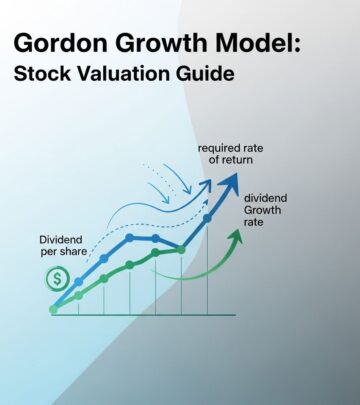
The most widely used version of the dividend discount model is the Gordon Growth Model (GGM), named after financial economist Myron Gordon. This constant-growth form of the DDM assumes that dividends grow at a steady, perpetual rate and applies the following formula:
P = D₁ / (r – g)
Where:
– P = Current stock price or intrinsic value- D₁ = Expected dividend per share in the next period- r = Required rate of return (cost of equity capital)- g = Constant growth rate of dividends in perpetuity
How the Dividend Discount Model Works
The DDM calculation process involves several steps. First, investors project future dividend payments based on historical patterns and company guidance. Second, they determine an appropriate discount rate that reflects both the time value of money and the investment risk. Third, they discount each projected dividend back to its present value. Finally, they sum all present values to arrive at the stock’s intrinsic value.
The underlying mathematics derives from the principle that a dollar received today is worth more than a dollar received in the future due to the opportunity to invest it elsewhere. By discounting future dividends, the model converts future cash flows into today’s purchasing power, enabling direct comparison with the stock’s current market price.
Understanding the Variables
The Dividend Yield Component: The dividend yield (D₁/P₀) represents the annual dividend payment divided by the current stock price. This metric tells investors what percentage return they receive from dividends alone.
The Growth Rate: The growth rate reflects expectations for how quickly dividends will increase annually. Conservative investors might use historical growth rates, while aggressive investors might project accelerated growth based on company prospects.
The Discount Rate: Also called the cost of equity capital, this rate represents the minimum return investors require to justify holding the stock rather than investing in alternative securities of similar risk.
Key Mathematical Relationships
An important relationship emerges from rearranging the Gordon Growth Model formula: when you add the dividend yield to the expected growth rate, you get the investor’s required rate of return. This can be expressed as:
Dividend Yield + Growth Rate = Required Return
Or: (D₁/P₀) + g = r
This relationship illustrates that total stock returns consist of two components: income from dividends and capital appreciation from price growth. Understanding this breakdown helps investors evaluate whether a stock offers an attractive total return relative to its risk.
Special Cases and Applications
Zero Growth Scenario: When dividends are not expected to grow (g = 0), the formula simplifies to a dividend capitalization model. In this case, P = D₁ / r, meaning the stock value equals the annual dividend divided by the required return rate. This approach works well for mature, stable companies in declining industries.
Two-Stage Model: Real-world analysis often recognizes that growth rates change over time. When a company is expected to experience high growth in the short term before settling into a lower, perpetual growth rate, analysts employ a two-stage DDM. This model values the company as the sum of dividends during the high-growth period plus the terminal value after growth stabilizes.
Multi-Stage Models: For companies with complex growth trajectories, more sophisticated multi-stage models divide the forecast period into several phases, each with different growth assumptions, before calculating a terminal value.
Total Return Analysis
The DDM provides insight into how stock returns are composed. An investor’s total return from holding a stock equals the dividend income received plus any capital appreciation (or loss) from price changes. By understanding this decomposition, investors can evaluate whether they are being adequately compensated for the risks they assume.
For example, a stock yielding 3% in dividends with 5% expected capital appreciation offers a 8% total return. The DDM framework helps investors determine whether this total return justifies the investment risk.
Limitations and Challenges of the DDM
Non-Dividend Paying Stocks: A critical limitation of the basic DDM is its inability to value stocks that do not pay dividends. Many high-growth companies reinvest all earnings rather than paying dividends. In such cases, modified approaches using earnings per share (EPS) instead of dividends may be employed, though this introduces different assumptions about capital allocation efficiency.
Growth Rate Sensitivity: The model’s valuations prove highly sensitive to the assumed growth rate. Small changes in the growth rate assumption can dramatically alter the calculated intrinsic value. This sensitivity requires careful, realistic growth rate estimates based on industry analysis and company fundamentals.
Perpetual Growth Assumption: The standard DDM assumes dividends grow at a constant rate forever. This assumption becomes questionable for companies in declining industries or those facing long-term structural challenges. No company can maintain constant growth indefinitely due to market saturation and competitive pressures.
Discount Rate Determination: Accurately estimating the required rate of return presents significant challenges. Small errors in this critical variable substantially affect valuations. Investors must carefully consider company risk, market conditions, and alternative investment opportunities.
Strengths of the Dividend Discount Model
Despite its limitations, the DDM offers several advantages. It grounds valuation in actual cash returned to shareholders, making it theoretically sound. For dividend-paying companies with stable business models, it provides straightforward, defensible valuations. The model also clearly highlights the relationship between dividends, growth, and required returns, facilitating better investor understanding of value drivers.
Comparing the DDM to Other Valuation Methods
| Valuation Method | Best For | Key Limitation |
|---|---|---|
| Dividend Discount Model | Established dividend-paying companies | Doesn’t work for non-payers |
| Discounted Cash Flow | Any company with predictable cash flows | Requires detailed projections |
| Price-to-Earnings Ratio | Quick comparative valuation | Doesn’t account for growth |
| Asset-Based Valuation | Capital-intensive businesses | Ignores earning power |
Practical Examples of DDM Application
Example 1 – Stable Utility Stock: Consider a utility company paying an annual dividend of $3.00 per share with a historical growth rate of 2% annually. If the required return is 8%, the intrinsic value would be $3.06 / (0.08 – 0.02) = $51 per share. If the stock trades below this price, it may represent an attractive value opportunity.
Example 2 – Growing Dividend Stock: A consumer staples company might pay a $2.50 dividend with 5% expected growth and an 10% required return. The calculation yields $2.625 / (0.10 – 0.05) = $52.50 per share. This higher valuation reflects the stronger growth expectations.
Modern Applications and Alternatives
Contemporary financial analysis often uses the DDM in conjunction with other valuation approaches. The discounted cash flow (DCF) method extends the concept beyond just dividends to include all cash flows available to shareholders, including both dividends and retained earnings used for buybacks or reinvestment. This provides a more comprehensive valuation that captures all shareholder returns.
Many institutional investors employ dividend discount models as one input among several valuation tools, cross-checking results against relative valuation metrics like price-to-earnings multiples and price-to-book ratios to triangulate fair value estimates.
Frequently Asked Questions
Q: What is the main advantage of using the dividend discount model?
A: The DDM’s primary advantage is its theoretical soundness—it values stocks based on actual cash returned to shareholders, making it particularly reliable for mature, dividend-paying companies with stable business models.
Q: Can I use the DDM to value growth stocks that don’t pay dividends?
A: The basic DDM cannot directly value non-dividend payers. However, analysts sometimes substitute earnings per share for dividends, assuming companies that reinvest earnings will eventually create shareholder value, though this requires careful consideration of capital allocation efficiency.
Q: How sensitive is the DDM to changes in the growth rate assumption?
A: The model is highly sensitive to growth rate assumptions. Small percentage changes in the assumed perpetual growth rate can significantly alter the calculated intrinsic value, sometimes by 20-30%, making accurate growth forecasting critical.
Q: What discount rate should I use in the Gordon Growth Model?
A: The discount rate should reflect your required return based on the stock’s risk level relative to alternatives. This typically ranges from the risk-free rate plus a risk premium that varies by company and industry.
Q: How does the DDM compare to the P/E ratio approach?
A: The DDM provides a fundamental, bottom-up valuation based on expected cash flows, while P/E ratios offer quick comparative valuations. The DDM is more theoretically rigorous but requires more inputs, whereas P/E ratios are simpler but lack growth expectations.
Q: What is the difference between the Gordon Growth Model and a two-stage DDM?
A: The Gordon Growth Model assumes constant growth forever, while the two-stage DDM recognizes that companies typically experience different growth phases—high growth initially, then stabilization—and values each phase separately.
References
- Dividend Discount Model — Wikipedia. Retrieved from https://en.wikipedia.org/wiki/Dividend_discount_model
- Gordon Growth Model: Basics and Formula — Corporate Finance Institute. https://corporatefinanceinstitute.com/resources/valuation/gordon-growth-model/
- Discounted Cash Flow Analysis — U.S. Securities and Exchange Commission. https://www.sec.gov/
Similar Articles








Read full bio of medha deb