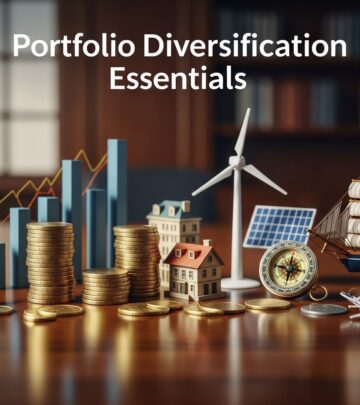
Diversification in Investing
Learn how spreading investments across assets reduces risk and boosts long-term portfolio stability for smarter wealth building.

Spreading investments across various assets is a proven method to shield wealth from market turbulence while pursuing steady growth. This approach counters the dangers of concentrating funds in one area, ensuring no single setback derails financial objectives.
Understanding the Core Principles of Portfolio Spread
Diversification means allocating capital to a range of investments that respond differently to economic shifts. Instead of betting everything on one stock or sector, investors blend equities, fixed income, and alternatives to balance potential losses with gains elsewhere. This strategy hinges on the fact that asset classes rarely move in unison, providing a natural buffer during downturns.
Historical data shows diversified holdings often outperform concentrated ones over time by limiting severe drops. For instance, during economic crises, while some markets plummet, others stabilize or rise, preserving overall value. The key is selecting assets with low correlation—their performance patterns diverge enough to offset volatility.
Key Advantages of Adopting a Diversified Approach
Implementing diversification yields multiple benefits that enhance portfolio health.
- Lower Overall Volatility: By mixing assets, sharp declines in one area get cushioned by steadier performers, creating a smoother growth trajectory suitable for long-term savers.
- Enhanced Return Potential: Exposure to high-growth sectors alongside stable ones allows capturing upside from various market cycles without excessive risk.
- Improved Risk-Adjusted Performance: Metrics like the Sharpe ratio improve as returns rise relative to volatility, making the strategy efficient for goal-oriented investing.
- Psychological Comfort: Reduced extreme swings help investors stay committed during uncertainty, avoiding panic-driven decisions that harm returns.
- Broader Opportunity Access: Global and sectoral variety uncovers emerging trends missed by narrow portfolios.
These advantages compound over decades, turning modest contributions into substantial wealth through disciplined allocation.
How Diversification Counters Specific Investment Risks
Markets face systematic threats like recessions and idiosyncratic ones like company failures. Diversification tackles both by dispersing exposure. Systematic risk affects broad categories, but blending stocks and bonds mitigates this—bonds often gain when equities falter due to shifting investor preferences for safety.
Idiosyncratic risk, tied to individual holdings, diminishes with scale. Owning hundreds of securities via funds slashes the impact of any single flop. Data from past crises illustrates this: undiversified stock-heavy portfolios lost over 50% in downturns, while balanced mixes dropped under 30%, recovering faster.
| Portfolio Type | Max Drawdown (Crisis Period) | Recovery Time |
|---|---|---|
| All-Stock | -55% | 4+ Years |
| Diversified (70% Stock, 25% Bond, 5% Cash) | -28% | 2 Years |
| All-Cash | -0% | N/A (No Growth) |
This table highlights how balance preserves capital and accelerates rebound.
Essential Strategies for Effective Asset Allocation
Achieving diversification requires intentional steps across multiple dimensions.
Across Asset Classes
Core holdings include stocks for growth, bonds for income and stability, and cash equivalents for liquidity. Stocks capture economic expansion, bonds provide ballast via interest payments, and alternatives like real estate add uncorrelated returns. A typical mix might allocate 60% equities, 30% fixed income, and 10% others, adjusted for age and risk appetite.
Within Equities: Size, Style, and Sector Balance
Equities diversify by company size—large-cap for reliability, small-cap for vigor—and style: growth for innovation, value for undervalued assets. Sectors matter too; technology surges in booms, while utilities endure recessions. Aim for exposure to at least 10 industries to avoid sector-specific slumps.
Geographic Expansion
U.S. markets represent under half of global equity value, so international stocks tap diverse economies. Emerging markets offer high growth potential, developed ones add stability. Currency fluctuations introduce extra layers, but hedging tools manage this.
Incorporating Fixed Income Variety
Bonds span government treasuries (safest), corporates (higher yield), municipals (tax advantages), and high-yield (riskier). Shorter maturities reduce interest rate sensitivity, while longer ones boost income in low-rate eras.
Practical Tools and Vehicles for Diversification
Individual stock picking demands expertise and time; funds simplify the process.
- Index Mutual Funds and ETFs: Track broad indices like S&P 500 for instant equity spread, or total bond market funds for fixed income.
- Target-Date Funds: Auto-adjust allocation based on retirement timeline, gliding toward conservatism.
- Thematic ETFs: Sector or theme-focused, like clean energy, for targeted diversification without overconcentration.
- Robo-Advisors: Algorithm-driven platforms customize portfolios at low cost, rebalancing automatically.
These vehicles lower barriers, enabling even novices to build robust portfolios with minimal fees.
The Role of Rebalancing in Sustaining Diversification
Markets shift allocations over time—winning assets grow disproportionately. Annual or threshold-based rebalancing (e.g., when any class deviates 5%) restores targets, enforcing “sell high, buy low.” This discipline boosts returns by 0.5-1% annually per studies, without increasing risk.
For example, post-bull market, stocks might hit 75% from a 60% target; selling some to buy bonds locks gains and repositions for recovery.
Navigating Common Diversification Pitfalls
Even strong strategies falter without vigilance.
- Over-Diversification: Too many holdings dilute returns, mimicking cash with high fees.
- Home Bias: Favoring domestic assets ignores global chances; limit U.S. equities to 70% max.
- Style Drift: Chasing hot trends unbalances portfolios; stick to plans.
- Ignoring Correlations: Assets like junk bonds mimic stocks in crashes, offering false security.
Regular reviews with advisors prevent these errors.
Tailoring Diversification to Personal Circumstances
No universal mix fits all; factors dictate adjustments.
| Investor Profile | Equity % | Bond % | Alternatives % |
|---|---|---|---|
| Young Aggressive | 80-90% | 10-15% | 5% |
| Mid-Career Balanced | 60-70% | 25-35% | 5-10% |
| Near-Retiree Conservative | 40-50% | 45-55% | 5% |
Time horizon, income needs, and tolerance shape these. Tax considerations favor accounts like Roth IRAs for high-growth assets.
Real-World Evidence of Diversification Success
From 2008 financial crisis to COVID volatility, diversified portfolios demonstrated resilience. A 70/25/5 stock/bond/cash mix lost far less than pure equities, capturing most rebounds while cash lagged entirely. Long-term, such strategies align with reaching milestones like retirement funding.
Frequently Asked Questions
What is the ideal number of stocks for diversification?
20-30 stocks reduce most idiosyncratic risk, but funds achieve this with one purchase for broader coverage.
Does diversification guarantee profits?
No, it manages risk but can’t eliminate market losses; it improves odds of positive outcomes.
How often should I rebalance?
Yearly or when allocations shift 5-10%, balancing discipline with transaction costs.
Can I over-diversify?
Yes, excessive holdings raise fees without added benefit; focus on quality over quantity.
Is international diversification still relevant?
Absolutely, as non-U.S. markets offer unique growth decoupled from domestic cycles.
Steps to Implement Diversification Today
- Assess goals, timeline, and risk comfort.
- Choose core asset classes and targets.
- Select low-cost funds/ETFs.
- Fund and automate contributions.
- Schedule annual check-ups.
Starting small builds habits leading to substantial security.
References
- Guide to Diversification — Fidelity. 2023. https://www.fidelity.com/viewpoints/investing-ideas/guide-to-diversification
- Portfolio Diversification: What It Is and How It Works — Vanguard. 2025. https://investor.vanguard.com/investor-resources-education/portfolio-management/diversifying-your-portfolio
- Diversification in Investing May Reduce Risk — U.S. Bank. 2024. https://www.usbank.com/investing/financial-perspectives/investing-insights/diversification-important-in-investing-because.html
- 3 Reasons to Consider Portfolio Diversification — Comerica. 2023. https://www.comerica.com/insights/personal-finance/3-reasons-to-consider-portfolio-diversification.html
- Diversifying Investments for the Long Run — BlackRock. 2024. https://www.blackrock.com/americas-offshore/en/education/portfolio-construction/diversifying-investments
Similar Articles








Read full bio of medha deb