6 Famous Discontinued U.S. Currency Denominations
Explore rare and discontinued U.S. currency denominations that shaped American financial history.
6 Famous Discontinued and Uncommon U.S. Currency Denominations
The history of U.S. currency reflects the evolving needs of the American economy and society. Throughout the nation’s financial journey, numerous currency denominations have been introduced and subsequently discontinued. Understanding these discontinued denominations provides valuable insights into monetary policy, economic decisions, and the practical challenges of maintaining an efficient circulating currency system. From high-value bills that have largely disappeared from everyday transactions to obscure coins that never gained public acceptance, the story of U.S. currency is filled with fascinating examples of monetary experimentation.
This article explores six of the most famous and notable discontinued U.S. currency denominations, examining why they were created, how they functioned, and ultimately why they were removed from circulation. Whether you’re a history enthusiast, collector, or simply curious about the evolution of money in America, these denominations tell compelling stories about economic necessity, financial innovation, and the practical realities of currency management.
Understanding Currency Discontinuation
Before delving into specific denominations, it’s important to understand why currency denominations become obsolete. The Federal Reserve and the U.S. Department of the Treasury continuously evaluate the effectiveness of circulating currency. Denominations may be discontinued due to lack of public demand, economic inefficiency, redundancy with other denominations, or shifts in commercial practices. Some coins and bills were experimental in nature, created to address specific economic conditions that later changed or resolved. Others simply failed to gain acceptance among the public, becoming collector’s items rather than functional currency.
High-Denomination Paper Currency: The $500, $1,000, $5,000, and $10,000 Bills
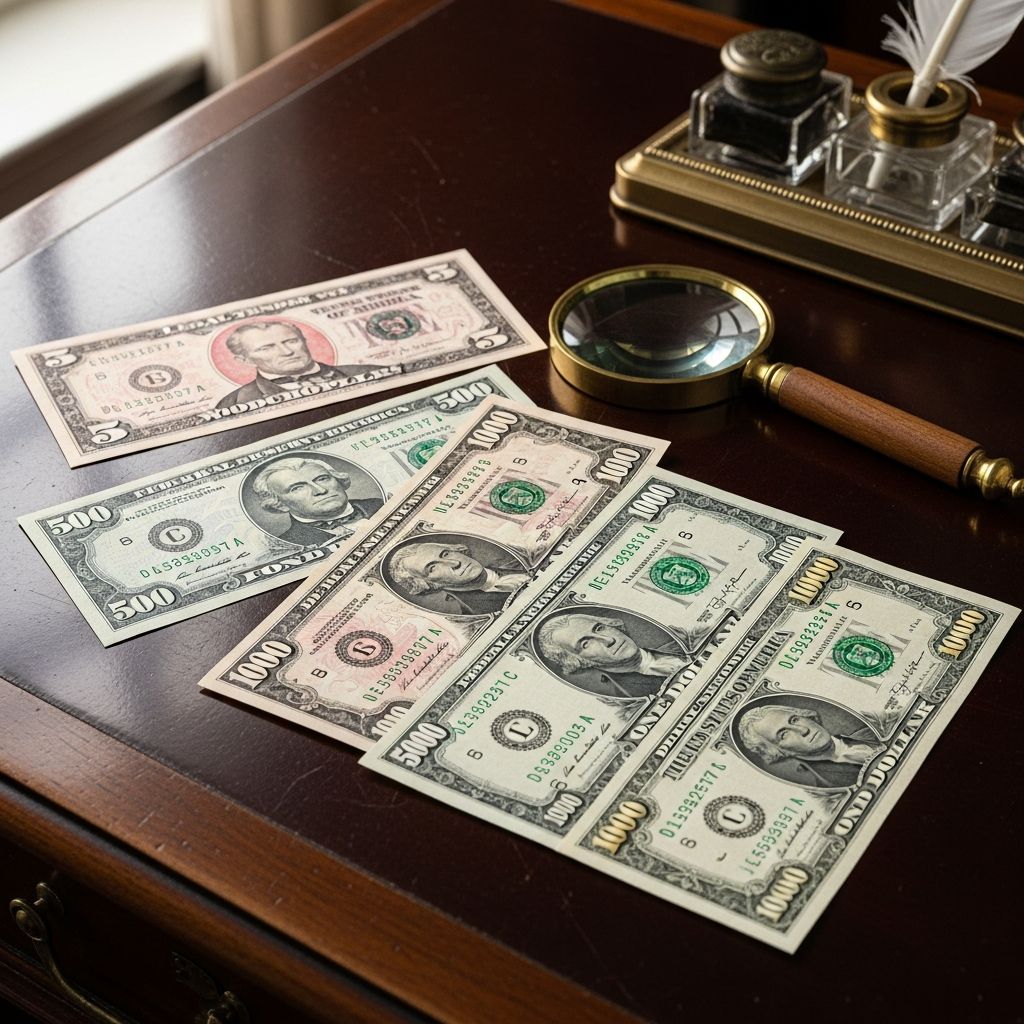
Among the most significant discontinued currency denominations are the high-value bills that once circulated in the United States. The U.S. government issued banknotes in denominations of $500, $1,000, $5,000, and $10,000, all of which were last printed in 1945. These high-denomination bills remained in circulation until they were officially discontinued on July 14, 1969, when the Federal Reserve and the U.S. Department of the Treasury announced their removal from active circulation.
These bills were primarily used for large financial transactions between banks and major commercial entities rather than for everyday consumer purchases. The $500 bill featured President William McKinley on its obverse, while the $1,000 bill displayed President Grover Cleveland. The $5,000 bill featured President James Madison, and the $10,000 bill showcased President Salmon Chase. Despite their historical significance, these denominations proved impractical for modern commerce. The decision to discontinue them reflected the growing use of electronic transfers and checks for large transactions, making physical high-denomination currency unnecessary. Interestingly, these bills remain legal tender and can be exchanged at banks, though they are rarely seen in circulation and are highly sought after by collectors.
The Half-Cent Coin: America’s Smallest Denomination
The half-cent coin holds the distinction of being the smallest denomination coin ever minted by the United States. First authorized under the Coinage Act of 1792, half-cent coins were issued from 1793 to 1857, representing a remarkable span of over six decades in American monetary history. These coins were composed of 100% copper and were significantly smaller than modern coins, measuring only 22 to 23 millimeters in diameter—slightly smaller than a modern quarter.
The half-cent was created to facilitate commerce in an era when the U.S. dollar held much greater purchasing power than it does today. A half-cent in the early 19th century represented a meaningful sum for everyday transactions. However, as inflation gradually eroded the value of small denominations and commerce patterns changed, the half-cent became increasingly impractical. By the mid-19th century, the coin had largely fallen out of favor with the public, and production was discontinued in 1857. Today, half-cent coins are prized by numismatists and collectors, commanding prices ranging from modest amounts for worn specimens to thousands of dollars for rare, well-preserved examples.
The Two-Cent Coin: A Brief and Unsuccessful Experiment
The two-cent piece represents one of the shortest-lived denominations in U.S. currency history, being issued only from 1864 to 1873. Despite this brief nine-year period of production, the two-cent coin carries significant historical importance. These coins were notable for being the first U.S. coins to feature the motto “In God We Trust” on their face. The addition of this religious motto was prompted by the surge in religious sentiment during the American Civil War, with many Americans seeking spiritual reassurance during the conflict’s turbulent years.
The two-cent coin’s introduction came during a period of Civil War inflation and currency disruption. However, the denomination quickly proved unpopular with the general public. Mintage figures declined sharply over the nine-year production period, as most people preferred using Indian Head cents for small transactions rather than adopting this odd denomination. The design featured a shield on the reverse and was struck primarily at the Philadelphia Mint, similar to the half-cent coins produced there decades earlier. Despite its failure as circulating currency, the two-cent piece has become a favorite among collectors, particularly those interested in Civil War-era coinage and the historical development of U.S. mottoes on currency.
The Twenty-Cent Silver Piece: A Design Disaster
The twenty-cent silver piece stands as perhaps the most infamous coinage blunder in American numismatic history. Issued only from 1875 to 1878, this denomination was created to address a specific regional economic need but failed to gain national acceptance. The coin featured a Liberty Seated design—a woman seated and holding a pole in one hand while grasping a shield emblazoned with “Liberty” in the other—identical to designs on other silver coins circulating at the time.
The primary problem with the twenty-cent piece was its confusing similarity to other silver denominations. The design was so similar to existing quarter and dime designs that it caused widespread confusion in commerce, with merchants and customers frequently mistaking it for other coins. Senator John P. Jones of Nevada introduced the legislation that created this denomination, originally intended to address a shortage of silver coinage in western states like Nevada. However, the eastern states had no use for the denomination, and even in Nevada, two silver dimes accomplished the same purpose more efficiently. As a result, a bill calling for the abolishment of the twenty-cent piece was introduced in 1876 and became law in 1878.
The coin’s circulation was extremely limited. It was only issued for circulation during 1875 and 1876, while only Proof versions were struck in 1877 and 1878. Notably, the twenty-cent piece produced at the Carson City Mint in 1876 (the 1876-CC) has become one of the great rarities of American coinage. Although 10,000 were originally minted, all but approximately 20 coins were destroyed, making surviving examples extraordinarily valuable. Today, these rare specimens command impressive prices, ranging from $270,000 in MS60 grade to over $1,000,000 for top-grade MS66 examples.
Gold Dollar Coins and Later Dollar Denominations
Gold dollar coins represented an important segment of U.S. currency throughout the 19th century, minted from 1849 to 1889. These coins served as a bridge between smaller silver coins and larger currency denominations, filling an important niche in commercial transactions. However, as economic conditions changed and paper currency became more prevalent, the utility of gold dollar coins diminished.
Following the era of gold dollar coins, the U.S. Mint attempted to introduce modern dollar denominations through the Eisenhower dollar (1971-1978) and the Susan B. Anthony dollar (1979-1981). The Eisenhower dollar was created to commemorate the Apollo 11 moon landing and was one of the largest circulating U.S. coins. The Susan B. Anthony dollar, minted a decade later, was intended to provide a coin-based alternative to the paper dollar bill. However, both of these modern dollar coins were eventually phased out due to lack of public acceptance and the continued preference for paper currency for dollar transactions. Despite their discontinuation from regular circulation, these dollar coins remain legal tender and are still produced in limited quantities for collector sets.
Other Notable Discontinued Denominations
Beyond the primary denominations discussed above, U.S. currency history includes numerous other discontinued and uncommon denominations. These include silver three-cent pieces, which circulated during the 19th century but were ultimately made obsolete by other denominations. Half dimes, also known as “half dimes,” represented another unusual denomination that failed to achieve lasting popularity. Various gold coins in denominations of $2.50 (quarter eagle) and $3 were also produced in limited quantities before being discontinued.
The U.S. Mint also proposed several denominations that were never actually minted or released into circulation. These include a three-dollar bill, which was proposed twice during the 1860s, with designs engraved for a potential $3 United States Note and a call for a $3 National Bank Note in 1865, though neither came to fruition. Such proposals demonstrate the experimental nature of U.S. monetary policy and the willingness of policymakers to consider unconventional denominations when addressing perceived economic needs.
Why Denominations Are Discontinued
Several factors typically lead to the discontinuation of currency denominations. Lack of public demand is perhaps the most common reason—if people simply don’t use a particular denomination in their daily transactions, it becomes economically inefficient to continue producing it. Redundancy with other denominations can also lead to discontinuation, as was the case with the twenty-cent piece, which duplicated the functionality of existing dimes and quarters. Economic shifts and changes in commerce patterns influence decisions about which denominations remain relevant. The shift from cash-based to check-based and later electronic transactions reduced the need for many physical denominations.
Additionally, some denominations are discontinued due to counterfeiting concerns or security improvements in currency design. The high-denomination bills discontinued in 1969 were partly phased out to combat money laundering and criminal activities that could exploit large amounts of untraceable cash. Modern monetary policy also plays a role, as central banks seek to maintain optimal inflation levels and control money supply more effectively through electronic means rather than physical currency.
Collector Value of Discontinued Currency
While discontinued denominations no longer circulate in everyday commerce, many have become highly valuable to collectors and numismatists. Factors affecting collector value include rarity, condition, mint marks, historical significance, and demand among collectors. A well-preserved half-cent from the early 19th century, for example, can be worth hundreds or even thousands of dollars, far exceeding its original face value. Similarly, rare specimens of the twenty-cent piece have become museum-quality pieces worth hundreds of thousands of dollars.
The high-denomination bills discontinued in 1969 have also become collectible items. Their rarity increases their value substantially above face value, with particularly well-preserved examples commanding premium prices at auctions. For serious collectors, these discontinued denominations represent not merely currency but pieces of American history and monetary evolution.
Frequently Asked Questions
Q: Are discontinued U.S. currency denominations still legal tender?
A: Yes, most discontinued denominations remain legal tender and can be exchanged at banks. However, extremely rare or historically significant pieces are typically valued by collectors at prices far exceeding face value and are rarely exchanged for their nominal worth.
Q: Why did the U.S. government discontinue high-denomination bills in 1969?
A: The $500, $1,000, $5,000, and $10,000 bills were discontinued partly to combat money laundering and criminal activities that exploited large amounts of untraceable cash. Additionally, the shift to electronic banking and checks for large transactions made physical high-denomination currency obsolete.
Q: Which discontinued U.S. coin is most valuable today?
A: The 1876-CC twenty-cent piece is among the most valuable, with rare examples worth over $1,000,000. However, certain early half-cent coins and other rare specimens also command exceptional prices depending on condition and rarity.
Q: What makes the two-cent piece historically significant?
A: The two-cent piece was the first U.S. coin to feature the motto “In God We Trust,” added during the Civil War due to increased religious sentiment. This motto later appeared on all U.S. currency.
Q: Can I still spend discontinued currency denominations?
A: Yes, discontinued denominations remain legal tender. However, most retailers and businesses will not be familiar with them. The best approach is to exchange them at your bank. Rare specimens should be valued by collectors rather than spent at face value.
Q: Why was the twenty-cent piece considered a design disaster?
A: The twenty-cent piece’s design was identical to other silver coins circulating at the time, causing widespread confusion and mistaken identity in commerce. Additionally, it was redundant with existing dimes and quarters, serving no unique economic purpose.
Conclusion
The history of discontinued U.S. currency denominations reflects the dynamic evolution of American monetary policy and commerce. From the practical difficulties of maintaining small denominations like the half-cent to the regional economic considerations behind the twenty-cent piece, each discontinued denomination tells a unique story. The removal of high-denomination bills in 1969 marks a significant shift toward modern banking practices and electronic transactions. Today, these discontinued denominations serve as fascinating windows into American economic history, valued by collectors and historians alike for their historical significance and rarity. As the U.S. monetary system continues to evolve, the lessons learned from discontinued denominations inform current decisions about currency design and circulation, ensuring that the nation’s money supply remains efficient, practical, and adapted to contemporary economic needs.
References
- Discontinued U.S. Currency: Rare Bills & Coins Explained — Tickeron. 2025. https://tickeron.com/trading-investing-101/what-are-the-discontinued-and-uncommon-us-currency-denominations/
- Canceled Denominations of United States Currency — Wikipedia. Accessed November 2025. https://en.wikipedia.org/wiki/Canceled_denominations_of_United_States_currency
- Discontinued US Currency Denominations — Bullion Shark. 2025. https://bullionsharks.com/blog/us-currency-denominations/
- History of U.S. Currency — U.S. Bureau of Engraving and Printing. 2025. https://www.uscurrency.gov/history
- 5 Forms of U.S. Currency That Are No Longer in Use — History Facts. 2025. https://historyfacts.com/us-history/article/5-forms-of-u-s-currency-that-are-no-longer-in-use/
- Obsolete Denominations of United States Currency — Wikipedia. Accessed November 2025. https://en.wikipedia.org/wiki/Obsolete_denominations_of_United_States_currency
- Discontinuation of U.S. Circulating Coins: Selected Examples — U.S. Congress, Congressional Research Service. https://www.congress.gov/crs-product/IF13063
Similar Articles








Read full bio of Sneha Tete