Direct Loan Consolidation: Benefits and Drawbacks
Explore how consolidating federal student loans into one payment simplifies finances but may extend repayment and reset key timelines.
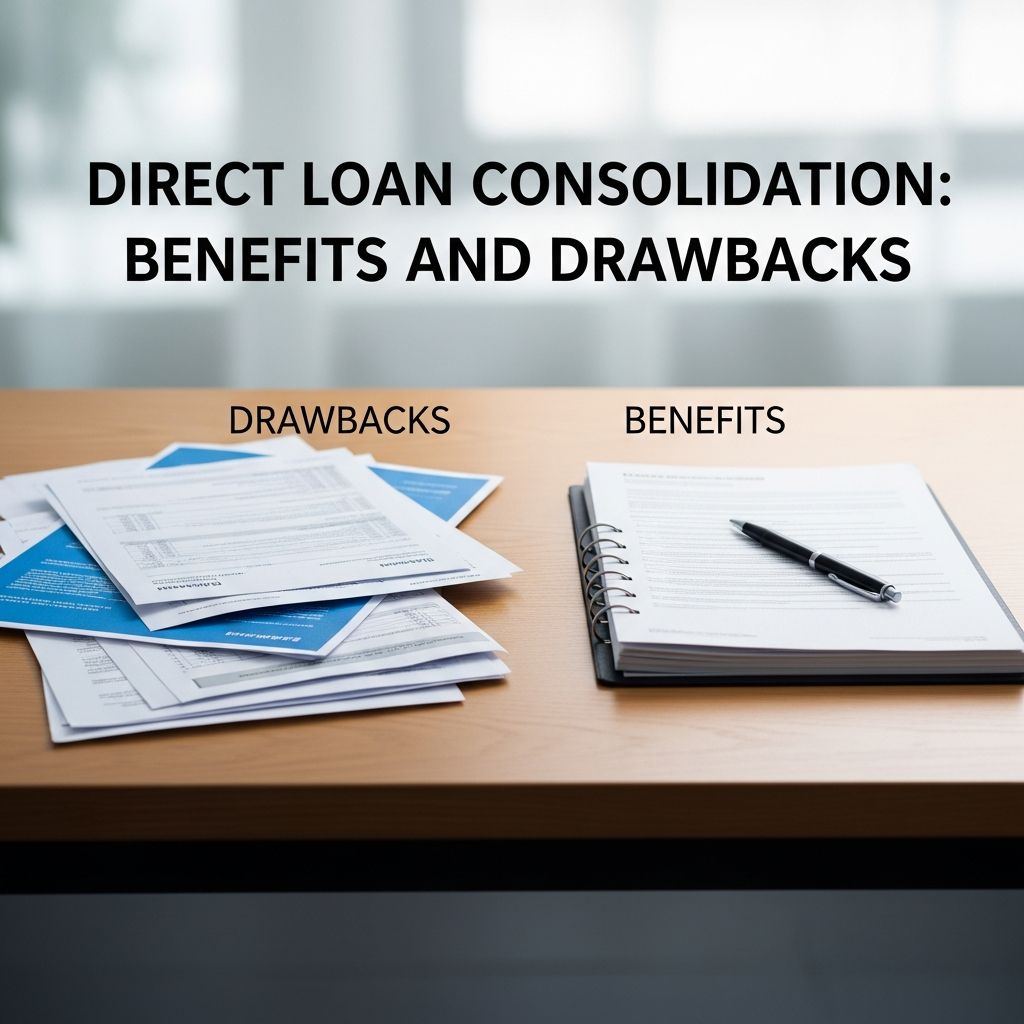
Direct Loan Consolidation enables federal student loan borrowers to combine multiple loans into a single monthly payment, streamlining debt management without altering the total principal owed. This process, governed by federal regulations, offers fixed interest rates based on a weighted average of existing loans and access to various repayment options.
Understanding the Core Mechanics of Consolidation
A Direct Consolidation Loan replaces individual federal education loans with one new Direct Loan from the U.S. Department of Education. The new loan pays off the principal and accrued interest on the selected loans, discharging them while establishing fresh terms for repayment. Eligible loans include Direct Subsidized and Unsubsidized Loans, Federal Stafford Loans, PLUS Loans, Perkins Loans, and others, provided they meet specific status requirements.
The interest rate for the consolidated loan calculates as the weighted average of the included loans’ rates, rounded up to the nearest one-eighth of one percent. This ensures predictability but does not lower costs inherently. Loan terms extend up to 30 years, depending on the chosen repayment plan and total debt amount.
Eligibility Criteria for Borrowers
To qualify, borrowers must hold eligible federal loans in good standing, repayment, grace period, or specific default scenarios. Defaulted loans can consolidate if the borrower makes three consecutive on-time payments or commits to an income-driven repayment plan.
- Federal loans only: Private loans cannot participate.
- Status requirements: Loans in active repayment, grace, or deferment qualify; those in default need rehabilitation steps.
- Restrictions on mixing: Student borrowers cannot consolidate parent PLUS loans with their own, though parents may include their PLUS loans with personal federal debt.
- Repeat consolidation: Existing consolidated loans require adding new eligible loans to re-consolidate.
Borrowers enter personal details, select loans, and choose servicers during application. Grace period loans can delay processing if specified.
Step-by-Step Application Process
Applying occurs online via StudentAid.gov or by paper form, typically taking under 30 minutes. Gather FSA ID, contact information, income details, and loan specifics beforehand.
- Prepare documentation: Review statements to identify loans for inclusion, noting grace periods.
- Submit application: Enter personal data, select loans, choose a servicer, and pick a repayment plan.
- Servicer review: The assigned servicer verifies eligibility, confirms payoff amounts with holders (within 10 days), pays off old loans, and activates the new loan.
- Continue payments: Keep paying existing loans until notified of payoff to avoid delinquency.
- NSLDS update: Old loans report as paid via consolidation.
Post-consolidation, the servicer handles billing, offering plan adjustments as needed.
Key Advantages of Consolidating Loans
Simplification stands out as the primary benefit, reducing multiple payments to one and potentially qualifying for enhanced repayment options.
| Advantage | Description | Impact |
|---|---|---|
| Single Payment | Combines loans into one bill from one servicer. | Reduces administrative burden and late payment risks. |
| Repayment Plan Access | Opens income-driven plans, even for defaulted loans. | Lowers monthly amounts based on income; aids PSLF eligibility. |
| Fixed Rate Conversion | Transforms variable rates to fixed. | Provides payment stability amid rate fluctuations. |
| Forgiveness Pathways | Makes non-Direct loans (e.g., Perkins) PSLF-eligible. | Supports public service workers pursuing forgiveness. |
| Default Rehabilitation | Consolidates defaulted loans under conditions. | Restores good standing and credit health. |
These features particularly benefit borrowers juggling numerous loans or seeking forgiveness programs.
Potential Downsides and Risks
While convenient, consolidation introduces trade-offs, notably in cost and timelines.
- Extended Repayment: Longer terms (10-30 years) reduce monthly payments but increase total interest paid.
- Interest Rate Rounding: Weighted average rounds up, potentially raising the effective rate slightly.
- Forgiveness Clock Reset: New loan restarts payment counts for programs like PSLF, losing prior progress on underlying loans.
- Lost Borrower Benefits: Subsidized portions may lose interest subsidies; Perkins loan forgiveness vanishes.
- No Principal Reduction: Total debt remains unchanged, focusing only on restructuring.
Borrowers must weigh these against simplification needs, especially if near forgiveness thresholds.
Available Repayment Options Post-Consolidation
New loans access standard federal plans:
- Standard: Fixed payments over 10-30 years based on amount.
- Graduated: Increasing payments starting low.
- Extended: Lower payments over 25 years for large balances.
- Income-Driven (IDR): Plans like SAVE, PAYE cap payments at income percentage, forgive remainder after 20-25 years; essential for default rehab.
PSLF requires 120 qualifying payments under IDR while employed full-time in public service; consolidation ensures eligibility.
Ideal Scenarios for Consolidation
Consider consolidation if:
- Multiple servicers complicate tracking.
- Default looms, needing IDR access.
- Non-Direct loans block PSLF pursuit.
- Variable rates create uncertainty.
Avoid if close to forgiveness on original loans or preferring shorter repayment to minimize interest.
Frequently Asked Questions
Does consolidation lower my interest rate?
No, the new rate is a weighted average of old rates, rounded up—no reduction occurs.
Can I consolidate during grace period?
Yes, but specify end date to delay; otherwise, repayment starts immediately.
Is there a fee to consolidate?
No application or processing fees apply.
How long until consolidation completes?
Servicers process within weeks; continue old payments until confirmation.
Can parents consolidate with child loans?
No for child; parents can consolidate their PLUS with own loans.
Strategic Tips Before Applying
Review NSLDS for all loans. Simulate payments via StudentAid.gov calculator. Consult servicers on forgiveness impacts. If PSLF-bound, verify qualifying employer. For large debts, model IDR scenarios against standard plans.
Consolidation suits organization over savings; pair with budgeting for optimal results.
References
- Direct Loan Consolidation Process at Catholic Law — Catholic University of America. Accessed 2026. https://www.law.edu/admissions/financial-aid/graduation-and-post-graduation/consolidationprocess.html
- 34 CFR § 685.220 – Consolidation — U.S. Government Publishing Office via Cornell Law. Current as of 2026. https://www.law.cornell.edu/cfr/text/34/685.220
- Pros and Cons of a Direct Loan Consolidation — Experian. Accessed 2026. https://www.experian.com/blogs/ask-experian/pros-and-cons-direct-loan-consolidation/
- What Is a Direct Consolidation Loan? — SoFi. Accessed 2026. https://www.sofi.com/learn/content/what-is-direct-consolidation-loan/
- Direct Consolidation Loan — Association of American Medical Colleges. Accessed 2026. https://students-residents.aamc.org/first/publication-chapters/direct-consolidation-loan
- What Is a Direct Consolidation Loan? What To Know in 2025 — Credible. Updated 2025. https://www.credible.com/student-loan-consolidation/direct-consolidation-loan
- Direct Consolidation Loan Processing Information — Federal Student Aid Partners. 2009-05-14. https://fsapartners.ed.gov/knowledge-center/library/electronic-announcements/2009-05-14/direct-loans-subject-direct-consolidation-loan-processing-information
Similar Articles








Read full bio of medha deb