Digital Banking Security: Essential Protections for 2026
Master the safeguards that keep your money secure in the digital age
Financial security has evolved dramatically as banking moves exclusively into the digital realm. Today’s banking customers face sophisticated cyber threats that go far beyond simple password theft. Understanding these risks and implementing comprehensive protection strategies is no longer optional—it is essential for maintaining the integrity of your financial life. The intersection of convenience and security defines modern banking, and finding the right balance requires informed decision-making and proactive risk management.
Understanding Contemporary Banking Threats
The landscape of financial cyber threats has transformed significantly. Traditional phishing emails remain common, but they now incorporate artificial intelligence-powered deepfakes that can replicate voices and appearances with disturbing accuracy. Attackers use these sophisticated tools to bypass voice authentication systems that many financial institutions rely upon. Mobile banking trojans designed specifically to intercept two-factor authentication codes represent another category of evolving danger, targeting the very security measures meant to protect accounts.
The emergence of ransomware-as-a-service platforms represents a fundamental shift in how cybercriminals operate. Unlike traditional hacking, which required technical expertise, these platforms function as subscription services where criminals rent attack tools. This democratization of cybercrime means that even relatively unsophisticated threat actors can target financial institutions without requiring extensive coding knowledge. These attacks specifically concentrate on banking and mobile applications where customers conduct daily financial transactions.
Building Comprehensive Authentication Systems
Authentication has become the cornerstone of banking security. A single password, regardless of its strength, provides insufficient protection against determined attackers. Multi-factor authentication (MFA) represents a fundamental evolution in how financial accounts are protected, requiring verification through multiple independent channels.
Multi-factor authentication operates on a simple principle: even if one verification method becomes compromised, additional barriers remain. When MFA is enabled, accessing an account requires at least two distinct proof points. These might include a password combined with a one-time code delivered via text or email, or biometric verification such as fingerprint scanning or facial recognition. This layered approach dramatically increases the effort required for unauthorized access.
For those unable to implement MFA universally, prioritization becomes critical. The most valuable accounts—online and mobile banking platforms, email accounts that often serve as password recovery channels, payment applications, and credit monitoring services—deserve protection first. The minor inconvenience of an additional verification step provides substantial security benefits, particularly when these seconds of additional authentication prevent complete financial account compromise.
Password Management and Creation Strategies
Passwords remain surprisingly effective security tools when created and managed properly. Unfortunately, many people perpetuate dangerous practices like reusing identical passwords across multiple financial platforms. When one account becomes compromised, others follow rapidly. Strong passwords form the foundation upon which other security measures build.
Effective passwords in 2026 share common characteristics. They avoid personal information such as birthdates, pet names, or anniversary dates that attackers can easily research through social media. Instead, strong passwords combine uppercase and lowercase letters, numbers, and special characters in patterns that resist both dictionary attacks and brute-force attempts. Critically, each financial account requires a unique password—a practice that defeats the common attacker strategy of credential stuffing, where compromised passwords from one platform get tested across others.
For those struggling to remember complex, unique passwords for dozens of accounts, password managers offer a practical solution. These encrypted tools generate and store strong passwords securely, eliminating the temptation to reuse weak credentials. Modern password managers employ military-grade encryption, meaning even if the service experiences a breach, stored passwords remain protected.
Network Security and Device Protection
The network through which banking occurs significantly impacts security outcomes. Public Wi-Fi networks found in coffee shops, airports, and hotels present particular vulnerabilities. These networks lack encryption, meaning data transmitted across them travels in plaintext readable by anyone monitoring the connection. Using public Wi-Fi for banking transactions exposes account credentials and financial information to interception.
When accessing banking services away from secured home networks, using cellular data provides superior security compared to public Wi-Fi. Alternatively, Virtual Private Networks (VPNs) create encrypted tunnels for data transmission, rendering intercepted information unreadable without the encryption keys. A VPN essentially creates a private, secure connection through an otherwise public network, addressing the fundamental vulnerability of unencrypted Wi-Fi banking.
Shared computing devices—including public library computers, hotel business centers, and other communal machines—present distinct risks. Even if a user correctly logs out, subsequent users may recover credentials through browser history, cache files, or stored passwords. For this reason, banking should be avoided on shared devices whenever possible. When unavoidable, users must thoroughly clear browsing history, cached data, and cookies before leaving the device.
Recognizing and Preventing Fraudulent Activity
Fraudsters employ increasingly sophisticated social engineering tactics that exploit human psychology rather than technical vulnerabilities. These attacks manifest across multiple channels. Legitimate financial institutions never request passwords, full card numbers, or security codes through unsolicited text messages or emails. Authentic banks never pressure customers into immediate action without allowing verification time. Recognizing these red flags prevents many common scams.
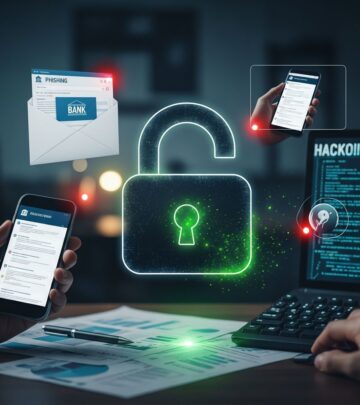
Phishing remains one of the most effective fraud vectors because it combines technical sophistication with psychological manipulation. A phishing email might appear to come from your bank, complete with authentic logos and formatting, directing you to click a link for “urgent security verification.” The link leads to a fake website that captures credentials when entered. Advanced phishing attacks now employ AI-generated content that perfectly mimics legitimate institutional communications.
When anything appears suspicious—an unexpected request, unusual account activity, or communication that feels slightly off—customers should pause and independently verify before taking action. Using trusted phone numbers or websites found through official channels (such as the back of a credit card) ensures communication with legitimate institutions rather than fraudster imposters.
Regulatory Framework and Institutional Responsibilities
Banking security no longer rests solely on customer vigilance. Regulators have recognized that cybersecurity represents a systemic risk to financial stability and are implementing increasingly stringent requirements. Financial institutions now face mandatory requirements for defending against ransomware and advanced cyberattacks. These regulatory demands represent a fundamental acknowledgment that security is not optional.
Data breach notification timelines have compressed dramatically. Institutions must now report security incidents to regulators within significantly shorter timeframes than previously required, increasing accountability and preventing cover-ups. Furthermore, global privacy standards like GDPR and CCPA influence how American financial institutions handle customer data, requiring robust policies for data handling, storage, and incident response.
Banks are investing in 24/7 Security Operations Centers staffed by cybersecurity professionals monitoring for threats in real-time. These centers employ behavioral analytics to identify unusual transaction patterns that might indicate compromise. Rather than waiting for customers to report suspicious activity, advanced institutions now detect and prevent fraud proactively through continuous monitoring.
Encryption and Data Protection Technologies
Encryption forms the technical foundation preventing unauthorized access to sensitive financial information during transmission and storage. When banking websites display a padlock icon and use HTTPS protocol (rather than HTTP), data travels in encrypted form. This encryption means that even if attackers intercept communications, the data remains mathematically unreadable without the proper decryption keys.
End-to-end encryption extends protection further by ensuring that only sender and recipient can read messages, with even the service provider unable to access content. Some financial institutions now employ this standard for sensitive communications.
Quantum-resistant encryption represents the next frontier. As quantum computing advances, current encryption standards that protect financial infrastructure may become vulnerable. Forward-thinking institutions are beginning migration plans toward quantum-resistant algorithms that will resist attacks from both classical and quantum computers.
Third-Party Vendor Risk Management
Financial security extends beyond the primary institution to encompass all connected third-party vendors. Payment processors, data storage providers, security software vendors, and countless other external services access financial data. A breach at any single vendor potentially compromises customer information.
Comprehensive vendor risk management programs evaluate security postures of all external partners. These programs establish baseline security requirements that vendors must meet, conduct regular audits to verify compliance, and maintain contractual provisions holding vendors accountable for breaches. For customers, this means understanding which third parties have access to financial information and researching their security practices.
Incident Response Planning and Recovery
Despite robust preventive measures, breaches occasionally occur. Effective incident response plans minimize damage from successful attacks. Financial institutions maintain detailed procedures for containing compromises, notifying affected customers, providing credit monitoring services, and restoring normal operations.
Customers should understand what steps to take if they suspect compromise. Immediately changing passwords, enabling fraud alerts with credit bureaus, monitoring account activity closely, and checking credit reports for unauthorized activity represent standard response procedures. Most financial institutions provide fraud protection, meaning customers bear no financial responsibility for unauthorized transactions they report promptly.
Staying Informed About Emerging Threats
The cybersecurity landscape evolves continuously as attackers develop new techniques and defenders respond with countermeasures. Staying informed about emerging threats helps customers maintain vigilance. Financial institutions regularly update security features and communicate changes to customers. Reading these communications rather than ignoring them ensures awareness of new protections and emerging risks.
Subscribing to security notifications from your financial institution, checking your bank’s website for security advisories, and reviewing quarterly statements for unexpected activity represent practical ways to stay engaged with account security. This ongoing attention and proactive monitoring significantly reduces breach impacts when they occur.
Best Practices Summary Table
| Security Practice | Implementation | Impact |
|---|---|---|
| Multi-Factor Authentication | Enable on all financial accounts, prioritizing banking platforms | Prevents unauthorized access even if password is compromised |
| Strong, Unique Passwords | Use 12+ characters mixing case, numbers, and symbols for each account | Eliminates credential stuffing attacks and brute-force vulnerabilities |
| Secure Networks | Avoid public Wi-Fi for banking; use VPN or cellular data | Protects data from interception on unencrypted networks |
| Device Security | Avoid shared computers; use updated antivirus on personal devices | Prevents malware and physical device compromise |
| Vigilance Against Fraud | Recognize phishing attempts and social engineering tactics | Prevents account compromise through deceptive communications |
Frequently Asked Questions
Is online banking truly safe?
Online banking is as safe as the security measures both institutions and users implement. Financial institutions employ extensive encryption, monitoring, and security protocols. When users follow best practices—enabling multi-factor authentication, using strong passwords, and avoiding public Wi-Fi—the combination provides robust protection. However, no system offers absolute safety; security represents an ongoing practice rather than a destination.
What should I do if I suspect my account has been compromised?
Contact your financial institution immediately using a trusted phone number from the back of your card or their official website. Change your password, enable additional fraud monitoring, place fraud alerts with credit bureaus, and review your credit report. Most institutions provide fraud protection, limiting your liability for unauthorized transactions reported promptly.
Are mobile banking apps as secure as website banking?
Modern banking apps often provide enhanced security through biometric authentication options and encrypted communication protocols specifically optimized for mobile devices. However, security depends on keeping your phone secure, immediately uninstalling the app from devices you no longer own, and not using public Wi-Fi when banking. Both apps and websites can be secure when properly implemented.
Why does my bank require frequent password changes?
Frequent password changes complicate attackers’ ability to maintain access after initially compromising credentials. However, research indicates that users forced to change passwords frequently often select weaker, more predictable passwords. Modern security wisdom emphasizes stronger initial passwords combined with multi-factor authentication rather than frequent mandatory changes, though your institution may maintain different standards.
References
- Banking Trends: The 8 Regulatory Trends of 2026 — OnCourse Learning. 2026. https://www.oncourselearning.com/resources/8-bank-regulatory-trends-2026
- Cybersecurity in Banking 2026: Challenges and Protection Guide — Fidelis Security. 2026. https://fidelissecurity.com/threatgeek/threat-detection-response/cybersecurity-in-banking/
- Banking Cybersecurity Trends 2026: Key Risks Ahead — Saturn Partners. January 2026. https://saturnpartners.com/2026/01/banking-cybersecurity-trends-2026/
- 2026 Guide to Cyber Security in Banking: Protecting Your Financial Data — Capital Credit Union. 2026. https://www.capitalcu.com/article/2026-guide-to-cyber-security-in-banking-protecting-your-financial-data
- Top 10 Cybersecurity Tips to Protect Your Finances in 2026 — Ozark Federal Credit Union. 2026. https://www.ozarkfcu.com/blogDetail.php?Top-10-Cybersecurity-Tips-to-Protect-Your-Finances-in-2026-64
Similar Articles








Read full bio of medha deb