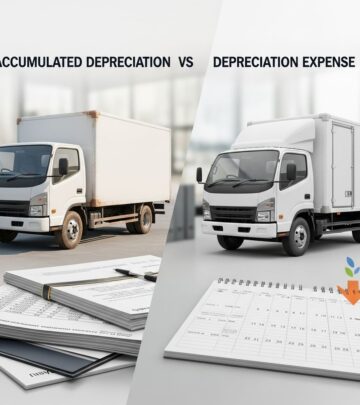
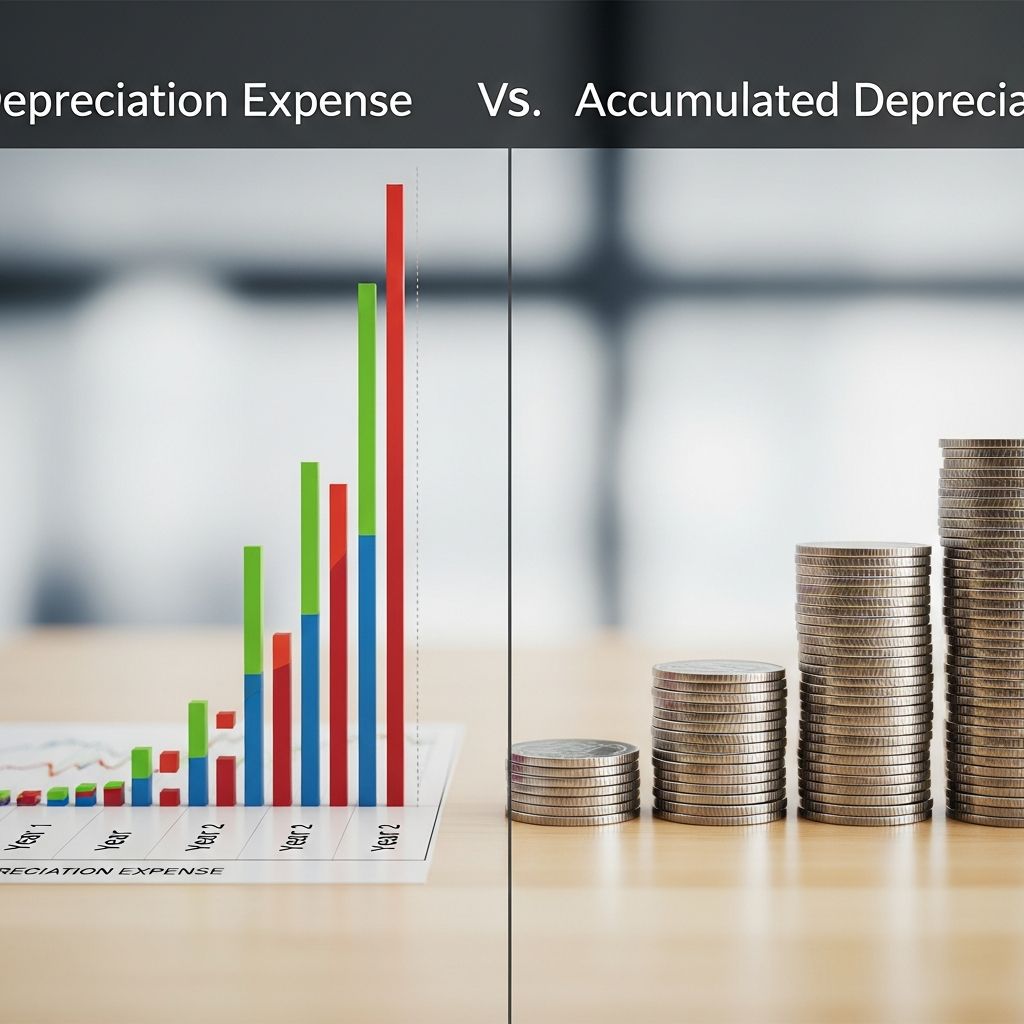
Depreciation Expense vs Accumulated Depreciation
Master the distinction between depreciation expense and accumulated depreciation for accurate financial reporting.
Understanding Depreciation Expense vs. Accumulated Depreciation
One of the most common sources of confusion in accounting relates to two interconnected yet distinct concepts: depreciation expense and accumulated depreciation. While both terms contain the word “depreciation” and relate to the same asset, they serve fundamentally different purposes in financial reporting and operate in entirely different sections of a company’s financial statements. Understanding when and how to use each is essential for accurate financial reporting, tax planning, and asset management.
Depreciation is an accounting method that distributes the cost of a tangible asset over its useful life. Rather than recording the entire cost of an asset as an expense in the year of purchase, companies use depreciation to spread this cost systematically across multiple periods. This approach provides a more accurate representation of the asset’s consumption and its impact on profitability over time. Without this mechanism, a company would bear the entire burden of a major asset purchase in a single year, potentially distorting financial results and making year-to-year comparisons misleading.
What Is Depreciation Expense?
Depreciation expense represents the periodic charge allocated to a specific accounting period, reflecting the portion of an asset’s value consumed during that time frame. This expense is recorded on the income statement and directly reduces a company’s net income or profit. When a company purchases a fixed asset such as machinery, equipment, vehicles, or buildings, the depreciation expense for each reporting period represents how much of that asset’s value has been used up during that particular year, quarter, or month.
From an accounting perspective, depreciation expense is debited on the income statement, meaning it reduces profitability. The depreciation expense account carries a debit balance and appears as a separate line item on the income statement. For manufacturing companies, depreciation expense may be further subdivided into portions that apply to the cost of goods sold and portions that apply to general and administrative expenses, depending on how the asset is utilized in operations.
For example, if a retailer purchases display racks for $84,000 with a useful life of 7 years and uses the straight-line depreciation method, the monthly depreciation expense would be $1,000 ($84,000 divided by 84 months). Each month, this $1,000 would appear on the income statement as an expense, reducing the company’s reported profit by that amount. This same expense figure remains consistent each month throughout the asset’s useful life.
What Is Accumulated Depreciation?
Accumulated depreciation, by contrast, is the cumulative total of all depreciation expenses that have been recorded for an asset since it was placed into service. Rather than representing a single period’s charge, accumulated depreciation represents the running sum of all depreciation recorded over the asset’s entire ownership period. This account appears on the balance sheet, not the income statement, and is classified as a contra-asset account.
A contra-asset account has a credit balance, which means it reduces the reported value of assets on the balance sheet. Accumulated depreciation is paired with the fixed assets line item and offsets the gross cost of those assets to show their net book value or carrying value. When a company reports “Property, Plant, and Equipment” on its balance sheet, the accumulated depreciation is typically shown below it, and the net figure (gross cost minus accumulated depreciation) represents the remaining value of those assets.
Using the same example of the $84,000 display racks, accumulated depreciation would total $1,000 at the end of the first month, $2,000 at the end of the second month, $3,000 at the end of the third month, and so on. After five years (60 months), accumulated depreciation would total $60,000. By the end of the asset’s 7-year useful life, accumulated depreciation would reach $84,000, at which point the asset would be fully depreciated and would have a book value of zero.
Key Differences Between Depreciation Expense and Accumulated Depreciation
While these two concepts are interrelated, they differ in several important ways that affect how they are used and reported in financial statements.
Financial Statement Placement
The most fundamental difference between depreciation expense and accumulated depreciation lies in where they appear in financial statements. Depreciation expense is reported on the income statement as an operating expense, while accumulated depreciation appears on the balance sheet as a contra-asset account. This distinction reflects their different purposes: depreciation expense measures the impact of asset consumption on current period profitability, while accumulated depreciation measures the total impact on asset values over time.
Account Balance and Debit/Credit Treatment
Depreciation expense carries a debit balance and reduces profitability during the reporting period in which it is recorded. Accumulated depreciation carries a credit balance and represents a reduction in the stated value of fixed assets on the balance sheet. From an accounting standpoint, when depreciation is recorded, depreciation expense is debited and accumulated depreciation is credited, establishing the connection between these two accounts while maintaining their distinct purposes.
Time Period Covered
Depreciation expense represents only the current period’s allocation of an asset’s cost. Whether your reporting period is monthly, quarterly, or annual, depreciation expense shows only that specific period’s charge. Accumulated depreciation, however, spans the entire period from when the asset was placed into service. It continually grows as each period’s depreciation expense is added to it, creating a historical record of the asset’s total consumption.
Subsequent Accounting Treatment
The treatment of these accounts changes when an asset is sold or disposed of. Depreciation expense for an asset ceases when the asset is no longer in use or is sold. The accumulated depreciation associated with that asset, however, is reversed entirely, removing all traces of the asset from the company’s balance sheet. This reversal is necessary because once an asset leaves the company’s possession, it should no longer appear in the fixed assets section of the balance sheet.
When to Use Each Account
Understanding when to use depreciation expense versus accumulated depreciation depends on what question you are trying to answer or what financial purpose you are trying to accomplish.
Use Depreciation Expense When:
Analyzing Current Period Profitability: Depreciation expense is the appropriate measure when evaluating how much of an asset’s cost has been consumed in the current reporting period. This information is crucial for income statement analysis and understanding operational performance.
Calculating Earnings and Tax Obligations: Depreciation expense directly affects net income and is a non-cash expense that reduces taxable income. When calculating taxes or determining reported earnings, depreciation expense is the relevant figure.
Computing Financial Metrics: Many financial metrics and ratios use depreciation expense in their calculations. When computing metrics like EBITDA (earnings before interest, taxes, depreciation, and amortization) or operating profit margins, depreciation expense is the appropriate input, as it represents the current period’s operational impact.
Use Accumulated Depreciation When:
Assessing Asset Age and Condition: Accumulated depreciation provides insight into how much of an asset’s useful life has been consumed. By comparing accumulated depreciation to an asset’s total cost, analysts can estimate the remaining useful life of assets and gauge the overall age of a company’s asset base.
Determining Net Asset Values: When analyzing balance sheet strength and asset quality, accumulated depreciation is necessary to calculate the net book value of fixed assets. This figure is important for credit analysis, valuation, and understanding what portion of assets represent fully depreciated, potentially outdated equipment.
Making Disposition Decisions: When deciding whether to repair, replace, or dispose of an asset, accumulated depreciation helps determine the asset’s current book value and remaining useful life. This information informs capital budgeting and asset replacement decisions.
Practical Example: Factory Equipment
Consider a manufacturing company that purchases factory machinery for $500,000 with an estimated salvage value of $100,000 and a useful life of 5 years. Using the straight-line depreciation method, the annual depreciation expense would be calculated as ($500,000 – $100,000) / 5 = $80,000.
| Year | Annual Depreciation Expense | Accumulated Depreciation | Book Value |
|---|---|---|---|
| 0 (Purchase) | — | $0 | $500,000 |
| 1 | $80,000 | $80,000 | $420,000 |
| 2 | $80,000 | $160,000 | $340,000 |
| 3 | $80,000 | $240,000 | $260,000 |
| 4 | $80,000 | $320,000 | $180,000 |
| 5 | $80,000 | $400,000 | $100,000 |
In this example, each year’s income statement reports the same $80,000 depreciation expense. However, the balance sheet shows increasing accumulated depreciation and decreasing book value. After five years, the accumulated depreciation of $400,000 represents the total consumption of the asset’s value above its salvage value. The book value of $100,000 equals the estimated salvage value, indicating the machinery has been fully depreciated according to the company’s estimates.
Impact on Financial Analysis and Decision-Making
The distinction between these two accounts has significant implications for financial analysis and business decision-making. Investors and creditors rely on depreciation expense to assess operational performance and profitability. Accumulated depreciation helps them evaluate the composition and age of a company’s asset base. A company with high accumulated depreciation relative to gross fixed assets may be operating with aging equipment, which could signal future capital expenditure needs or potential operational risks.
Management uses these figures in capital budgeting decisions, determining whether to repair existing assets or invest in new ones. The book value derived from accumulated depreciation also affects balance sheet metrics and financial ratios that creditors and investors use to evaluate creditworthiness and financial health.
Frequently Asked Questions
Q: Can accumulated depreciation ever exceed the cost of an asset?
A: No. Accumulated depreciation cannot exceed an asset’s original cost. Once accumulated depreciation equals the asset’s cost (or cost minus salvage value), the asset is considered fully depreciated, and no additional depreciation is recorded.
Q: Is depreciation expense a cash expense?
A: No. Depreciation expense is a non-cash expense. It reduces net income but does not involve an actual outflow of cash, which is why it is often added back when calculating cash flow from operations.
Q: How does accumulated depreciation affect a company’s taxes?
A: While accumulated depreciation itself does not directly affect taxes, the depreciation expense used to calculate it does reduce taxable income and thus reduces the company’s tax liability.
Q: What happens to accumulated depreciation when an asset is sold?
A: When an asset is sold, both the asset’s cost and its accumulated depreciation are removed from the balance sheet. The difference between the sale price and the book value (cost minus accumulated depreciation) is recognized as a gain or loss on the income statement.
Q: Why do some companies report accumulated depreciation separately on the balance sheet?
A: Some companies report accumulated depreciation separately to provide transparency about the age of assets and the gross versus net values. This separation helps financial statement users better understand asset composition and remaining useful life.
Conclusion
The distinction between depreciation expense and accumulated depreciation is fundamental to understanding financial reporting and asset accounting. Depreciation expense represents the current period’s allocation of an asset’s cost and appears on the income statement, affecting profitability and taxes. Accumulated depreciation represents the cumulative total of all depreciation recorded over an asset’s life and appears on the balance sheet as a contra-asset, reducing the reported value of fixed assets to their net book value.
Using the correct account depends on your purpose: use depreciation expense when analyzing current period profitability, calculating taxes, or computing financial metrics; use accumulated depreciation when assessing asset age, determining net asset values, or making asset disposition decisions. Proper application of these concepts ensures accurate financial reporting, informed decision-making, and meaningful financial analysis for all stakeholders in the organization.
References
- Accumulated Depreciation and Depreciation Expense: A Complete Guide — HCO. Accessed 2025. https://www.hco.com/insights/accumulated-depreciation-and-depreciation-expense-a-complete-guide
- The Difference Between Depreciation Expense and Accumulated Depreciation — AccountingTools. Accessed 2025. https://www.accountingtools.com/articles/the-difference-between-depreciation-expense-and-accumulated
- What is the Difference Between Depreciation Expense and Accumulated Depreciation — Accounting Coach. Accessed 2025. https://www.accountingcoach.com/blog/what-is-the-difference-between-depreciation-expense-and-accumulated-depreciation
- All You Need to Know About Accumulated Depreciation vs. Depreciation Expense — TFX Tax. Accessed 2025. https://tfx.tax/business-owners/articles/all-you-need-to-know-about-accumulated-depreciation-vs-depreciation-expense
- Tracking Depreciation on a Balance Sheet or Income Statement — AssetPanda. Accessed 2025. https://www.assetpanda.com/resource-center/blog/depreciation-and-balance-sheet-accounting
Similar Articles








Read full bio of medha deb