Depository Trust Company (DTC) Explained: A Clear Guide
Understanding how DTC settles securities trades and manages custody globally.
Understanding the Depository Trust Company (DTC)
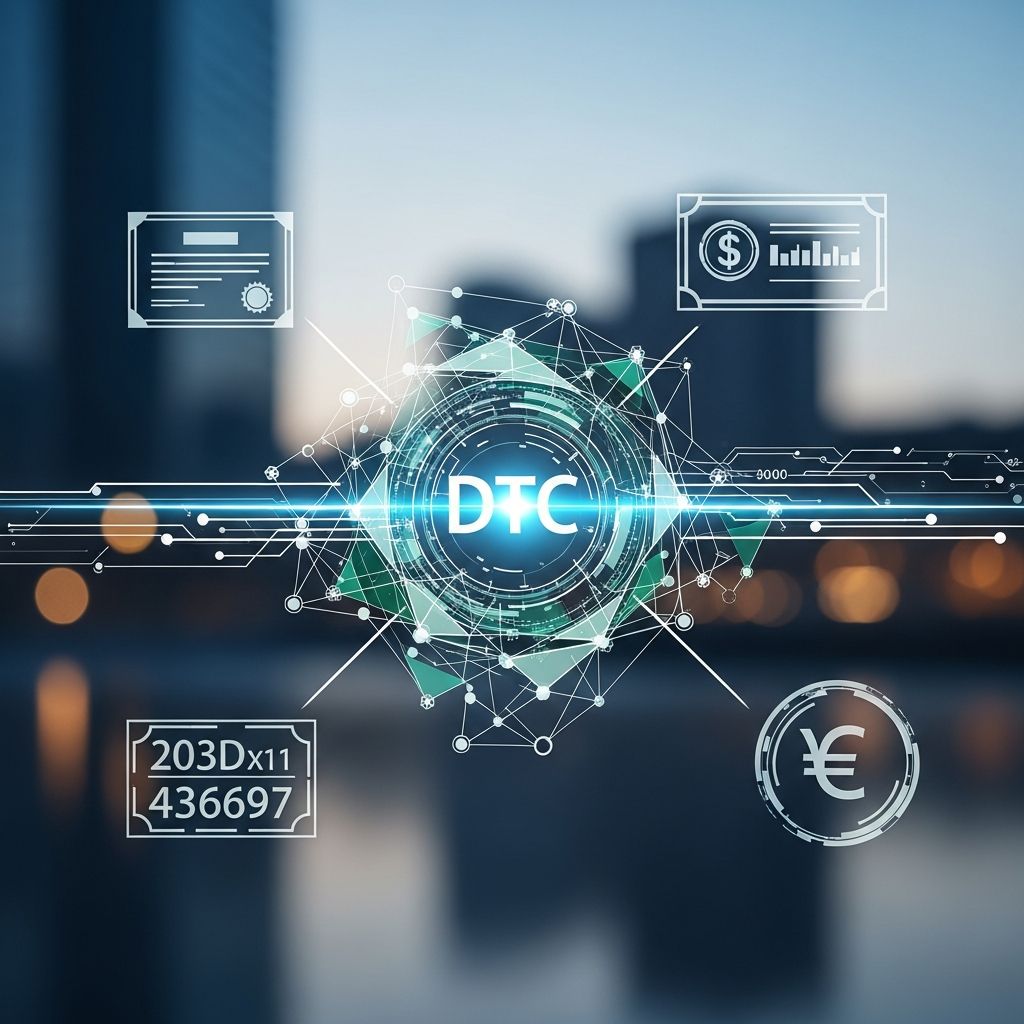
The Depository Trust Company (DTC) is a critical infrastructure institution that underpins modern securities trading and settlement in the United States and globally. As a subsidiary of the Depository Trust & Clearing Corporation (DTCC), the DTC serves as the backbone of how securities transactions are processed, settled, and custodied. Whether you are an individual investor, broker-dealer, or financial institution, your securities likely interact with DTC systems at some point in their lifecycle.
Established in 1973, the DTC was created to reduce costs and provide efficiencies by immobilizing securities and introducing “book-entry” changes to show ownership. This revolutionary approach eliminated the need for physical stock certificates to be transferred between parties for each transaction, dramatically streamlining the settlement process. Today, the DTC processes and settles an enormous volume of financial transactions, making it the highest financial value processor in the world.
The Evolution and Formation of DTCC
While DTC was established in 1973, the modern structure we know today took shape in 1999 when DTC merged with the National Securities Clearing Corporation (NSCC) under a holding company called the Depository Trust & Clearing Corporation (DTCC). This merger combined the expertise and capabilities of two critical financial infrastructure organizations, creating an even more powerful entity capable of handling the complexity of modern securities markets.
The formation of DTCC in 1999 represented a strategic consolidation that allowed for better coordination between clearing and settlement functions, ultimately benefiting all market participants through improved efficiency and reduced operational risk. Today, DTCC operates as a user-owned, mutually-governed organization that automates, centralizes, standardizes, and streamlines processes across the capital markets.
Core Functions and Services of DTC
The DTC performs several critical functions that keep financial markets running smoothly:
- Securities Settlement: DTC moves securities for NSCC’s net settlements and handles settlement for institutional trades involving money and securities transfers between custodian banks and broker-dealers.
- Custody Services: DTC retains custody of 3.5 million securities issues valued at $87.1 trillion, including securities issued in the United States and more than 170 other countries.
- Book-Entry System: Instead of physical certificates, DTC maintains electronic records of ownership through its book-entry system, making transfers instantaneous and reducing fraud.
- Corporate Actions: DTC facilitates corporate events such as mergers, stock splits, and dividend distributions to investors holding securities through its system.
- Money Market Services: DTC handles settlement and custody for money market instruments, government securities, and mortgage-backed securities.
How DTC Settlement Works
When two parties engage in a securities transaction, the actual transfer of ownership doesn’t happen instantaneously at the moment of the trade. Instead, it goes through a settlement process that typically takes one to two business days. During this period, DTC acts as an intermediary, ensuring that the seller delivers the securities and the buyer transfers the funds in a coordinated manner.
DTC operates through a network of participants, which include most large U.S. broker-dealers and banks that deposit and hold securities at DTC facilities. These participants maintain accounts at DTC and can transfer securities between accounts electronically. When an investor sells securities through their broker-dealer, the actual shares are transferred from one participant’s account to another at DTC, not from the individual investor directly.
One key innovation DTC introduced is the concept of fungible bulk holdings. This means that securities held by DTC are not specifically identified by individual certificate number or unique identifier. Rather, each participant owns a pro rata interest in the aggregate number of shares of a particular issuer held at DTC. This approach dramatically simplifies operations and reduces the administrative burden of tracking individual certificates.
DTC Membership and Participation
Most large U.S. broker-dealers and banks are full DTC participants, giving them direct access to DTC’s settlement and custody services. When securities are deposited at DTC, the company appears in the issuer’s stock records as the sole registered owner of those securities. This arrangement creates a hierarchy of ownership:
- DTC is listed as the registered owner in the issuer’s records
- Each DTC participant owns a pro rata share of the securities held at DTC
- Each customer of a DTC participant (such as an individual investor) owns a pro rata share in the shares held by their broker-dealer
This hierarchical structure requires that issuers and their transfer agents interact with DTC to facilitate dividend distributions, corporate actions, and accurate record-keeping of share ownership. The system works seamlessly because DTC maintains detailed records of which participant owns what portion of each security, even though the issuer only sees DTC as the owner.
Global Scale and Impact
The scale at which DTC operates is truly remarkable. In 2022, DTC processed $2.5 quadrillion in transactions, making it the world’s largest financial value processor by an enormous margin. To put this in perspective, that’s more financial value than the entire global GDP processed through a single institution. This extraordinary volume underscores how critical DTC is to global financial markets.
Beyond U.S. borders, DTC maintains custody of securities issued in more than 170 countries, demonstrating its international significance. The company operates facilities in the New York metropolitan area and maintains multiple locations both inside and outside the United States to serve a global client base.
DTC is a member of the U.S. Federal Reserve System and operates as a registered clearing agency with the Securities and Exchange Commission. This regulatory oversight ensures that DTC maintains the highest standards of operational security, risk management, and financial stability.
DTC’s Regulatory Role and Risk Management
Operating as a critical financial infrastructure provider, DTC carries significant regulatory responsibilities. The company must maintain systems and controls to prevent fraud, ensure accurate record-keeping, and manage systemic risk in the financial system. DTC’s role became even more prominent following financial crises, as regulators recognized the importance of infrastructure providers in maintaining market stability.
In 2008, DTC demonstrated its commitment to managing new and emerging risks by partnering with The Clearing Corporation (CCorp) to leverage CCorp’s netting and risk management processes for credit default swaps (CDS). Additionally, DTCC entered into a joint venture with the New York Stock Exchange (NYSE) known as New York Portfolio Clearing, which allows investors to combine cash and derivative positions in one clearinghouse to lower margin costs.
Derivatives and Trade Repository Services
Beyond traditional securities settlement, DTCC expanded its services to handle over-the-counter (OTC) derivatives. The company created Deriv/SERV LLC in 2003 to address OTC derivatives challenges through automated matching and confirmation services for derivatives trades, including credit, equity, and interest rate derivatives. By 2006, Deriv/SERV was processing 2.6 million transactions annually for dealers and buy-side firms from 30 countries.
In 2019, DTCC rebranded its derivatives and trade repository businesses as Repository and Derivatives Services (RDS), consolidating these critical functions under a unified framework. This rebranding reflected the growing importance of transparent, centralized reporting for derivatives trading, particularly following regulatory changes implemented after the 2008 financial crisis.
Following Brexit, DTCC created an EU entity based in Dublin, which ESMA registered as an EU trade repository in late 2020. This expansion demonstrates how DTC and its parent company continuously adapt to global regulatory changes and market structure evolution.
The Importance of DTC in Modern Finance
The existence of DTC is so fundamental to modern finance that most market participants take it for granted. Without DTC’s centralized settlement and custody system, financial markets would face enormous challenges:
- Settlement times would be measured in weeks rather than days, tying up capital
- Fraud and errors would increase exponentially due to physical certificate handling
- Costs for market participants would be substantially higher
- Cross-border transactions would be far more complex and time-consuming
- Corporate actions and dividend distributions would be inefficient and error-prone
DTC has essentially made securities trading and settlement invisible to most market participants—transactions happen seamlessly in the background through DTC’s highly efficient systems.
Frequently Asked Questions (FAQs)
Q: What is the primary purpose of DTC?
A: DTC’s primary purpose is to settle securities transactions, maintain custody of securities, and facilitate efficient transfer of ownership through electronic book-entry systems rather than physical certificate transfers.
Q: Who can be a DTC participant?
A: Typically, large broker-dealers and banks can be full DTC participants. Individual investors access DTC services indirectly through their broker-dealers, which hold their securities at DTC.
Q: How long does settlement typically take at DTC?
A: Most securities trades in the United States settle through DTC on a T+1 basis (one business day after the trade date), though this can vary depending on the type of security.
Q: Does DTC hold physical stock certificates?
A: No, DTC operates through electronic book-entry systems. Securities are recorded as electronic entries in DTC’s system rather than as physical certificates, which dramatically improves efficiency and reduces fraud.
Q: Is DTC regulated by government agencies?
A: Yes, DTC is a member of the U.S. Federal Reserve System and operates as a registered clearing agency with the Securities and Exchange Commission (SEC), ensuring strict regulatory oversight and compliance standards.
References
- Depository Trust & Clearing Corporation — DTCC Official Website and Regulatory Filings. 2024. https://www.dtcc.com/
Similar Articles








Read full bio of medha deb