Demonetization: Definition, Impact, and Global Examples
Understanding demonetization: how governments eliminate currency and reshape economies.
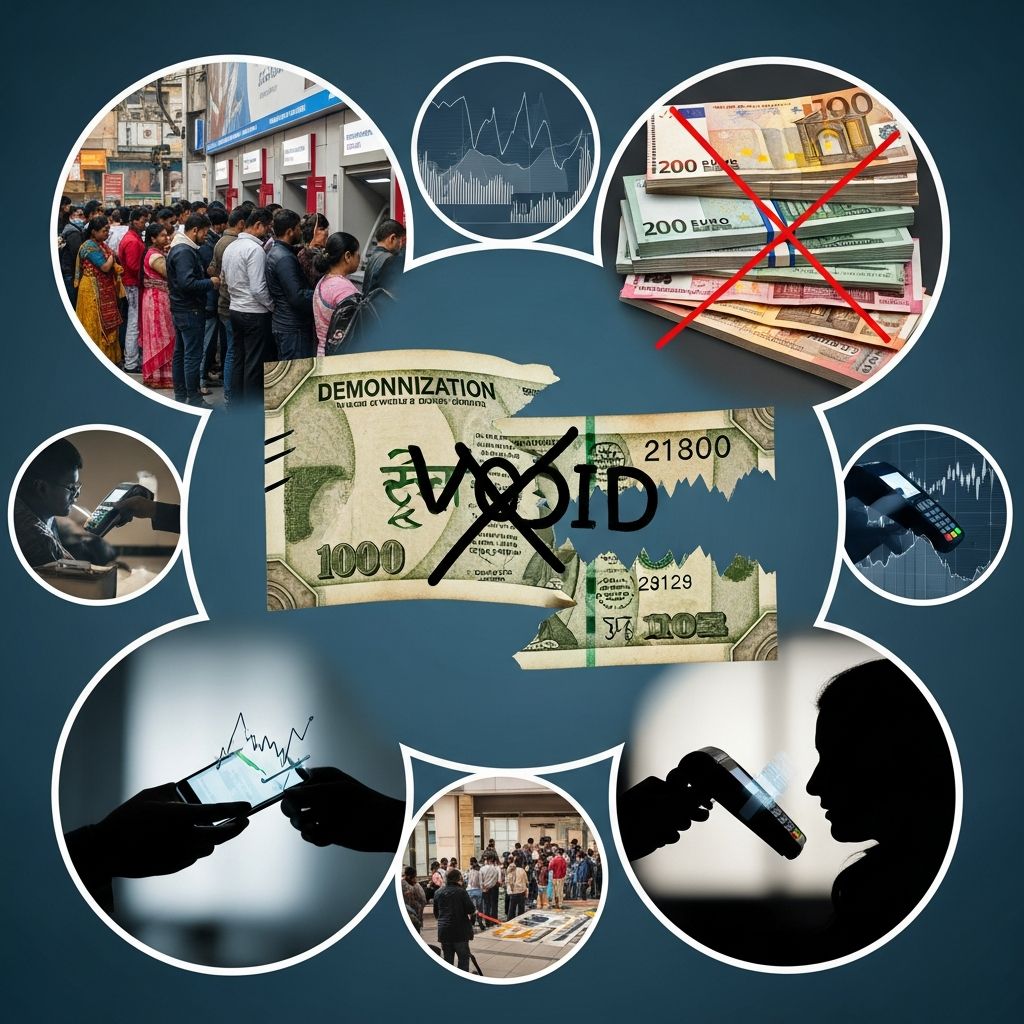
What Is Demonetization?
Demonetization is an economic process in which a government strips a currency unit of its legal tender status, effectively removing it from circulation and rendering it unusable for transactions. This centralized intervention can affect all currency in circulation or target specific denominations, banknotes, or coins. When demonetization occurs, the affected currency loses its monetary value and can no longer be used to purchase goods or services. Countries typically demonetize their economies when changing the currency they use as legal tender or when replacing existing currencies, banknote denominations, or coinage with new ones.
Demonetization represents one of the most drastic monetary policy tools available to governments. While it is relatively rare, economists generally view it as an extreme measure that carries significant risks when used in response to existing or looming economic problems. However, when managed through careful planning and conservative economic principles, demonetization can facilitate a smooth transition and help restore or maintain the stability of a national or transnational economy.
Historical Context and Early Examples
Demonetization is not a new phenomenon. Throughout economic history, governments have employed this measure for various reasons. In the 1870s, the United States demonetized certain coins to address inflation driven by the discovery of silver deposits, which threatened currency stability. This early example demonstrated how demonetization could serve as a tool to manage inflation and preserve the value of remaining currency.
In India, demonetization has been used previously. High-denomination notes were banned once in January 1946 when India possessed 1,000, 5,000, and 10,000 rupee denominations. These notes were subsequently relaunched in 1954. The second instance occurred on January 16, 1978, when Prime Minister Morarji Desai declared 1,000, 5,000, and 10,000 rupee notes illegal. These earlier interventions laid the groundwork for understanding the policy’s long-term effects and implementation challenges.
The European Union’s Successful Transition
One of the most comprehensive and successful demonetization efforts occurred in 2002 when most European Union member states completed the demonetization of their legacy currencies to adopt the euro as legal tender. This massive undertaking represented a carefully planned, smooth, and successful transition that served as a model for coordinated demonetization.
The key to the EU’s success lay in meticulous planning and sufficient preparation time. Participating member states allowed citizens to convert their demonetized currencies to euros at fixed exchange rates, ensuring a fair transition. The coordinated approach across multiple nations demonstrated that demonetization could be implemented effectively when governments provide adequate notice, maintain transparent communication, and establish clear conversion mechanisms. The euro transition remains one of the most successful large-scale demonetization efforts in modern economic history, affecting millions of people across multiple countries with minimal disruption to economic activity.
Zimbabwe’s Hyperinflation Response
In 2015, Zimbabwe undertook a dramatic demonetization program in response to catastrophic hyperinflation. The country’s official inflation rate had reached an astounding 231,000,000 percent in 2008, plunging the southern African nation into spectacular financial collapse. By 2015, the Zimbabwean government recognized that its currency had become essentially worthless and demonetized the Zimbabwe dollar as a desperate measure to restore economic stability.
The demonetization program unfolded over three months, during which the legacy Zimbabwe dollar was withdrawn from circulation and nullified of value. Rather than adopting a single new currency, Zimbabwe replaced its failed currency with a basket of regional and international currencies, including the US dollar, the South African rand, and the Botswana pula. These foreign currencies had already been widely introduced into the country’s economy in 2009 as citizens and businesses sought alternatives to the collapsing local currency. This pragmatic approach reflected the reality of Zimbabwe’s economic collapse and demonstrated how demonetization could serve as a tool for economic recovery when traditional monetary policy had failed.
India’s Landmark 2016 Demonetization Policy
India’s 2016 demonetization program represented one of the most ambitious and controversial demonetization efforts in modern times. On November 8, 2016, Prime Minister Narendra Modi announced a ban on 500-rupee and 1,000-rupee notes of the Mahatma Gandhi series. This decision impacted approximately 86 percent of all cash circulating in India’s economy at the time, making it one of the most expansive demonetization policies ever implemented.
While the official announcement occurred on November 8, 2016, government planning actually began in January 2016, giving officials considerable time to prepare the policy despite the public shock of the announcement. The government implemented this radical policy as a bold bid to reduce corruption, counterfeiting, and the prevalence of so-called black money in the Indian economy. Officials believed that eliminating high-denomination notes would disrupt illegal financial activities and encourage citizens to transition to digital payment systems.
Economic Effects and Recovery
Following the policy’s implementation, India’s economy experienced turbulence before stabilizing. However, the country’s economic performance proved resilient. In the final financial quarter of 2016, when the demonetization policy went into effect, India’s Central Statistics Office reported that the economy grew by 7 percent, precisely aligning with growth estimates released prior to the demonetization program. This data essentially demonstrated that the unusual policy move had no negative impact on the country’s overall financial health.
The political response to demonetization proved notably positive. In 2017, state-level elections were held in India, which many observers characterized as a de facto referendum on the demonetization program. Voters rewarded the incumbent government with widespread victories, effectively signaling their approval of the controversial policy.
Long-Term Consequences
Despite initial political support, later analysis revealed mixed results. While the demonetization scheme inspired significant innovation in India’s digital transaction space, encouraging the adoption of digital payments and financial technology, it also had adverse effects on employment rates and overall economic activity in certain sectors. The policy’s long-term success remains subject to debate among economists, who point to both positive innovations in the financial technology sector and negative impacts on informal economy workers and small businesses that relied heavily on cash transactions.
Key Reasons Governments Implement Demonetization
Governments implement demonetization for various strategic reasons. The primary motivations include:
Inflation Control: When inflation reaches unsustainable levels, demonetization can reduce the money supply and stabilize currency value. Zimbabwe’s implementation exemplified this approach, though the country’s situation had deteriorated beyond the point where this measure alone could restore stability.
Currency Replacement: Transitioning to new currencies or denominations often requires demonetization of older versions. The EU’s shift to the euro demonstrates how this can be accomplished smoothly with proper planning.
Combating Illegal Activities: India’s 2016 policy aimed to disrupt black markets, reduce counterfeiting, and eliminate illegal hoards of cash used in corrupt transactions. This objective reflected a belief that eliminating high-denomination notes would make illegal financial activities more difficult.
Modernizing Payment Systems: Demonetization can accelerate the transition to digital financial systems. India’s policy successfully encouraged rapid adoption of mobile payment systems and digital transactions.
Risks and Challenges of Demonetization
When demonetization is implemented abruptly without sufficient preparation, it can lead to significant economic disruptions. The primary risks include:
Economic Disruption: Sudden removal of currency can create chaos in markets, particularly affecting small businesses and informal sector workers who rely on cash transactions. Supply chain disruptions and reduced consumer spending can follow.
Employment Effects: India’s experience demonstrated that demonetization can adversely affect employment rates, particularly in sectors dependent on cash transactions.
Informal Economy Impact: Workers in the informal economy face particular hardship when demonetization removes their primary transaction medium without adequate alternative systems in place.
Implementation Complexity: Successfully executing demonetization requires coordination across banks, businesses, and millions of individuals. Inadequate preparation can create logistical nightmares and reduce public confidence in government institutions.
Success Factors for Demonetization
The European Union’s successful euro transition and India’s ultimate economic stability despite disruptions highlight key success factors:
Advance Planning: Extended preparation periods allow governments to establish infrastructure, train personnel, and communicate with the public.
Clear Communication: Transparent explanation of objectives and procedures reduces panic and encourages cooperation.
Adequate Conversion Mechanisms: Providing accessible methods for converting old currency to new currency or alternative payment systems reduces friction.
Phased Implementation: Gradual rollout, when possible, allows markets and individuals to adjust more smoothly than abrupt changes.
Support for Vulnerable Populations: Targeted assistance for informal sector workers and vulnerable groups can mitigate negative effects.
Frequently Asked Questions
What exactly is demonetization?
Demonetization is the process by which a government removes a currency’s legal tender status, making it unusable for transactions. This can affect all currency in circulation or specific denominations, and typically occurs when countries change their currency or replace existing denominations.
How does demonetization affect the average person?
Demonetization directly impacts individuals by rendering their cash holdings worthless unless converted to new currency or alternative payment methods. This can be particularly disruptive for those in the informal economy or rural areas with limited access to banking services and digital payment systems.
Is demonetization common?
No, demonetization is relatively rare in modern economies. Economists generally consider it an extreme measure that carries significant risks. Most countries prefer gradual monetary policy adjustments to address economic challenges rather than resorting to demonetization.
What was the purpose of India’s 2016 demonetization?
India’s 2016 demonetization aimed to reduce corruption, counterfeiting, and black money by eliminating high-denomination notes (500 and 1,000 rupees) that represented 86 percent of circulating cash. The policy also intended to encourage transition to digital payment systems.
Was India’s demonetization successful?
The answer is mixed. While the policy did boost digital transaction adoption and the economy maintained steady growth during implementation, it also negatively affected employment rates and informal sector activities. Political support remained strong, but long-term economic analysis shows both positive and negative consequences.
How did Zimbabwe’s demonetization differ from India’s?
Zimbabwe implemented demonetization in response to catastrophic hyperinflation (231,000,000 percent in 2008) and replaced its failed currency with a basket of international and regional currencies. India implemented demonetization as a policy measure to combat corruption and black money in a relatively stable economy, creating very different contexts and outcomes.
Can demonetization be done successfully?
Yes, demonetization can be successful when carefully planned and executed. The European Union’s 2002 euro transition demonstrated this, utilizing advance notice, fixed exchange rates, accessible conversion mechanisms, and coordinated implementation across multiple countries.
References
- Demonetization | Research Starters – EBSCO — EBSCO Information Services. 2024. https://www.ebsco.com/research-starters/social-sciences-and-humanities/demonetization
- Demonetisation and its Effect on the Indian Economy — SSRN Electronic Journal. 2021. https://papers.ssrn.com/sol3/papers.cfm?abstract_id=3915041
- Demonetisation: Its Socio-Economic Impact — Intercontinental Journal of Finance Research. 2017. https://www.ijirmf.com/
Similar Articles








Read full bio of Sneha Tete