DeMarker Indicator: Technical Analysis Tool Explained
Master the DeMarker indicator for identifying overbought and oversold market conditions.
Understanding the DeMarker Indicator
The DeMarker indicator, often abbreviated as DeM, is a technical analysis tool designed to help traders identify potential price reversals and assess market sentiment. Named after technical analyst Thomas DeMark, this oscillator compares the highest and lowest price levels within the current time period against those achieved in the previous period. By analyzing these price dynamics, the DeMarker provides traders with valuable insights into market conditions and potential trading opportunities.
As a leading indicator, the DeMarker signals potential changes in price trends before they fully materialize, making it a useful tool for anticipating market reversals rather than confirming established trends. Unlike many lagging indicators that follow price movements, the DeMarker attempts to identify inflection points where market direction may shift, offering traders the opportunity to act ahead of major price movements.
How the DeMarker Indicator Works
The DeMarker indicator operates by examining the relationship between current and previous price bars. The calculation process involves several key steps that transform raw price data into meaningful trading signals.
The indicator first identifies whether the current bar’s high is greater than the previous bar’s high. If this condition is met, the difference between these two values is recorded as a positive figure. Conversely, if the current bar’s high is lower than or equal to the previous high, a zero value is recorded. This same logic applies to the low prices, where positive differences indicate lower prices and zeros indicate higher or equal prices.
These values are then assessed over a specified number of price bars, typically 14 periods, which is the standard default setting. The calculation produces two components: the numerator, known as DeMMAX, which represents the Simple Moving Average of maximum price values over the period, and the denominator, known as DeMMIN, which represents the Simple Moving Average of minimum price values over the same period.
The DeMarker formula can be expressed as:
DeM = SMA(DeMMAX) / [SMA(DeMMAX) + SMA(DeMMIN)]
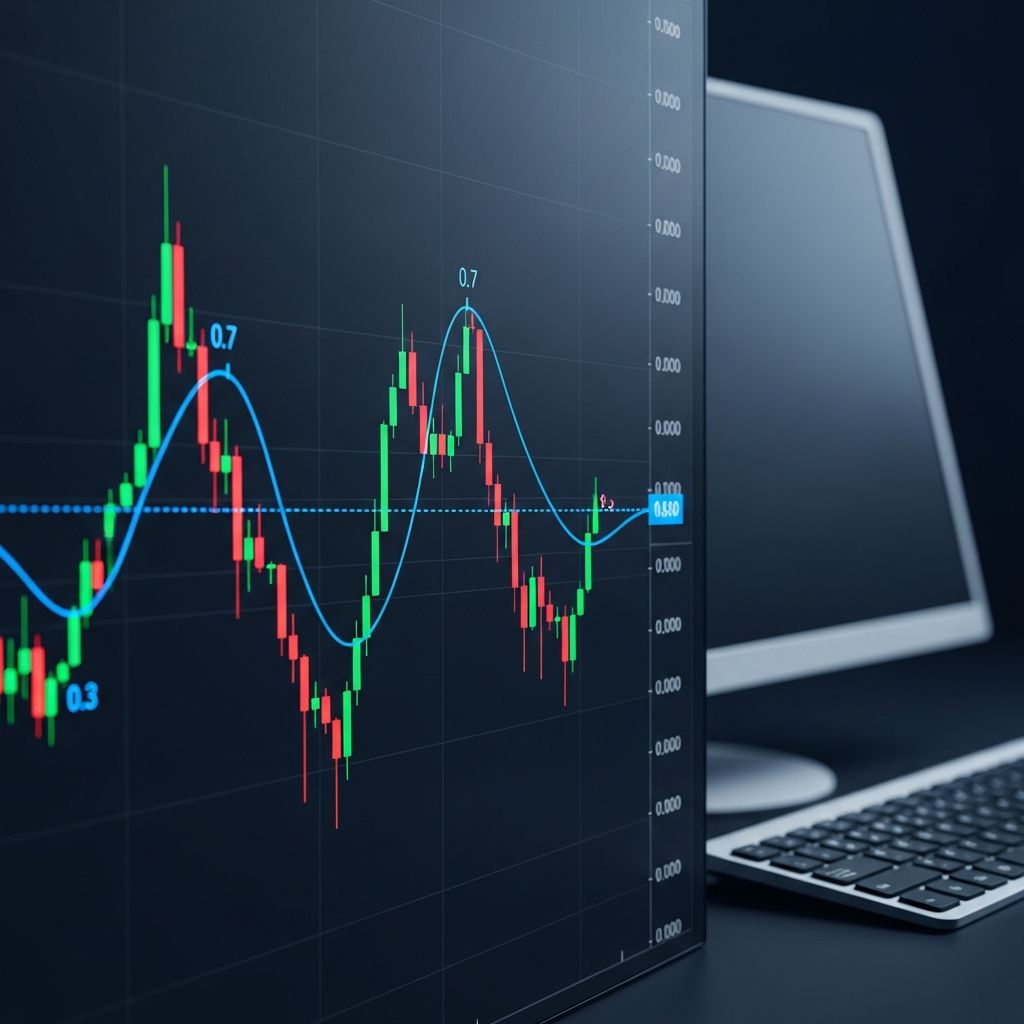
This equation generates values that typically range from 0 to 100, or sometimes from -100 to +100 depending on the specific version used. Some versions oscillate between 0 and 1, with a base level at 0.5. The resulting values provide traders with clear thresholds for identifying market conditions.
Interpreting DeMarker Signals
One of the most important aspects of using the DeMarker indicator is understanding what different readings signify about market conditions. The interpretation of DeMarker values follows specific thresholds that have become standard in technical analysis.
Overbought and Oversold Conditions
When DeMarker values exceed 70, the market is considered overbought, suggesting that prices may be unsustainably high and a potential reversal downward could occur. Conversely, when values fall below 30, the market is considered oversold, indicating that prices may be excessively low and a potential reversal upward might be imminent. These thresholds serve as warning signals that the market has moved to extremes.
Volatility and Risk Assessment
Beyond overbought and oversold conditions, the DeMarker can also provide insights into market volatility and risk levels. Values above 60 typically indicate lower volatility and reduced risks, suggesting a more stable market environment. In contrast, readings below 40 often point toward increased risks and higher volatility, warning traders to exercise greater caution.
Trend Confirmation and Momentum Analysis
When the price is on an increasing trajectory with a rising DeMarker value, traders can expect the current uptrend to continue with strengthening momentum. However, if DeMarker values fall while an uptrend is still in progress, this divergence suggests the upward trend is losing momentum and a price reversal may occur soon. Similarly, when prices decline and the DeMarker value also decreases, the downtrend is expected to persist.
DeMarker vs. Other Technical Indicators
The DeMarker indicator shares similarities with other technical analysis tools but maintains distinct characteristics that set it apart. The most notable comparison is with the Relative Strength Index (RSI), another popular oscillator used by traders worldwide.
| Feature | DeMarker Indicator | Relative Strength Index (RSI) |
|---|---|---|
| Price Data Used | Intra-period highs and lows | Closing price levels only |
| Calculation Method | Compares price extremes between periods | Compares gains to losses |
| Sensitivity to Price Range | Less prone to distortions | More sensitive to closing prices |
| Signal Type | Leading indicator | Momentum indicator |
The key distinction is that the DeMarker bases its calculations on intra-period price highs and lows rather than just closing levels, making it fundamentally different in approach. This difference can result in fewer false signals and more accurate identification of price extremes, as the indicator accounts for the full range of price movement during each period.
Customizing the DeMarker Indicator
One of the advantages of the DeMarker indicator is its flexibility in application across different trading timeframes and strategies. Traders can customize the time period used in calculations to suit their specific trading objectives.
The standard 14-period setting is most commonly used and has been proven effective for many traders. However, shorter timeframes, such as 1-minute, 5-minute, or hourly periods, can be employed for day trading and scalping strategies. These shorter timeframes allow traders to spot precise entry and exit points more quickly.
The trade-off with shorter timeframes is an increased probability of false signals, which can lead to premature or incorrect trading decisions. Longer timeframes, conversely, may require more patience but provide better confirmation of trends and reduce the likelihood of whipsaw effects. The choice of timeframe should align with your trading style and risk tolerance.
Practical Trading Applications
Identifying Price Reversals
Contrarian traders find particular value in the DeMarker indicator for sourcing potential price reversals within confirmed trends. However, simply identifying overbought and oversold regions is typically insufficient for predicting reversals. Instead, traders should observe the duration for which prices remain in these extreme zones. If the market stays in the overbought region for an extended period, this often indicates a strong ongoing uptrend rather than an imminent reversal.
Entry and Exit Point Optimization
One effective approach to using the DeMarker involves monitoring when the indicator exits overbought and oversold regions. The objective is to capture temporary price drops in upward trends (buying opportunities) and temporary price increases in downtrends (selling opportunities). By waiting for the DeMarker to move out of extreme zones, traders can identify higher-probability entry points with better risk-reward ratios.
Range-Bound Trading Strategy
The DeMarker provides useful signals primarily during range-bound trading periods. When the trading range cycle aligns with the indicator’s parameters, the signals are typically reliable. However, when strong trends develop with large volumes, the indicator may generate conflicting signals, as it could remain in overbought or oversold regions for extended periods.
Advantages of the DeMarker Indicator
The DeMarker offers several compelling advantages that contribute to its popularity among technical traders. First, it is less prone to distortions compared to other indicators. The design reduces the chances of sudden, unexplained shifts in the momentum line when current price levels remain unchanged, providing more stable and consistent readings.
Second, the indicator’s use of intra-period highs and lows captures a more complete picture of price action than closing-price-only methods. This comprehensive approach helps identify genuine price extremes and can reduce false signals in ranging markets.
Third, the DeMarker can serve as a multifaceted tool, functioning not just for identifying reversals but also for assessing volatility and estimating risk levels. Its movement between critical levels provides insights into flat market conditions and potential price movement patterns.
Limitations and Risks
Despite its advantages, the DeMarker indicator has notable limitations that traders must understand. Like most oscillators, it offers useful signals primarily during range-bound trading conditions. When the trading range cycle does not correspond to the indicator’s parameters, signals can become unreliable and generate false positives.
During strong trending markets accompanied by large volumes, the indicator frequently generates conflicting signals. For example, in a powerfully trending market, the DeMarker may remain in overbought or oversold regions for extended periods, which reduces its reliability as a reversal indicator during these critical times.
Additionally, the DeMarker should not be used in isolation. Traders must combine it with other technical tools, fundamental analysis, and risk management practices to make well-informed trading decisions.
Frequently Asked Questions
Q: What is the optimal time period setting for the DeMarker indicator?
A: The standard 14-period setting is most commonly used and effective for most traders. However, the optimal setting depends on your trading style. Shorter periods like 5 or 7 are better for day trading, while longer periods like 21 or 28 work better for swing trading and identifying longer-term trends.
Q: How does the DeMarker indicator differ from the RSI?
A: The DeMarker uses intra-period highs and lows for calculations, while the RSI uses closing prices only. This makes the DeMarker less prone to distortions and better at capturing the full range of price action during each period.
Q: Can the DeMarker indicator be used alone for trading decisions?
A: No, the DeMarker should be combined with other technical indicators, fundamental analysis, and risk management strategies. Using it in isolation can lead to false signals and poor trading outcomes.
Q: What do values above 70 indicate in the DeMarker?
A: Values above 70 indicate overbought conditions, suggesting prices may be unsustainably high and a potential downward reversal could occur.
Q: How can traders use the DeMarker to assess market volatility?
A: Values above 60 indicate lower volatility and reduced risk, while readings below 40 suggest increased volatility and higher risk. This helps traders adjust their strategies according to current market conditions.
Q: Is the DeMarker suitable for trending markets?
A: The DeMarker is most effective in range-bound markets. In strong trending markets, it may generate conflicting signals and remain in extreme zones for extended periods, reducing its reliability during these conditions.
Conclusion
The DeMarker indicator represents a valuable tool in the technical analyst’s toolkit, offering unique insights into market conditions through its analysis of intra-period price extremes. By comparing high and low prices across time periods, traders gain access to leading indicators of potential price reversals and market sentiment shifts. While the indicator provides significant advantages in identifying overbought and oversold conditions, assessing volatility, and spotting entry and exit opportunities, its limitations in trending markets must be acknowledged and respected. Successful traders recognize that the DeMarker works best when combined with complementary technical indicators, fundamental analysis, and disciplined risk management practices. Whether you are a day trader seeking precise entry points or a swing trader confirming trend changes, understanding how to properly apply and interpret the DeMarker indicator can enhance your trading performance and decision-making process.
References
- De-Marker Indicator (DeM) — Blackwell Global. Accessed November 29, 2025. https://www.blackwellglobal.com/de-marker-indicator-dem/
- DeMARK Indicators — DeMark Analytics. Accessed November 29, 2025. https://demark.com/demark-indicators/
- Technical Analysis from A to Z — Steven B. Achelis. Founder of Chart School, educational reference for technical analysis methodologies. https://www.investopedia.com/
Similar Articles








Read full bio of Sneha Tete