Delivered at Place (DAP): Definition & How It Works
Understanding DAP Incoterms: Seller responsibilities, buyer obligations, and international shipping logistics.
What Is Delivered at Place (DAP)?
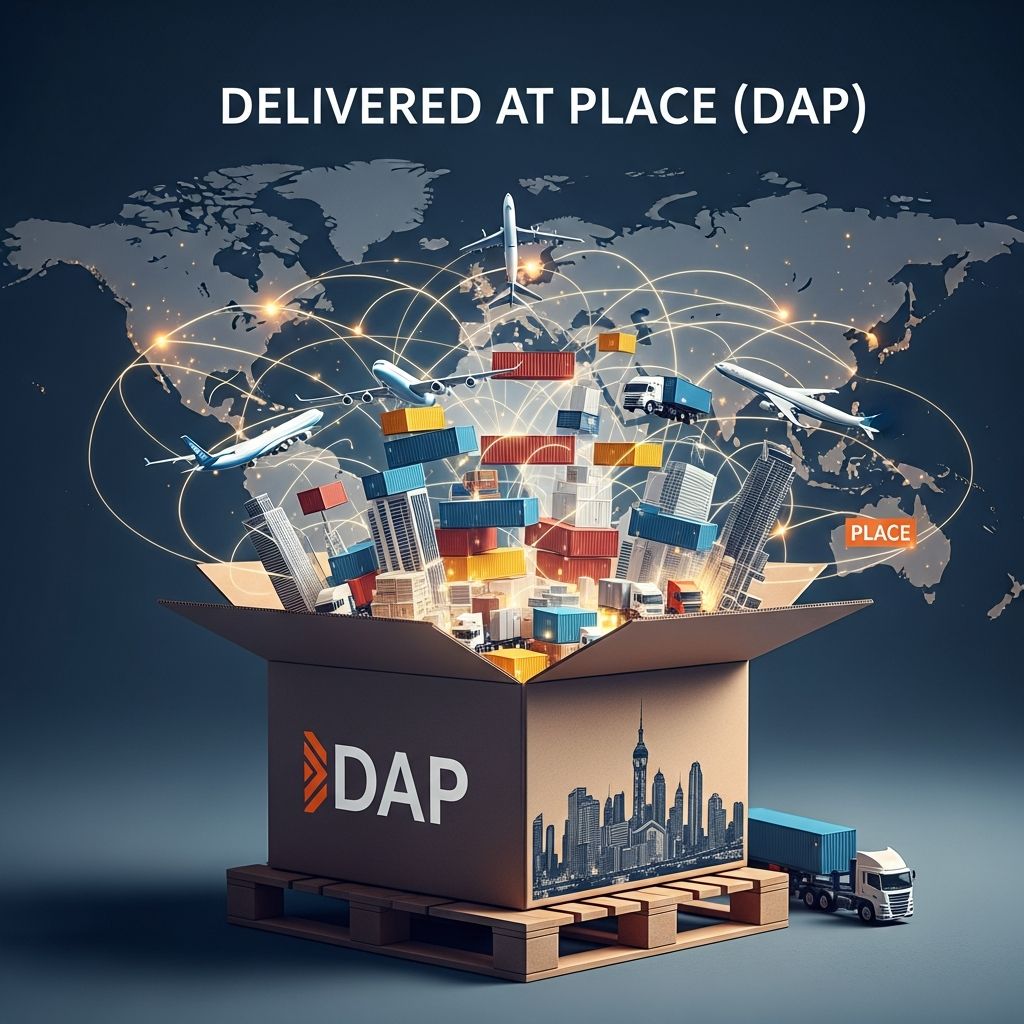
Delivered at Place (DAP) is an internationally recognized Incoterm used in commercial trade to define the responsibilities and obligations of both sellers and buyers when transporting goods across borders. Under DAP terms, the seller agrees to bear the responsibility and cost of transporting goods to a specified destination, while the buyer assumes responsibility for import-related duties and taxes upon arrival. This arrangement provides clarity on cost allocation and risk transfer throughout the shipping journey, making it one of the most commonly used terms in international commerce.
The term was first introduced in the Incoterms 2010 publication by the International Chamber of Commerce (ICC) as a replacement for the previous Delivered Duty Unpaid (DDU) designation. The 2010 naming convention better reflects the actual nature of the transaction, as it clarifies that the seller delivers goods to a named place ready for unloading, without responsibility for import duties. This term has remained unchanged through the Incoterms 2020 version, continuing to provide a standardized framework for international transactions.
How DAP Shipping Works
Under DAP terms, the seller bears all risks and costs associated with transporting goods to the agreed-upon destination, excluding import duties and taxes. The delivery point is typically the buyer’s warehouse or premises, though it can be any specified location mutually agreed upon by both parties. The seller’s responsibility ends when the goods are placed at the disposal of the buyer at the named destination, ready for unloading.
The risk of loss or damage transfers from the seller to the buyer once the goods arrive at the agreed delivery point. This means that the seller assumes all responsibility for any damage or loss that occurs during transit, including transit through different countries, ports, and transportation modes. However, once the goods reach the named destination and are ready for unloading, the buyer assumes all subsequent risks.
Seller’s Responsibilities Under DAP
The seller has substantial obligations when entering into a DAP agreement, encompassing multiple aspects of the shipping process:
- Arranging and paying for all transportation from the point of origin to the specified destination
- Covering all freight costs, including loading, carriage, and initial handling charges
- Ensuring proper packaging and labeling to protect goods during transit
- Handling all export customs formalities and documentation requirements
- Assuming all risks of loss or damage until goods reach the agreed delivery location
- Bearing the cost of any damage or loss that occurs during transportation
- Providing necessary shipping documents to the buyer
The seller’s financial commitment extends throughout the entire journey. For example, a seller in New York shipping to London must pay for transportation from their storage facility to the port, ocean freight to the London port, and any additional freight charges to the buyer’s final destination. If the goods are damaged during any stage of this journey, the seller bears the financial responsibility for replacement or compensation.
Buyer’s Responsibilities Under DAP
While the seller carries most of the transportation burden, the buyer has clearly defined obligations that begin upon delivery:
- Unloading the goods at the named destination
- Handling import customs clearance procedures
- Paying all import duties, tariffs, and applicable taxes
- Paying value-added tax (VAT) and excise duties where applicable
- Taking delivery of goods when they arrive at the agreed point
- Assuming all risks after goods are delivered at the specified location
The buyer becomes responsible for managing customs procedures and ensuring that all necessary documentation is prepared for import clearance. This includes coordinating with local customs authorities and paying any applicable fees. Additionally, the buyer manages any storage costs that may arise if delays occur in completing import formalities, provided the seller has supplied all necessary documentation on time.
Cost Breakdown in DAP Transactions
Understanding the various cost components in DAP arrangements is essential for accurate pricing and budgeting:
Freight and Transportation
Freight encompasses all charges related to moving goods from the point of production to the assigned port for initial shipment and subsequently to the destination port. Separate freight charges apply to different stages of the journey, including inland transportation, ocean freight, and final delivery to the buyer’s location. The seller bears all these transportation costs under DAP terms.
Packaging and Insurance
The seller must ensure adequate packaging to protect goods during transit and minimize the risk of damage. Packaging costs are the seller’s responsibility, as is arranging insurance coverage for the goods during transit. While insurance is typically obtained by the party bearing the risk of loss, the seller—being responsible for goods until delivery—would prudently arrange appropriate coverage, though this is not explicitly mandated in DAP terms.
Customs and Border Clearance
Export customs formalities, including documentation and clearance, are the seller’s responsibility. However, import customs clearance, duties, and tariffs fall to the buyer. These border-related costs can be substantial, particularly for goods subject to high tariff rates or regulatory compliance requirements.
Unloading and Final Delivery
Once goods reach the destination port, charges for unloading and transportation to the buyer’s warehouse become the buyer’s responsibility. These costs can vary significantly depending on the location of the final destination and the specific handling requirements of the goods.
Key Advantages of DAP Shipping
Planning and Forecasting
DAP terms enable buyers to plan inventory and sales forecasts more efficiently. Since the buyer knows when goods will arrive at the specified destination, they can allocate resources, arrange storage space, and prepare warehousing operations accordingly. This predictability improves supply chain management and operational efficiency.
Cost Transparency
The seller bears significant logistics costs up to the point of delivery, allowing the buyer to clearly understand which costs remain their responsibility. This transparency facilitates more accurate cost estimation and budget planning for both parties.
Risk Management and Clarity
DAP shipping provides clear risk transfer documentation, which is one of its most significant benefits. Both parties understand precisely when risk transfers from seller to buyer, eliminating ambiguity that could lead to disputes. The seller bears all transportation risks until delivery, protecting the buyer from unexpected losses during transit.
Balanced Security
DAP offers security and protection to both parties at different stages of the journey. The buyer gains confidence knowing that goods will be delivered from origin to the specified location ready for unloading. The seller receives a secure method for international shipping while avoiding responsibility for customs-related complications that can arise at destination ports.
DAP vs. Other Incoterms
| Incoterm | Seller Responsibility | Buyer Responsibility | Risk Transfer Point |
|---|---|---|---|
| DAP | Transportation to named place; export customs | Unloading; import customs; duties and taxes | At delivery location, ready for unloading |
| DDP | Transportation; all customs; duties and taxes | Unloading only | At buyer’s premises after duties paid |
| DPU | Transportation and unloading at destination | Import customs; duties and taxes | After unloading at destination |
| CPT | Transportation; export customs | Import customs; duties and taxes | When goods handed to carrier |
Common Challenges in DAP Arrangements
Documentation and Authorization Issues
Documentation requirements and definitions vary significantly from place to place, as they are prescribed by national authorities. When disputes arise regarding delayed delivery or customs clearance, fault determination can be complicated due to these varying requirements. In such situations, the party that failed to discharge its duty of providing timely authorization and complete documentation may be held responsible.
Port Authority Variations
Ports within a single country are often controlled by different local authorities, which can lead to unanticipated inconsistencies. These variations can result in unexpected delays or additional requirements that neither the seller nor buyer anticipated during contract negotiation.
Specificity of Delivery Location
If the delivery location is not precisely specified, disputes can arise regarding where the seller must deliver goods. The seller can select the point that best suits its purposes if an exact location is not agreed upon, which will usually be the cheapest option, such as a cargo terminal. However, this may not align with the buyer’s preferences or operational needs.
Practical Examples of DAP in Action
Electronics Shipment
A US-based electronics manufacturer ships goods to a retailer in Germany under DAP terms. The manufacturer handles all transport logistics and risks until the goods arrive at the retailer’s warehouse, where the retailer then manages unloading and customs duties. This arrangement allows the retailer to forecast inventory arrival and prepare their receiving dock in advance.
Automotive Parts Supply
A Canadian supplier sends automotive parts to a factory in Mexico under DAP terms. The supplier ensures delivery to the factory door, bearing all costs and risks of transport. The factory then handles import procedures, tariffs, and unloading. This clear division of responsibilities facilitates smooth operations for both parties.
When to Use DAP
DAP is particularly suitable for transactions within established trade relationships where both parties have experience with customs procedures and import requirements. It works well for domestic trade and transactions within customs unions. However, DAP can become impractical for cross-ocean trade where import customs clearance delays are common. In such situations, goods may be held in customs bonded warehouses or terminals until formalities are completed, potentially creating storage cost disputes.
DAP is most effective when the buyer has the equipment and expertise to unload goods at the specified location. If specialized unloading equipment is required or unavailable, the Delivered at Place Unloaded (DPU) Incoterm would be more appropriate, as it places unloading responsibility on the seller.
Frequently Asked Questions About DAP
Q: What does DAP stand for?
A: DAP stands for Delivered at Place. It is an Incoterm that specifies the seller delivers goods to a named location ready for unloading, with the buyer assuming responsibility for import duties and customs clearance.
Q: Who is responsible for unloading under DAP?
A: The buyer is responsible for unloading goods at the specified delivery location. The seller’s responsibility ends when goods are placed at the buyer’s disposal ready for unloading.
Q: Can the delivery location be the buyer’s warehouse?
A: Yes, under DAP the delivery location can be the buyer’s warehouse or any other specified location mutually agreed upon by both parties. However, if the warehouse requires additional freight charges, these are typically the seller’s responsibility.
Q: What is the difference between DAP and DDP?
A: Under DAP, the buyer pays import duties and taxes. Under DDP (Delivered Duty Paid), the seller assumes responsibility for all duties and taxes, delivering goods to the buyer fully cleared for import.
Q: Is insurance mandatory under DAP?
A: Insurance is not explicitly mandated under DAP terms, though the seller bears the risk until delivery and would prudently arrange coverage. The buyer has no insurable interest in the goods until they are delivered.
Q: How does DAP differ from the older DDU term?
A: DAP replaced DDU in the 2010 Incoterms revision. DAP better reflects actual transaction practices by clarifying that delivery occurs at the agreed location ready for unloading, eliminating confusion about when import duties are paid.
References
- Delivered-at-Place (DAP) – Definition, How It Works — Corporate Finance Institute. 2024. https://corporatefinanceinstitute.com/resources/commercial-lending/delivered-at-place-dap/
- What is Delivered At Place (DAP)? | Interwf — Interwf. 2024. https://interwf.com/freight-glossary/dap-delivered-at-place/
- DAP Incoterm (Delivered at Place) – Use and Meaning — iContainers. 2024. https://www.icontainers.com/help/incoterms/dap/
- Delivered at Place (DAP) – Incoterms® 2020 Rules — Trade Finance Global. 2025. https://www.tradefinanceglobal.com/incoterms/dap-delivery-at-place/
- What is DAP Shipping (Delivered at Place)? — Windward. 2024. https://windward.ai/glossary/dap-shipping/
Similar Articles








Read full bio of Sneha Tete