Definition of Equity: A Complete Financial Guide
Understand equity in business and investing: ownership value, calculations, and financial significance.

What Is Equity? Definition and Meaning
Equity represents the fundamental concept of ownership and financial interest in a business or asset. In its most straightforward definition, equity is the amount of money that would remain after liquidating all of a company’s assets and paying off all outstanding debts and liabilities. Think of equity as the true ownership stake—what actually belongs to the owners after all financial obligations have been settled.
For individual investors, equity works similarly. If you own a home worth $500,000 with a $400,000 mortgage, your equity in that home is $100,000. This represents your actual ownership interest in the property after accounting for what you still owe.
Equity serves as a critical indicator of financial health and is essential for understanding a company’s balance sheet, valuation, and long-term sustainability. It tells stakeholders what portion of the company truly belongs to its owners versus what portion is financed through debt.
Understanding the Basic Equity Formula
The foundation of calculating equity rests on a simple but powerful formula that accountants and financial professionals use globally:
Equity = Total Assets – Total Liabilities
This fundamental equation demonstrates that equity is what remains after subtracting everything the company owes from everything it owns. To use this formula effectively:
Step 1: Identify Total Assets — Locate your company’s balance sheet and find the total assets figure, which includes cash, investments, equipment, property, inventory, and any other resources the company owns.
Step 2: Identify Total Liabilities — Determine all outstanding obligations, including loans, accounts payable, mortgages, and other debts owed to creditors and lenders.
Step 3: Perform the Calculation — Subtract total liabilities from total assets to arrive at your equity figure.
For practical illustration, if a business has assets totaling $1,000,000 and liabilities of $600,000, the equity would be $400,000. This $400,000 represents the true ownership value available to shareholders or business owners.
The Balance Sheet Equation and Equity
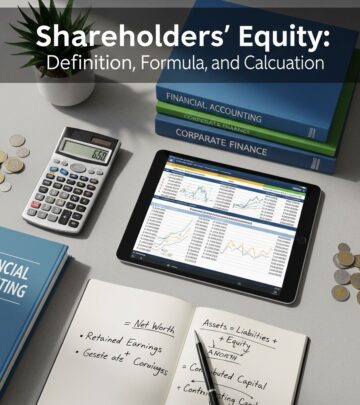
The balance sheet operates on a fundamental accounting principle that guides all financial reporting: Assets = Liabilities + Shareholders’ Equity. This equation, known as the accounting equation or balance sheet equation, forms the backbone of double-entry bookkeeping and ensures that financial statements remain balanced and accurate.
Understanding this relationship is crucial because it shows that every dollar of assets is either financed through debt (liabilities) or owned by shareholders (equity). Rearranging this equation reveals why equity calculation works: Shareholders’ Equity = Assets – Liabilities.
On a company’s balance sheet, equity appears in a dedicated section that may include:
Common Stock — Represents the equity stake held by common shareholders in publicly traded companies.
Retained Earnings — Profits that the company reinvested back into the business rather than distributing as dividends to shareholders.
Additional Paid-in Capital — The amount shareholders paid above the par value when purchasing stock.
Treasury Stock — Shares repurchased by the company from shareholders.
These components together represent the total shareholders’ equity and demonstrate where the company’s ownership value originates.
Shareholders’ Equity vs. Owner’s Equity
While these terms are often used interchangeably, they carry important distinctions based on business structure and ownership configuration.
Shareholders’ Equity applies to corporations, particularly publicly traded companies where multiple shareholders own stock. It represents the total residual value of the company that belongs to all shareholders collectively after all liabilities are paid. When you see equity mentioned in discussions about large corporations, analysts typically refer to shareholders’ equity.
Owner’s Equity typically applies to sole proprietorships and partnerships where one or a few individuals own the business. It represents the personal ownership stake of the proprietor or partners in the business. For a sole proprietor who owns 100 percent of a business, owner’s equity and shareholders’ equity are essentially the same concept.
Despite these naming differences, both concepts follow the same fundamental calculation: the value of assets minus the value of liabilities. The distinction primarily reflects the legal structure and ownership arrangement of the business entity rather than a different financial principle.
Why Equity Matters for Investors and Business Owners
Equity holds significant importance for multiple stakeholders in the business ecosystem. For investors, equity represents their ownership stake and potential claim on company profits and assets. When you purchase stock in a company, you’re buying equity—a piece of ownership that may generate returns through capital appreciation or dividend payments.
For business owners, equity represents their net worth in the business—how much they would receive if they sold the company and paid all debts. Monitoring equity helps owners understand whether their business is growing in value and whether they’re building wealth through their entrepreneurial efforts.
For creditors and lenders, equity serves as a safety cushion. Companies with strong equity positions have more protection against financial downturns and are less likely to default on loans. Banks and other lenders often examine equity ratios before extending credit.
For employees and other stakeholders, a company’s equity level indicates financial stability and the organization’s ability to weather economic challenges and continue operations.
How Equity Fluctuates and Changes Over Time
Equity is not a static figure but rather a dynamic value that changes throughout the business year based on several factors.
Earnings and Profitability — When a company generates profits, net income increases equity. Conversely, operating losses reduce equity. This is why quarterly and annual earnings reports significantly impact equity values.
Dividend Distributions — When companies pay dividends to shareholders from retained earnings, equity decreases. This represents a distribution of company value back to owners.
Stock Issuance — When a company issues new shares, it raises capital and increases equity. This occurs through initial public offerings (IPOs) or secondary offerings.
Share Buybacks — Companies sometimes repurchase their own shares from the market. These treasury shares reduce the equity available to remaining shareholders, though total company value may remain unchanged.
Asset and Liability Changes — As asset values fluctuate due to market conditions or as the company takes on or pays off debt, equity adjusts accordingly.
Accumulated Other Comprehensive Income — Unrealized gains or losses from investments and foreign currency transactions can impact equity even if they haven’t been realized through sales.
Measuring Financial Health With Equity
Equity serves as a fundamental metric for assessing company financial health. Positive and growing equity typically indicates a healthy, profitable business building value for owners. Companies that consistently grow their equity year-over-year demonstrate strong management, profitability, and reinvestment of earnings.
Negative equity—where liabilities exceed assets—signals serious financial distress. A company with negative equity has given away more than it owns to creditors and faces potential insolvency. This situation demands immediate restructuring or intervention.
Investors often analyze equity relative to company size through metrics like Return on Equity (ROE), which measures how efficiently management uses shareholder capital to generate profits. Higher ROE typically indicates better management performance and more effective use of equity capital.
Balance sheet analysis examining the relationship between assets, liabilities, and equity provides insights into how aggressively a company finances operations through debt versus equity funding. Companies with high debt-to-equity ratios face greater financial risk during economic downturns.
Equity in Real Estate and Personal Finance
The equity concept extends beyond business to personal finance and real estate investments. Homeowners build equity as they pay down mortgages—the difference between their home’s market value and remaining mortgage balance represents their equity stake. As property values appreciate, home equity increases, providing collateral for loans or wealth for estate planning.
Real estate investors carefully track equity in rental properties since it represents their actual ownership after accounting for financing. Building equity through mortgage paydown and property appreciation creates long-term wealth.
In personal investment portfolios, stock ownership represents equity positions in companies. Investors diversify across multiple equity holdings to manage risk while pursuing growth through ownership stakes in various businesses.
Common Equity Misconceptions Clarified
Many people mistakenly believe that business owners own everything in their company without limitation. In reality, owners can only claim equity—the remaining value after creditors receive their due. Creditors have legal priority over owners when companies face financial difficulties or liquidation.
Another misconception involves confusing equity value with market value. Owner’s or shareholders’ equity shown on balance sheets often differs significantly from what the market would pay for the entire company. Accounting rules require assets to be recorded at historical cost or net realizable value rather than current market prices, meaning accounting equity may be lower than fair market value.
Some assume that high equity automatically means a successful business. While positive equity is important, context matters. A mature company might maintain stable but modest equity growth, while a startup might show negative equity as it invests heavily in growth. Industry conditions, business stage, and strategic objectives all influence appropriate equity levels.
Building and Protecting Equity
Business owners can strengthen equity through multiple strategies. Profitability remains paramount—generating consistent earnings and reinvesting them into the business directly builds equity. Minimizing debt reduces liabilities and increases the equity proportion of the capital structure.
Strategic asset management ensures that company resources create maximum value. Efficient operations that generate strong returns on assets effectively build equity. Conversely, poor asset management or wasteful spending erodes equity.
Protecting equity requires managing liabilities carefully. Over-leveraging the company through excessive borrowing increases financial risk and reduces equity cushion. Conservative debt management maintains financial flexibility and protects against economic downturns.
Frequently Asked Questions
Q: What is the difference between equity and debt financing?
A: Equity financing involves selling ownership stakes in the company to investors in exchange for capital. Debt financing involves borrowing money that must be repaid with interest. Equity increases shareholders’ ownership but doesn’t create payment obligations, while debt obligates the company to make regular payments regardless of profitability.
Q: Can equity be negative?
A: Yes, negative equity occurs when liabilities exceed assets. This signals serious financial distress and often indicates insolvency. Companies with negative equity have given creditors more than the company’s total asset value.
Q: How often should I check my company’s equity?
A: Companies should review equity regularly—at minimum quarterly with financial statements, though many track it monthly. Regular monitoring helps identify emerging financial trends and allows management to take corrective action promptly.
Q: Why would a company have low equity despite being profitable?
A: Young companies might have low equity because they’re still building retained earnings. Highly leveraged companies use substantial debt financing, reducing equity proportion. Companies that distribute large dividends reduce retained earnings, lowering equity despite current profitability.
Q: How does equity relate to stock price?
A: While equity per share (book value) provides one valuation metric, stock price reflects investor expectations about future earnings, growth potential, and market sentiment. Stock prices typically diverge significantly from book value, sometimes trading above and sometimes below equity values.
References
- Equity in Business: What Is It (and Why Does It Matter) — Bryant & Stratton. 2024. https://www.bryantstratton.edu/blog/business-degrees/equity-in-business/
- Making Sense of Balance Sheets and Equity — Taxfyle. 2024. https://www.taxfyle.com/blog/balance-sheets-and-equity
- What Is Equity? Definition of Equity, Equity Meaning — Economic Times. 2024. https://economictimes.com/definition/equity
- What is equity and how does it work — Fidelity Investments. 2024. https://www.fidelity.com/learning-center/trading-investing/what-is-equity
- What is Equity — TD Bank. 2024. https://www.td.com/ca/en/investing/direct-investing/articles/equity
- Owner’s Equity: Definition and How to Calculate It — NetSuite. 2024. https://www.netsuite.com/portal/resource/articles/accounting/owners-equity.shtml
Similar Articles








Read full bio of medha deb