Defined Contribution Plan: Complete Guide
Understanding defined contribution plans: Your complete guide to retirement savings and investment control.
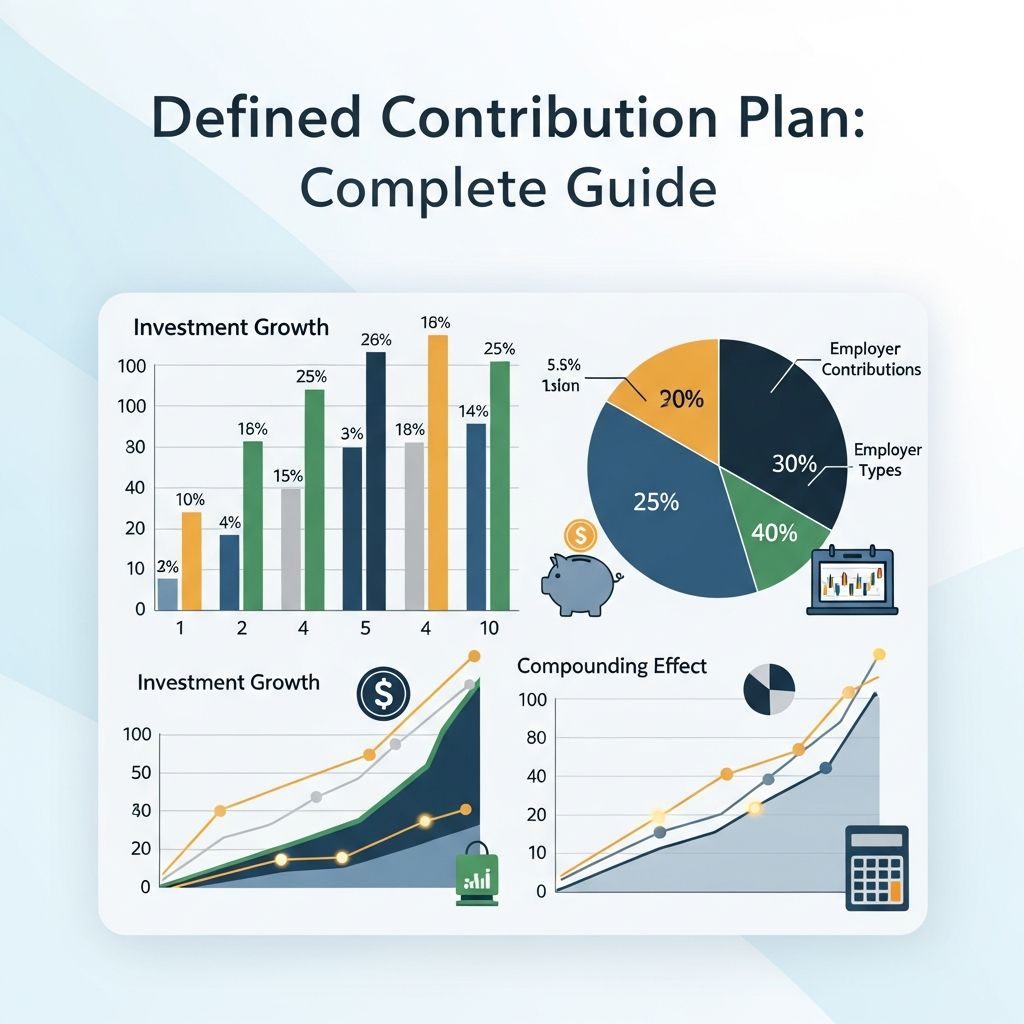
What Is a Defined Contribution Plan?
A defined contribution plan is a retirement savings arrangement where employees and employers contribute money to individual accounts established for each worker. Unlike pension plans that guarantee a specific benefit amount upon retirement, defined contribution plans place the investment risk and responsibility squarely on the employee’s shoulders. The final retirement benefit depends entirely on how much money has been contributed to the account and how well those investments perform over time.
The employee bears the investment risk in a defined contribution plan, meaning the retirement income received depends directly on contributions made and investment returns achieved. This structure has become increasingly popular among employers because it transfers the burden of ensuring adequate retirement funding from the company to the individual worker. As of recent data, millions of Americans participate in various types of defined contribution plans as their primary retirement savings vehicle.
How Defined Contribution Plans Work
The mechanics of a defined contribution plan are straightforward yet significant for long-term financial planning. When an employee enrolls in such a plan, a portion of their salary is automatically deducted and deposited into an individual account in their name. Employers frequently match a percentage of employee contributions, though this is voluntary and varies widely across organizations.
The contributed money is then invested according to the employee’s chosen investment options, which typically include mutual funds, target-date funds, stable value funds, and company stock. The employee maintains control over how their contributions are invested, allowing for portfolio customization based on individual risk tolerance and retirement timeline. Over time, the account balance grows through contributions and investment gains (or decreases through investment losses).
Key Mechanics:
- Employee salary deferrals: Workers contribute pre-tax dollars from their paychecks
- Employer matching contributions: Companies may add money based on employee contributions
- Investment growth: Account balances accumulate through market gains
- Vesting schedules: Employees gradually gain ownership of employer contributions
- Distribution flexibility: Participants can typically access funds after leaving employment or reaching retirement age
Common Types of Defined Contribution Plans
Several varieties of defined contribution plans exist, each with distinct characteristics and eligibility requirements:
401(k) Plans
The 401(k) plan remains the most prevalent type of employer-sponsored defined contribution plan in the United States. Named after the section of the Internal Revenue Code that governs them, 401(k) plans allow employees to contribute up to a specified annual limit. For 2024, the contribution limit is $23,500 for employees under age 50, with an additional $7,500 catch-up contribution available for those 50 and older. Employers often match a percentage of employee contributions, typically ranging from 25% to 100% of contributions up to a certain percentage of salary.
403(b) Plans
Educational institutions, hospitals, and certain nonprofit organizations typically offer 403(b) plans, which function similarly to 401(k)s but are exclusive to nonprofit employers. These plans allow for comparable contribution limits and employer matching arrangements.
457 Plans
State and local government employees can participate in 457 plans, which offer similar features to 401(k)s but with slightly different rules regarding distributions and loan provisions.
Individual Retirement Accounts (IRAs)
Self-employed individuals and those without access to employer plans can establish Traditional IRAs or Roth IRAs. While these aren’t technically employer-sponsored, they function as defined contribution vehicles where individuals make contributions and manage investments independently.
Simplified Employee Pensions (SEPs)
Small business owners and self-employed individuals frequently utilize SEP-IRAs, which allow for higher contribution limits than traditional IRAs while remaining administratively simpler than 401(k) plans.
Employer Matching and Vesting
Two critical components of defined contribution plans involve employer contributions and vesting schedules:
Employer Matching Contributions
Many employers offer matching contributions to incentivize employee participation and encourage adequate retirement savings. Common matching formulas include:
- Dollar-for-dollar match up to a specified percentage of salary (e.g., 100% match up to 3% of salary)
- Partial matches (e.g., 50 cents for every dollar contributed up to 6% of salary)
- Discretionary matches that vary annually based on company performance
Employer matching essentially provides free money toward retirement savings, making it important for employees to contribute at least enough to capture the full match. Failing to do so means leaving compensation on the table.
Vesting Schedules
Vesting refers to the process by which employees gain ownership rights to employer contributions in their retirement accounts. Employer contributions don’t automatically belong to employees; instead, vesting schedules determine when workers obtain full ownership. Common vesting schedules include:
- Cliff vesting: Employees gain full ownership of employer contributions after a specific number of years (typically three to five years)
- Graded vesting: Employees gain increasing ownership percentages over time (e.g., 20% annually over five years)
- Immediate vesting: Some employers vest contributions immediately, though this is less common
Understanding vesting schedules is crucial when changing jobs, as unvested employer contributions may be forfeited when leaving employment.
Investment Options and Portfolio Management
One distinguishing feature of defined contribution plans is that participants typically control investment decisions. Most plans offer a range of investment options that may include:
- Stock mutual funds (domestic and international)
- Bond mutual funds
- Target-date funds that automatically adjust asset allocation based on retirement timeline
- Money market funds and stable value funds for conservative investors
- Company stock (though financial advisors often caution against overconcentration)
- Self-directed brokerage accounts (in some plans)
Participants should carefully assess their risk tolerance, time horizon, and diversification needs when selecting investments. Target-date funds have become increasingly popular because they automatically shift from aggressive to conservative allocations as retirement approaches.
Advantages of Defined Contribution Plans
Defined contribution plans offer several benefits for both employees and employers:
For Employees:
- Portability: Employees can take their accumulated balance when changing jobs
- Investment control: Workers make investment decisions aligned with their preferences and risk tolerance
- Employer matching: Access to employer-contributed funds represents immediate returns on contributions
- Flexibility: Many plans allow for loans against account balances
- Tax advantages: Pre-tax contributions reduce current taxable income
- Transparency: Employees can easily monitor account balances and investment performance
For Employers:
- Predictable costs: Employer contributions are limited and defined upfront
- Reduced liability: Employers don’t guarantee specific retirement income levels
- Portability: Employees can take accounts when leaving, reducing long-term liabilities
- Tax deductions: Employer contributions are typically tax-deductible business expenses
- Recruitment and retention: Plans help attract and retain quality employees
Disadvantages and Risks of Defined Contribution Plans
Despite their popularity, defined contribution plans present several challenges and risks:
Investment Risk Transfer:
Unlike traditional pensions, defined contribution plans place investment risk squarely on employees. Market downturns directly impact account balances and retirement readiness. Employees must possess investment knowledge or actively seek professional guidance to make sound decisions.
Inadequate Savings:
Many employees fail to contribute sufficient amounts to support retirement. Low contribution rates early in careers or inability to save consistently can result in inadequate account balances at retirement.
Investment Mistakes:
Employees may make poor investment choices, such as excessive concentration in employer stock, failure to diversify, or market-timing decisions that lock in losses.
Fees and Expenses:
Investment management fees, administrative costs, and plan management expenses can reduce net returns significantly over decades.
Longevity Risk:
Employees must manage their accumulated balances to ensure funds last throughout retirement, requiring careful withdrawal strategies.
Vesting Restrictions:
Employees departing before vesting schedules complete may forfeit employer contributions they believed they were accumulating.
Defined Contribution vs. Defined Benefit Plans
Understanding the differences between defined contribution and defined benefit plans helps contextualize the tradeoffs:
| Feature | Defined Contribution Plan | Defined Benefit Plan |
|---|---|---|
| Benefit Amount | Unknown; depends on contributions and investment returns | Known; formula-determined specific amount |
| Investment Risk | Employee bears risk | Employer bears risk |
| Employer Cost | Predictable and limited | Potentially unlimited and variable |
| Portability | High; employees take balances when departing | Low; benefits typically non-portable |
| Investment Control | Employee controlled | Employer/professional manager controlled |
| Prevalence | Increasingly common in private sector | Declining; mainly public sector/unions |
Contribution Limits and Tax Considerations
The IRS establishes annual contribution limits for defined contribution plans. For 2024, employees can contribute up to $23,500 to 401(k) plans, with an additional $7,500 catch-up contribution for those age 50 and older. These limits adjust annually for inflation in $500 increments.
Contributions to Traditional 401(k)s and similar plans are made pre-tax, reducing current taxable income but resulting in taxation upon distribution during retirement. Roth 401(k)s and Roth IRAs allow after-tax contributions, with distributions in retirement being tax-free if certain conditions are met.
Withdrawal Rules and Penalties
Accessing defined contribution plan funds before reaching age 59½ typically triggers a 10% early withdrawal penalty plus income taxation on the distribution amount. However, several exceptions exist:
- Substantially equal periodic payments
- Disability or medical expenses exceeding 7.5% of adjusted gross income
- Separation from service at age 55 or older
- Qualified domestic relations orders (QDROs)
- Loans against the account (if permitted by the plan)
Required minimum distributions (RMDs) begin at age 73, though exceptions apply for those still actively employed.
Frequently Asked Questions (FAQs)
Q: What is the primary difference between defined contribution and defined benefit plans?
A: The main difference is that defined benefit plans guarantee a specific retirement income amount, while defined contribution plans depend on contributions made and investment performance. Investment risk falls on employees in defined contribution plans and employers in defined benefit plans.
Q: Should I always contribute enough to capture my employer’s full matching contribution?
A: Yes, capturing the full employer match is generally recommended because it represents immediate, guaranteed returns on your contributions. Failing to do so means forfeiting compensation.
Q: What happens to my defined contribution plan if I change jobs?
A: You can typically roll your account into your new employer’s plan, an IRA, or leave it with your previous employer’s plan administrator. Vested portions are yours to keep; unvested employer contributions may be forfeited.
Q: Can I withdraw money from my defined contribution plan before retirement?
A: Early withdrawals before age 59½ typically incur a 10% penalty plus income tax, with limited exceptions. Some plans allow loans against the account balance, which may be preferable to withdrawals.
Q: How do I choose investments in my defined contribution plan?
A: Consider your age, risk tolerance, and retirement timeline. Target-date funds offer automatic rebalancing, while diversified portfolios of stocks and bonds can align with individual preferences. Consider consulting a financial advisor.
Q: What are typical employer matching formulas?
A: Common formulas include 100% match up to 3% of salary, 50% match up to 6% of salary, or discretionary matches based on company performance. Review your specific plan documents for your employer’s formula.
References
- Retirement Topics – 401(k), 403(b), and 457(b) Contribution Limits — Internal Revenue Service. 2024. https://www.irs.gov/retirement-plans/retirement-topics-401k-403b-and-457b-contribution-limits
- Defined Contribution Plans — U.S. Department of Labor, Employee Benefits Security Administration. 2024. https://www.dol.gov/agencies/ebsa/retirement-plans/faq-defined-contribution
- Understanding Vesting and Portability of Your Retirement Account — U.S. Department of Labor, Employee Benefits Security Administration. 2023. https://www.dol.gov/agencies/ebsa/about-ebsa/our-activities/resource-centers/fact-sheets-and-faqs
- Employer-Sponsored Retirement Plans — FINRA Investor Education Foundation. 2024. https://www.finrafoundation.org/investors/learn-investing
- How to Make the Most of Your 401(k) Plan — Securities and Exchange Commission (SEC). 2023. https://www.sec.gov/investor/pubs/401k.htm
- Required Minimum Distributions (RMDs) — Internal Revenue Service. 2024. https://www.irs.gov/retirement-plans/retirement-topics-required-minimum-distributions-rmds
Similar Articles








Read full bio of Sneha Tete