P/E Ratio: A Practical Guide To Smarter Stock Valuation
Master the price-to-earnings ratio to evaluate stocks, spot undervalued gems, and make smarter investment choices in any market.

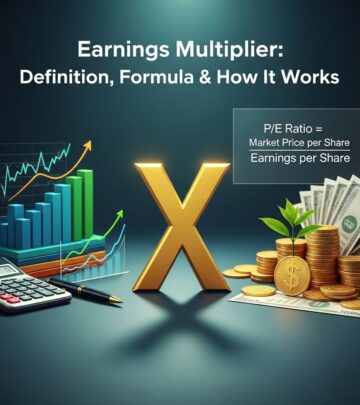
The price-to-earnings ratio, commonly known as the P/E ratio, stands as one of the most fundamental tools in an investor’s toolkit for evaluating a company’s stock value relative to its profitability. By dividing the current market price of a share by its earnings per share (EPS), this metric reveals how much investors are willing to pay for each dollar of a company’s earnings, offering insights into market expectations for future performance.
Understanding the Core Concept of P/E
At its essence, the P/E ratio quantifies the relationship between a stock’s price and the company’s underlying earnings power. A higher ratio typically reflects optimism about growth prospects, while a lower one might indicate caution or perceived undervaluation. This simple yet powerful indicator helps distill complex financial data into a single number that facilitates comparisons across companies and sectors.
Investors rely on it to answer critical questions: Is the stock priced fairly based on current profits? Does the market anticipate robust expansion ahead? However, context is crucial—isolated P/E figures without benchmarks can mislead.
How to Calculate the P/E Ratio Step by Step
Computing the P/E ratio is straightforward, requiring just two key inputs: the stock’s current market price and its EPS. The formula is:
P/E Ratio = Current Share Price / Earnings Per Share (EPS)
Key Components:
- Share Price: The real-time trading price on the stock exchange.
- EPS: Calculated as (Net Income – Preferred Dividends) / Average Outstanding Shares. This represents profit allocated to each share.
Example: Consider a company with shares trading at $40 and an EPS of $2. The P/E ratio is 40 / 2 = 20. This means investors pay $20 for every $1 of earnings.
| Company | Share Price | EPS | P/E Ratio |
|---|---|---|---|
| Tech Innovator Inc. | $50 | $3.00 | 16.7 |
| Stable Manufacturer Co. | $35 | $2.50 | 14.0 |
| Growth Pharma Ltd. | $80 | $4.00 | 20.0 |
This table illustrates varying P/E levels, highlighting how the metric aids quick comparisons.
Trailing vs. Forward P/E: Which to Use?
Two primary variants exist: trailing P/E and forward P/E, each serving distinct analytical purposes.
- Trailing P/E: Uses historical EPS from the past 12 months, providing a backward-looking snapshot grounded in actual results. Ideal for stable firms with predictable earnings.
- Forward P/E: Relies on projected future EPS from analyst estimates, forward-looking and speculative. Better suited for high-growth sectors where past performance doesn’t predict the future.
Forward P/E often appears lower for growth stocks due to anticipated earnings surges, but it carries higher uncertainty from forecasts.
Interpreting High and Low P/E Values
A P/E above the industry average may signal strong growth expectations, branding the stock as a ‘growth’ play with potential rewards but elevated risk. Conversely, a below-average P/E could flag a ‘value’ opportunity or underlying issues like stagnant growth.
Context matters immensely:
- High P/E (e.g., 25+): Common in tech or biotech, implying market bets on innovation-driven profits.
- Low P/E (e.g., under 10): Prevalent in utilities or mature industries, possibly indicating bargains or distress.
Always benchmark against peers; a standalone number lacks meaning.
Industry Benchmarks and Sector Variations
P/E norms differ sharply by sector due to growth rates, capital needs, and business models. Technology firms average 25-40, reflecting scalability, while energy or consumer staples hover at 10-15 for their steady cash flows.
| Sector | Average P/E Range | Typical Characteristics |
|---|---|---|
| Technology | 20-40 | High growth, innovation-focused |
| Healthcare | 15-30 | R&D intensive, regulatory hurdles |
| Utilities | 10-20 | Stable demand, dividends |
| Financials | 8-15 | Cyclical, interest-sensitive |
These ranges evolve with economic cycles; track updates via financial platforms.
Limitations and Pitfalls of Relying on P/E Alone
While invaluable, P/E has blind spots. It ignores debt, cash flows, and one-time events distorting EPS. Negative earnings render it useless, and accounting manipulations can inflate figures.
Other drawbacks:
- Doesn’t account for growth rates—use alongside PEG.
- Sensitive to interest rates; low rates boost high P/E stocks.
- Industry mismatches skew comparisons.
Combine with metrics like debt-to-equity, ROE, and free cash flow for a holistic view.
Enhancing P/E with the PEG Ratio
The price/earnings-to-growth (PEG) ratio refines P/E by factoring in expected annual EPS growth: PEG = (P/E) / Growth Rate (%). A PEG under 1 suggests undervaluation relative to growth; over 1 may indicate overpricing.
Example: Stock A: P/E 30, Growth 20% → PEG 1.5 (pricey). Stock B: P/E 20, Growth 25% → PEG 0.8 (attractive).
PEG bridges value and growth investing, ideal for dynamic markets.
Practical Strategies for Using P/E in Portfolio Building
Incorporate P/E systematically:
- Screen stocks by P/E relative to sector medians.
- Pair with forward estimates for growth tilts.
- Monitor changes over time for sentiment shifts.
- Diversify across P/E profiles: mix value and growth.
For beginners, start with index ETFs mirroring broad P/E averages to mitigate single-stock risks.
Real-World Case Studies: P/E in Action
During the 2020s tech boom, many SaaS companies sported P/Es over 50, justified by cloud adoption surges. Post-correction, those reverting to 20-30 ranges offered entry points. Meanwhile, value traps like declining retailers showed persistently low P/Es masking structural woes.
These examples underscore P/E’s role in timing and sector rotation.
Frequently Asked Questions (FAQs)
What does a negative P/E ratio mean?
It occurs when a company reports losses (negative EPS), making the ratio irrelevant for valuation. Focus on fundamentals and turnaround potential instead.
Is a higher P/E always bad?
No—context is key. High P/E can reflect justified growth premiums in innovative sectors.
How often should I check a stock’s P/E?
Quarterly with earnings releases, or real-time via apps for active trading.
Can P/E predict stock returns?
Not directly, but low P/E portfolios historically outperform over long horizons, per value investing principles.
Advanced Tips for Seasoned Investors
Delve into normalized EPS to smooth cyclical swings. Use justified P/E models incorporating payout ratios and growth rates for intrinsic value estimates: Justified P/E = (Payout Ratio) / (Required Return – Growth). Tools like Bloomberg or Yahoo Finance provide sector-adjusted views.
In volatile markets, blend trailing and forward P/E with scenario analysis for robust decisions.
References
- Understanding the price-to-earnings ratio: a key metric for stock valuation — AB Academies. 2023. https://www.abacademies.org/articles/understanding-the-pricetoearnings-ratio-a-key-metric-for-stock-valuation-17257.html
- The Price-to-Earnings (P/E) Ratio Explained — Guinness Global Investors. N/A. https://www.guinnessgi.com/insights/pe-ratio
- Price Earnings Ratio – Formula, Examples and Guide to P/E Ratio — Corporate Finance Institute. N/A. https://corporatefinanceinstitute.com/resources/valuation/price-earnings-ratio/
- Price-to-Earnings ratio explained: What it is and how to use it — Saxo Bank. N/A. https://www.home.saxo/learn/guides/financial-literacy/price-to-earnings-ratio-explained-what-it-is-and-how-to-use-it
- What is price-to-earnings (P/E) ratio? — Fidelity Investments. N/A. https://www.fidelity.com/learning-center/trading-investing/pe-ratio
- Price-to-Earnings Ratio Formula, Meaning, and Examples — Klipfolio. N/A. https://www.klipfolio.com/resources/kpi-examples/financial/price-to-earnings-ratio
- Using the P/E Ratio in Your Stock Analysis — Charles Schwab. N/A. https://www.schwab.com/learn/story/stock-analysis-using-pe-ratio
Similar Articles








Read full bio of medha deb