Decoding PITI: Your Guide to Mortgage Payments
Unlock the secrets of PITI—principal, interest, taxes, and insurance—and master your monthly mortgage costs for smarter home buying.

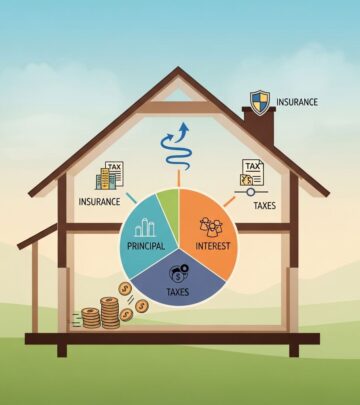
PITI represents the core components of a typical monthly mortgage payment:
principal
,interest
,taxes
, andinsurance
. This breakdown helps homeowners understand their full housing costs beyond just the loan amount.Why PITI Matters in Home Financing
Understanding PITI is crucial because it forms the total monthly obligation lenders evaluate during loan approval. Lenders use PITI to assess affordability through metrics like the debt-to-income (DTI) ratio, ensuring borrowers can handle payments alongside other debts.
For most mortgages, PITI encapsulates not only loan repayment but also ongoing property ownership expenses. Payments are often escrowed, meaning portions go into a dedicated account managed by the lender for taxes and insurance disbursements.
Breaking Down the Principal Component
The
principal
is the original loan amount borrowed to purchase the home, excluding interest or fees. For instance, on a $400,000 home with a $80,000 down payment, the principal would be $320,000.Each monthly payment reduces this balance gradually. Early in the loan term, a smaller portion targets principal reduction, with more allocated to interest. Over time, this shifts, accelerating equity buildup.
- Principal reduction builds home equity.
- Larger down payments lower the initial principal.
- Amortization schedules detail how payments split between principal and interest.
Understanding Interest Charges
**Interest** is the lender’s fee for providing the loan, calculated as a percentage of the outstanding principal. Rates are quoted annually but applied monthly.
For a $320,000 loan at 6.75% interest over 30 years, the principal and interest portion might total about $2,076 monthly. Shopping multiple lenders can secure better rates, directly impacting this cost.
The formula for monthly principal and interest (PI) payment is:
M = P [ r(1 + r)^n ] / [ (1 + r)^n - 1 ]
Where: M = monthly payment, P = principal, r = monthly interest rate, n = number of payments.
Property Taxes in Your PITI
**Taxes** refer to local property taxes levied by governments based on assessed home value and location. These are recurring costs, often paid annually but prorated monthly into PITI via escrow.
Rates vary widely: urban areas might charge 2-3% of value yearly, while rural spots are lower. Lenders estimate these for qualification, adjusting if assessments change.
| Location Example | Annual Tax Rate (% of Value) | Est. Monthly for $400k Home |
|---|---|---|
| Texas Average | 1.8% | $600 |
| New Jersey Average | 2.4% | $800 |
| National Median | 1.1% | $367 |
Table estimates based on typical rates; actuals depend on local assessments.
Homeowners Insurance Essentials
**Insurance** covers the home structure, personal property, and liability against perils like fire or theft. Lenders require it to protect their collateral.
Premiums factor in home value, location (e.g., flood zones increase costs), construction type, and coverage limits. A $400,000 dwelling might cost $1,500-$2,500 annually, or $125-$208 monthly.
- Shop policies for competitive rates.
- Bundling with auto insurance often saves 10-20%.
- Escrow ensures timely renewal payments.
Escrow Accounts and PITI Management
Most loans with less than 20% down require an escrow account where lenders collect and hold funds for taxes and insurance. This simplifies payments but can lead to annual adjustments if costs rise.
Benefits include avoiding large lump-sum bills; drawbacks are potential shortages requiring reimbursement. Review annual escrow statements to track balances.
Additional Costs Beyond Standard PITI
While PITI covers basics, extras like HOA fees (PITIA), private mortgage insurance (PMI), or flood insurance may apply.
PMI protects lenders on conventional loans with under 20% down, costing 0.5-1% of loan annually. It auto-terminates at 78% loan-to-value or can be requested at 80%.
VA loans exclude upfront fees but include funding fees rolled into principal.
Calculating Your Total PITI
To estimate PITI:
- Calculate PI using the formula or online tools.
- Add monthly property taxes (annual/12).
- Add monthly insurance premium.
- Include PMI/HOA if applicable.
Example: $320k loan @6.75% (PI: $2,076) + $500 taxes + $150 ins = $2,726 monthly.
Lender Underwriting and PITI Ratios
Lenders cap PITI at 28% of gross income (front-end DTI) and total debt at 36% (back-end). Exceeding these risks denial.[10]
Strong credit, stable income, and reserves improve approval odds. Preapproval reveals personalized PITI limits.
Strategies to Lower Your PITI Burden
Reduce PITI proactively:
- Bigger down payment: Cuts principal and avoids PMI.
- Boost credit score: Unlocks lower rates.
- Refinance: If rates drop, swap for better terms.
- Appeal taxes: Challenge assessments for reductions.
- Shop insurance: Compare quotes annually.
| Strategy | Potential Savings | Example Impact |
|---|---|---|
| 20% Down vs 10% | Eliminates PMI | -$150/mo |
| Rate Drop 1% | Lower Interest | -$200/mo on $320k |
| Refinance | Combined Effect | -$400+/mo |
Common PITI Myths Debunked
- Myth: PITI is fixed forever. Reality: Taxes/insurance fluctuate; rates adjustable via refi.
- Myth: Only principal/interest matters. Reality: Full PITI determines affordability.
- Myth: Escrow is optional. Reality: Required for many loans.
Frequently Asked Questions (FAQs)
What exactly does PITI stand for?
PITI means principal (loan balance), interest (borrowing fee), taxes (property levies), and insurance (home coverage).
Is PMI part of PITI?
Not always; it’s added for low-down-payment conventional loans but separate from core PITI.
How often does PITI change?
PI is fixed on fixed-rate loans; taxes/insurance adjust annually via escrow analysis.
Can I opt out of escrow?
Possible with 20%+ down and lender approval, but rare.
Does PITI apply to all mortgages?
Primarily conventional/FHA/VA; some interest-only loans exclude principal initially.
Long-Term PITI Planning for Homeowners
Monitor PITI yearly: review escrow, shop insurance, track equity for refi opportunities. Budget 1-3% of home value annually for maintenance beyond PITI.
As principal declines, redirect savings to investments or debt payoff. Tools like amortization calculators aid forecasting.
References
- What is PITI? — Consumer Financial Protection Bureau. 2023-10-01. https://www.consumerfinance.gov/ask-cfpb/what-is-piti-en-152/
- What is Principal, Interest, Taxes, and Insurance (PITI)? — The Federal Savings Bank. 2024-05-15. https://www.thefederalsavingsbank.com/Blog/what-is-principal-interest-taxes-and-insurance-piti/
- Principal, Interest, Taxes and Insurance (PITI) — Gate City Bank. 2024-01-20. https://www.gatecity.bank/education/glossary/principal-interest-taxes-and-insurance/
- What Does PITI Mean On A Mortgage? — Bankrate. 2025-11-12. https://www.bankrate.com/mortgages/piti/
- PITI — Wikipedia (informational). N/A. https://en.wikipedia.org/wiki/PITI
Similar Articles








Read full bio of medha deb