Decentralized Finance (DeFi): Complete Guide
Understanding DeFi: How blockchain technology is revolutionizing financial services and banking.
What Is Decentralized Finance (DeFi)?
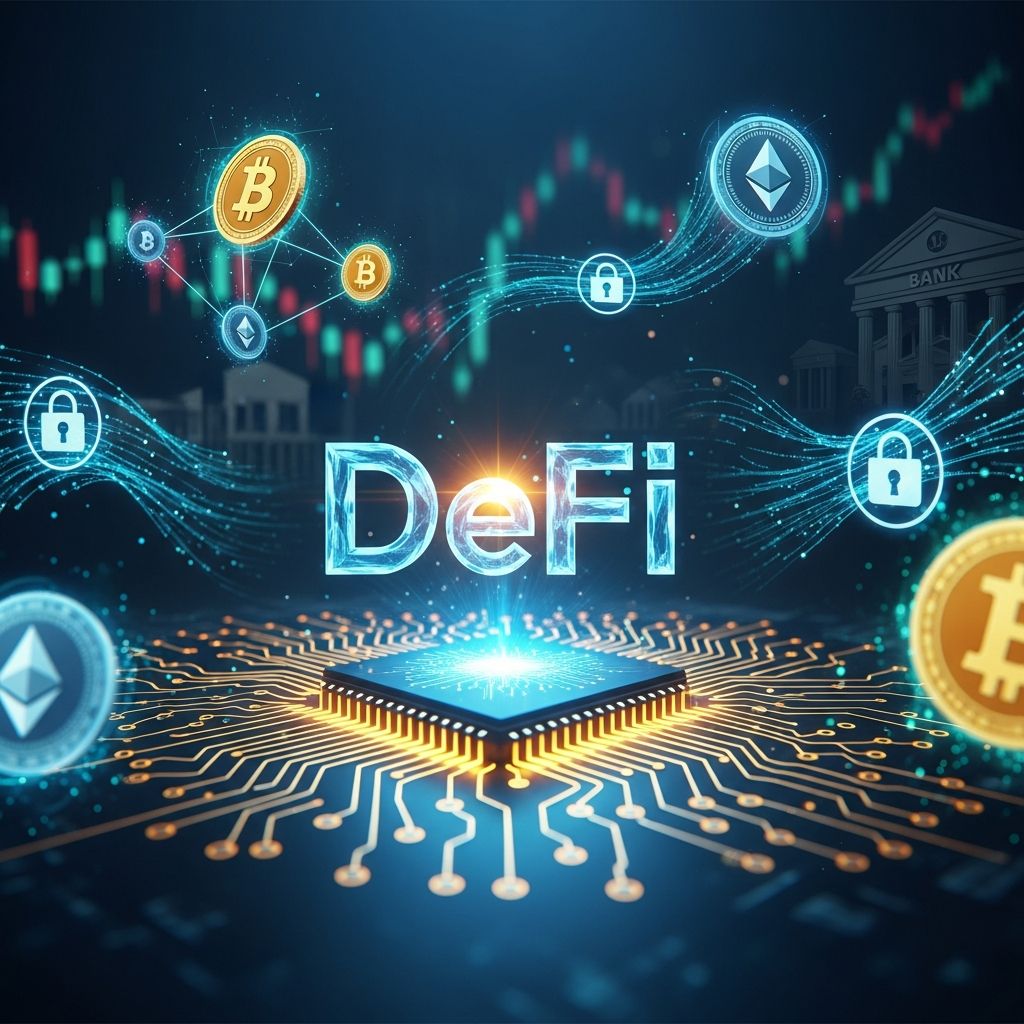
Decentralized Finance, commonly known as DeFi, represents a revolutionary approach to financial services built on blockchain technology. Unlike traditional financial systems that rely on centralized intermediaries such as banks, brokers, and payment processors, DeFi platforms enable peer-to-peer financial transactions directly between users without requiring intermediaries. This transformation is facilitated by smart contracts—self-executing code that automatically enforces the terms of an agreement when predetermined conditions are met.
DeFi encompasses a wide range of financial services including lending, borrowing, trading, asset swaps, yield farming, and insurance, all operating on decentralized networks. The primary advantage of this approach is that it removes the need for traditional gatekeepers, reduces transaction costs, improves transaction speed, and provides financial services to anyone with an internet connection, regardless of geographic location or banking status.
The DeFi ecosystem primarily operates on blockchain networks like Ethereum, though other platforms such as Binance Smart Chain, Polygon, and Solana have also become significant players in the space. These networks provide the infrastructure necessary for users to interact with decentralized protocols and smart contracts securely and transparently.
How Does Decentralized Finance Work?
DeFi operates through a combination of blockchain technology, smart contracts, and decentralized applications (dApps). Understanding the mechanics of DeFi requires comprehending several key components and processes:
Smart Contracts and Automation
Smart contracts are the backbone of DeFi platforms. These are self-executing programs written in code that automatically execute transactions when specific conditions are met. For example, a lending smart contract might automatically disburse funds to a borrower and set up repayment terms, all without human intervention. This automation eliminates the need for intermediaries and reduces the potential for human error or manipulation.
Blockchain Networks
DeFi transactions are recorded on public blockchains, which maintain a distributed ledger of all transactions. This ensures transparency and security, as every transaction is cryptographically verified and permanently recorded. The decentralized nature of these networks means no single entity controls the system, making it resistant to censorship and system failures.
Liquidity Pools
Many DeFi protocols use liquidity pools, where users deposit cryptocurrency into smart contracts to enable trading and lending. In return, these liquidity providers earn fees or rewards from the transactions that occur in their pools. This mechanism has replaced traditional order books used in centralized exchanges, allowing for more efficient and decentralized trading.
Tokenization
DeFi platforms use tokens to represent assets and ownership. Users receive tokens that represent their deposits, ownership stakes, or rewards. These tokens can be traded, transferred, or used within the ecosystem, providing flexibility and liquidity to users’ positions.
Key Features of Decentralized Finance
Several distinctive characteristics make DeFi appealing to users and investors:
- Accessibility: Anyone with a wallet and internet connection can access DeFi platforms, regardless of credit history or banking status. This is particularly beneficial for unbanked and underbanked populations worldwide.
- Transparency: All transactions and smart contract code are visible on the blockchain, allowing users to verify operations and identify potential risks.
- Lower Costs: By eliminating intermediaries, DeFi platforms significantly reduce fees associated with traditional financial services. Users benefit from reduced transaction costs and improved margins.
- Faster Transactions: Blockchain-based transactions settle much faster than traditional banking systems, which can take days to process payments.
- Programmability: Developers can create complex financial instruments and services by combining smart contracts, enabling innovation and new use cases.
- Composability: DeFi protocols can integrate with one another, creating a modular financial system where applications can build upon existing protocols.
- 24/7 Operation: Unlike traditional financial markets with fixed operating hours, DeFi platforms operate continuously, allowing users to trade and transact at any time.
Types of DeFi Platforms and Services
Decentralized Exchanges (DEXs)
Decentralized exchanges allow users to trade cryptocurrencies directly from their wallets without depositing funds on a centralized platform. DEXs use automated market makers (AMMs) to determine token prices and facilitate trades. Popular DEXs include Uniswap, SushiSwap, and Curve Finance. These platforms are faster, more transparent, and provide better control of funds compared to centralized exchanges.
Lending and Borrowing Platforms
DeFi lending protocols enable users to deposit cryptocurrency to earn interest or borrow against their crypto holdings. These platforms automatically match lenders and borrowers while smart contracts manage repayment terms and collateral. Notable platforms include Aave, Compound, and MakerDAO, which have accumulated billions in total value locked (TVL).
Staking Platforms
Staking involves holding cryptocurrency to validate network transactions and earn rewards. DeFi staking platforms make this process accessible and offer various staking options with different risk and reward profiles. Users can stake their holdings to support network security while generating passive income.
Derivatives and Prediction Markets
DeFi platforms offer decentralized derivatives trading, allowing users to speculate on price movements or hedge their positions. Prediction markets on platforms like Polymarket enable users to bet on real-world events. These services provide sophisticated trading tools previously available only through centralized institutions.
Asset Management and Yield Farming
Yield farming involves providing liquidity to DeFi protocols and earning rewards in return. Asset management platforms like Yearn Finance optimize yield farming strategies, automatically moving users’ funds to the most profitable opportunities. This allows users to earn competitive returns on their cryptocurrency holdings.
Insurance Protocols
Decentralized insurance platforms provide coverage against smart contract failures, hacks, and other DeFi-specific risks. Protocols like Nexus Mutual allow users to purchase insurance or become underwriters, creating a decentralized insurance market.
Advantages of Decentralized Finance
DeFi offers numerous benefits compared to traditional finance:
- Financial Inclusion: DeFi eliminates barriers to financial services, providing banking capabilities to billions of unbanked individuals worldwide.
- Enhanced Security: Blockchain-based systems provide cryptographic security and reduce fraud risk compared to traditional systems.
- User Control: Users maintain custody of their assets through private keys, eliminating counterparty risk associated with centralized institutions.
- Competitive Returns: DeFi yields are often substantially higher than traditional banking products, with lending rates reaching double digits annually.
- Reduced Middlemen: Eliminating intermediaries reduces costs and delays, improving market efficiency.
- Innovation: The open, programmable nature of DeFi enables rapid innovation and new financial products.
Risks and Challenges in DeFi
Smart Contract Vulnerabilities
Bugs or vulnerabilities in smart contract code can result in significant financial losses. While code audits help reduce risk, no smart contract is entirely free from potential issues. Users must carefully evaluate the security of protocols before depositing substantial funds.
Impermanent Loss
Liquidity providers in AMM-based DEXs face impermanent loss when token prices diverge significantly. This occurs when the value of tokens deposited differs considerably from their current market prices, potentially resulting in losses compared to simply holding the tokens.
Market Volatility
Cryptocurrency markets experience extreme price volatility, which amplifies risk in DeFi. Users can lose substantial portions of their investments during market downturns, and leveraged positions can result in liquidation.
Regulatory Uncertainty
The regulatory landscape for DeFi remains unclear globally. Future regulatory actions could restrict DeFi access, impose compliance requirements, or fundamentally alter how these platforms operate.
Liquidity Risks
Some DeFi tokens lack sufficient liquidity, making it difficult to exit positions without significant slippage. Low-liquidity tokens are more susceptible to price manipulation and sudden crashes.
Flash Loan Attacks
Flash loans allow users to borrow substantial amounts without collateral, provided they repay within a single transaction block. Attackers have exploited this feature to manipulate prices and extract profits, resulting in millions in losses.
Scams and Rug Pulls
New DeFi projects sometimes disappear after collecting user deposits in exit scams called “rug pulls.” Users must conduct thorough research and due diligence before investing in new protocols.
DeFi Market Growth and Statistics
The DeFi sector has experienced explosive growth since its inception. The total value locked (TVL) in DeFi protocols has grown from millions to tens of billions of dollars, representing one of the fastest-growing financial sectors globally. Major protocols now manage billions in assets, demonstrating significant institutional and retail adoption.
The rapid expansion reflects increasing mainstream acceptance of decentralized finance, growing recognition of its benefits, and continuous innovation within the ecosystem. However, growth has been volatile, with periodic corrections reflecting market sentiment changes and regulatory concerns.
Future of Decentralized Finance
DeFi continues to evolve rapidly, with several emerging trends shaping its future:
Institutional Adoption
Major financial institutions and corporations are increasingly exploring DeFi integration. This institutional interest could substantially expand DeFi markets and provide greater liquidity and stability.
Cross-Chain Solutions
Bridges connecting different blockchain networks are enabling users to move assets across chains and access liquidity across multiple ecosystems. This interoperability could significantly expand DeFi’s functionality.
Improved User Experience
Simplified interfaces, better wallet integration, and reduced technical barriers are making DeFi more accessible to non-technical users. These improvements are crucial for mainstream adoption.
Regulatory Clarity
As governments establish clearer regulatory frameworks for DeFi, market participants will gain greater certainty regarding legal compliance and operational requirements.
Enhanced Security
Advances in smart contract auditing, formal verification, and insurance solutions are reducing DeFi security risks and building user confidence.
Frequently Asked Questions (FAQs)
Q: Is DeFi the same as cryptocurrency?
A: No, while DeFi operates using cryptocurrencies and blockchain technology, they are distinct concepts. Cryptocurrency is digital money, whereas DeFi refers to financial services built on decentralized networks. DeFi uses cryptocurrencies as its native assets but encompasses broader financial applications beyond simple money transfers.
Q: How do I get started with DeFi?
A: To start using DeFi, you need a cryptocurrency wallet, some cryptocurrency holdings, and knowledge of available platforms. Research specific DeFi protocols, understand their mechanisms and risks, start with small amounts, and gradually increase your involvement as you gain experience.
Q: What is total value locked (TVL)?
A: TVL represents the total amount of cryptocurrency deposited in DeFi protocols. It serves as a key metric for assessing DeFi market size and protocol popularity. Higher TVL generally indicates greater protocol adoption, though it doesn’t guarantee safety or profitability.
Q: Are DeFi platforms regulated?
A: DeFi platforms exist in a regulatory gray area. Most operate without traditional financial licenses, though regulations are rapidly evolving globally. Users should understand applicable regulations in their jurisdictions before participating in DeFi activities.
Q: Can I lose money in DeFi?
A: Yes, DeFi investments carry substantial risks. Users can lose their entire investment due to smart contract vulnerabilities, market volatility, impermanent loss, or scams. Only invest amounts you can afford to lose and conduct thorough research before deploying capital.
Q: What’s the difference between DeFi and traditional finance?
A: Traditional finance relies on centralized institutions (banks, brokers) that serve as intermediaries and custodians. DeFi enables peer-to-peer transactions through smart contracts, offering greater transparency, lower costs, and accessibility, but with different risk profiles and less regulatory oversight.
References
- What Is Decentralized Finance (DeFi)? — Investopedia. 2024. https://www.investopedia.com/decentralized-finance-defi-5113835
- Smart Contracts: The Blockchain Application Every Enterprise Needs to Know — Ethereum Foundation. 2024. https://ethereum.org/en/developers/docs/smart-contracts/
- Decentralized Finance (DeFi): An Emerging Alternative Model — Federal Reserve Bank of St. Louis. 2023. https://research.stlouisfed.org/
- The DeFi Handbook: A Comprehensive Guide to Decentralized Finance — CoinGecko. 2024. https://www.coingecko.com/
- Automated Market Makers: A Framework for Decentralized Exchange Design — Paradigm Research. 2023. https://www.paradigm.xyz/
Similar Articles








Read full bio of medha deb