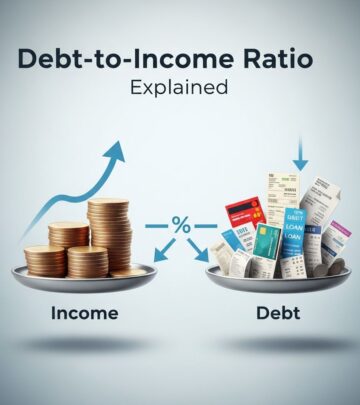
Debt-to-Income Ratio Explained
Master your debt-to-income ratio to unlock better loan approvals and financial freedom.

Your
debt-to-income ratio (DTI)
is a critical financial metric that lenders use to evaluate your borrowing capacity. It measures the percentage of your gross monthly income dedicated to debt repayments, helping determine if you can handle additional loans responsibly.Why DTI Matters in Today’s Economy
In an era of rising interest rates and housing costs, maintaining a healthy DTI is more important than ever. Lenders, including those for mortgages, auto loans, and personal credit, rely on this ratio to gauge risk. A strong DTI signals financial stability, while a high one can block approvals or lead to unfavorable terms.
According to the Consumer Financial Protection Bureau (CFPB), DTI directly influences your ability to service debts without strain. Banks like Navy Federal and Wells Fargo emphasize its role in mortgage and vehicle financing decisions.
Breaking Down the Two Core Types of DTI
DTI calculations split into two primary categories, each serving distinct purposes in loan assessments.
- Front-End DTI (Housing Ratio): Focuses solely on housing-related expenses like mortgage principal, interest, taxes, insurance, and HOA fees. This isolates your housing burden relative to income.
- Back-End DTI (Total Debt Ratio): Encompasses all recurring debts, including housing plus credit cards, auto loans, student debt, and alimony. This provides a holistic view of your financial commitments.
Lenders often prioritize the back-end ratio for comprehensive risk analysis, but mortgages scrutinize both.
Step-by-Step Guide to Calculating Your DTI
Computing your DTI is straightforward with these precise steps, backed by standard formulas from financial authorities.
- Compile Monthly Debt Obligations: Sum minimum payments on all debts. Include mortgage/rent, auto loans, student loans, credit card minimums, child support, and personal loans. Exclude non-debt expenses like groceries, utilities, or insurance premiums.
- Determine Gross Monthly Income: Use pre-tax earnings from wages, salaries, bonuses, rental income, and side gigs. For self-employed individuals, average the prior two years’ income.
- Perform the Division: Divide total monthly debts by gross monthly income (e.g., $2,000 debts ÷ $6,000 income = 0.333).
- Convert to Percentage: Multiply by 100 for your DTI (0.333 × 100 = 33.3%).
Real-World Calculation Examples
Consider these scenarios to illustrate:
| Scenario | Monthly Debts | Gross Income | DTI Calculation | Result |
|---|---|---|---|---|
| Single Homeowner | $1,900 (mortgage $1,200, car $300, student $350, card $50) | $4,000 | $1,900 ÷ $4,000 = 0.475 × 100 | 47.5% |
| High Earner | $2,480 (various loans) | $6,500 | $2,480 ÷ $6,500 ≈ 0.382 × 100 | 38.2% |
| Basic Renter | $2,000 (rent $1,500, auto $100, other $400) | $5,000 | $2,000 ÷ $5,000 = 0.4 × 100 | 40% |
These examples, drawn from lender guidelines, show how small debt changes significantly alter your ratio.
Ideal DTI Benchmarks for Loan Success
Lenders set DTI thresholds based on loan type and risk tolerance. General guidelines include:
- 36% or Lower: Excellent range; preferred for most loans, indicating ample budget flexibility.
- 37%-42%: Acceptable for conventional mortgages, but may require compensating factors like high credit scores.
- 43%-50%: Threshold for qualified mortgages (QM) under CFPB rules; FHA allows up to 50% with strong profiles.
- Over 50%: High risk; often disqualifies applicants unless exceptional circumstances apply.
Mortgage-specific limits: Front-end ideally under 28%, back-end under 36%. Government-backed loans offer more leniency.
Powerful Strategies to Reduce Your DTI
Improving DTI doesn’t require drastic measures. Implement these evidence-based tactics:
- Boost Income Streams: Add freelance work, overtime, or rental income to inflate your gross earnings denominator.
- Pay Down Principal Balances: Target high-interest revolving debts first to lower minimum payments.
- Refinance High-Rate Debts: Secure lower rates on auto or student loans to reduce monthly outflows.
- Consolidate Multiple Payments: Debt consolidation loans simplify and potentially cut totals without credit hits.
- Avoid New Debt: Pause credit applications during improvement phases to prevent ratio spikes.
Budget reviews reveal
Similar Articles








Read full bio of Sneha Tete