Debt Service Coverage Ratio: Step-By-Step Guide
Master the DSCR: Learn how this vital financial metric assesses your business's ability to handle debt and secure funding.
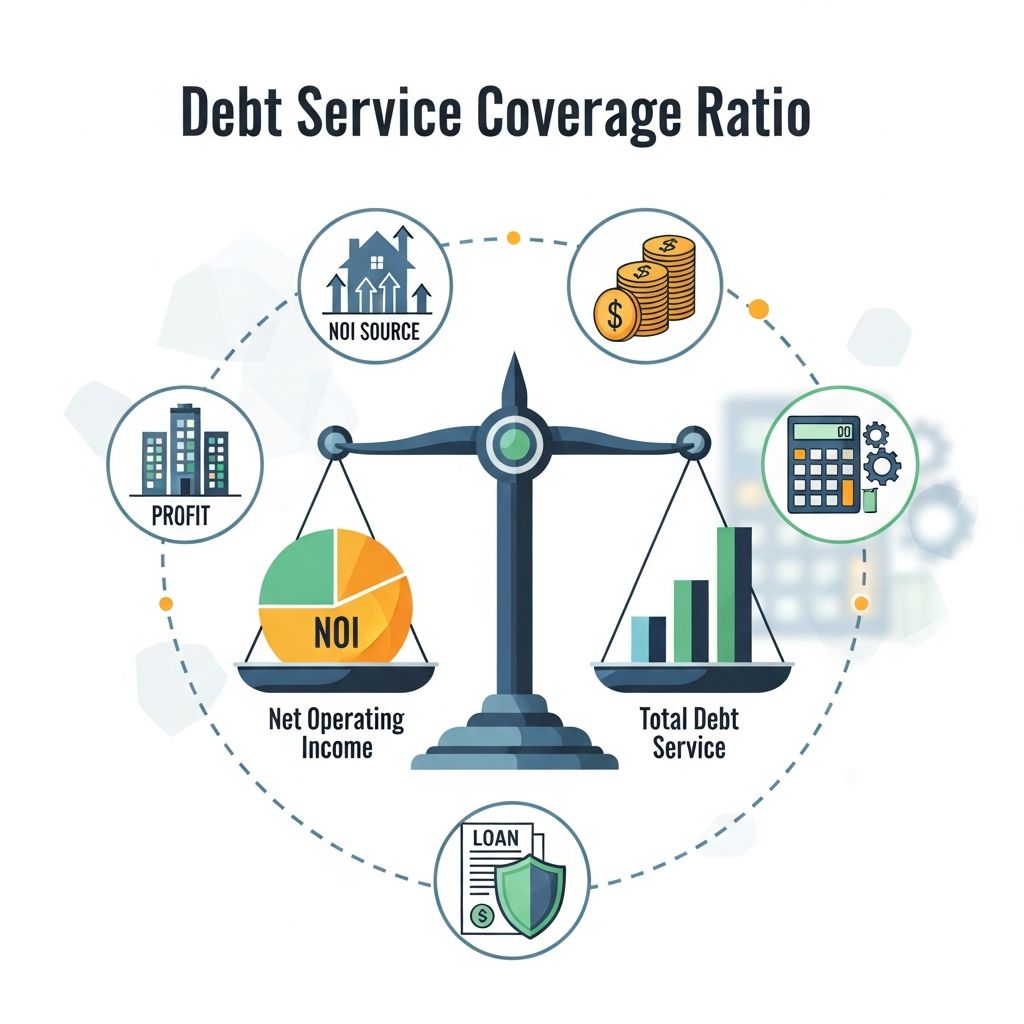
The Debt Service Coverage Ratio (DSCR) serves as a fundamental financial indicator that reveals whether a business produces sufficient cash flow to meet its debt obligations, including both principal repayments and interest expenses. Lenders and investors rely on this ratio to gauge creditworthiness and financial stability.
Why DSCR Matters in Business Finance
In the realm of commercial lending and corporate finance, DSCR provides a clear snapshot of operational efficiency relative to debt burdens. It helps stakeholders determine if earnings can sustain loan repayments without straining other essential activities like reinvestment or dividend payouts. A strong DSCR signals robust financial health, often paving the way for favorable loan terms or additional capital.
Businesses across industries—from manufacturing to real estate—use DSCR to monitor performance. For instance, in project finance, it ensures that cash flows from assets like renewable energy plants can support financing structures. Regularly tracking this metric allows owners to proactively address potential shortfalls before they impact credit ratings or operations.
Core Components of the DSCR Formula
At its essence, DSCR compares cash available for debt payments against total debt service costs. The standard formula uses Net Operating Income (NOI) or EBITDA divided by annual debt obligations:
DSCR = NOI (or EBITDA) / Total Debt Service
Here, NOI represents revenue minus operating expenses, excluding non-cash items like depreciation. Total Debt Service includes principal, interest, lease payments, and sometimes sinking fund contributions.
- Net Operating Income (NOI): Core earnings from operations, adjusted for taxes, interest, depreciation, and amortization in some variants.
- Total Debt Service: Sum of all required payments on outstanding debts over a period, typically one year.
Variations exist by context. In project finance, Cash Flow Available for Debt Service (CFADS) replaces NOI, accounting for maintenance capital expenditures and working capital changes: CFADS = EBITDA – Maintenance Capex ± Change in Working Capital – Cash Taxes.
Step-by-Step Guide to Calculating DSCR
Computing DSCR requires accurate financial statements and loan schedules. Follow these steps for precision:
- Gather Income Data: Extract EBITDA or NOI from your profit and loss statement. Verify figures with an accountant to avoid common errors like overlooking non-operating income.
- Compile Debt Details: Obtain repayment schedules from lenders, totaling principal and interest for the period. Include all facilities like term loans and lines of credit.
- Perform Division: Divide the cash flow numerator by the debt service denominator. For example, $500,000 NOI ÷ $300,000 debt service = 1.67 DSCR.
- Adjust for Context: In real estate or leasing, incorporate fixed charges; for corporations, use trailing twelve months (TTM) data for trends.
Tools like spreadsheets or online calculators simplify this, but manual verification ensures reliability, especially for covenant compliance.
Benchmarking Your DSCR: What Counts as Healthy?
Interpreting DSCR thresholds depends on industry, lender preferences, and economic conditions. Generally:
| DSCR Range | Interpretation | Typical Use Case |
|---|---|---|
| > 2.0 | Excellent – Ample cushion for growth and downturns | Prime borrowers, stable sectors like utilities |
| 1.2 – 2.0 | Good – Meets obligations with moderate buffer | Standard commercial loans, growing businesses |
| 1.0 – 1.2 | Marginal – Barely covers debt, risky | High-yield or turnaround financing |
| < 1.0 | Poor – Insufficient cash, potential default risk | Requires restructuring or equity infusion |
A ratio of 1.0 means earnings exactly match debt payments, leaving no room for taxes, capex, or surprises. Lenders often demand 1.25x or higher for covenants.
Real-World Examples Across Scenarios
Consider a manufacturing firm with $282,800 EBITDA, $21,000 interest, and $49,700 principal repayments. Debt service totals $70,700, yielding DSCR = 282,800 / 70,700 ≈ 4.0 – a stellar result indicating strong repayment capacity.
In retail, a brewery generates $500,000 NOI against $300,000 debt service (DSCR 1.67), qualifying it for SBA expansion loans amid sales growth. Contrast this with a startup at 1.07 ($150,000 EBITDA / $140,000 obligations), signaling tight margins needing cost controls.
For project finance, a solar asset with $150 CFADS and sculpted debt service of $100 achieves 1.50x, balancing risk with 10% interest on $800 debt.
Strategies to Strengthen Your DSCR
A suboptimal DSCR demands action. Key tactics include:
- Boost Revenues: Expand markets, optimize pricing, or launch products to lift NOI.
- Cut Costs: Streamline operations, negotiate supplier terms, or reduce overhead without harming growth.
- Refinance Debts: Secure lower interest rates or extend maturities to shrink service requirements.
- Manage Working Capital: Accelerate receivables and delay payables to free up cash.
- Equity Infusion: Inject owner capital to retire high-cost debt, improving ratios instantly.
Monitor quarterly; aim for trends above lender minimums to maintain compliance and access better financing.
DSCR in Lending and Investment Decisions
Banks and investors scrutinize DSCR during underwriting. It’s part of broader coverage analysis alongside interest coverage (EBIT/Interest) and fixed charge ratios. In SBA loans, a 1.15x minimum is common; private equity targets 1.5x+ for leveraged buyouts.
Non-compliance triggers events of default, waiving penalties or accelerating repayments. Proactive forecasting with scenario analysis (e.g., recession impacts) builds lender confidence.
Common Pitfalls and How to Avoid Them
Errors erode accuracy:
- Inaccurate Debt Schedules: Always cross-check with lenders; bookkeepers often adjust miscalculations.
- Overlooking Adjustments: Exclude non-recurring items from NOI for realistic views.
- Ignoring Seasonality: Use annualized or TTM figures for volatile businesses.
- Static Analysis: Track over time; single-period snapshots mislead.
Engage accountants for audits and software for automation.
Industry-Specific DSCR Applications
DSCR adapts to sectors:
- Real Estate: NOI from rents covers mortgage; 1.25x typical.
- Project Finance: CFADS sculpts repayments; 1.3-1.8x for renewables.
- Manufacturing: EBITDA focus amid capex; >1.5x preferred.
- Services: High margins allow 1.2x; growth-stage flexibility.
Frequently Asked Questions
What is a strong DSCR for loan approval?
Most lenders seek 1.25x or higher; 1.5x+ offers better rates.
Does DSCR include lease payments?
Yes, in fixed charge variants; standard focuses on interest and principal.
How often should I calculate DSCR?
Quarterly for monitoring, annually for projections.
Can DSCR be below 1.0?
Possible short-term, but signals distress; improvement plans essential.
What’s the difference between DSCR and debt-to-equity?
DSCR assesses cash flow coverage; debt-to-equity measures leverage structure.
References
- What is the debt service coverage ratio (DSCR)? — BDC. 2023. https://www.bdc.ca/en/articles-tools/entrepreneur-toolkit/templates-business-guides/glossary/debt-service-coverage-ratio
- How to Calculate the Debt Service Coverage Ratio to Gain Visibility — DebtBook. 2023. https://www.debtbook.com/blog/capturing-your-debt-coverage-ratio-how-to-improve-covenant-compliance
- Debt Service Coverage Ratio (DSCR): Full Tutorial — Breaking Into Wall Street. 2023. https://breakingintowallstreet.com/kb/project-finance/debt-service-coverage-ratio/
- What is the debt-service coverage ratio (DSCR)? — Chase. 2023. https://www.chase.com/business/knowledge-center/start/what-is-the-debt-service-coverage-ratio
- Debt Service Coverage Ratio – Guide on How to Calculate DSCR — Corporate Finance Institute. 2023. https://corporatefinanceinstitute.com/resources/commercial-lending/debt-service-coverage-ratio/
- Calculating Your Debt-Service Coverage Ratio — Peoples State Bank. 2023. https://www.bankpeoples.com/learn/calculating-your-debt-service-coverage-ratio
- Debt Service Coverage Ratio Calculator — Brookline Bank. 2023. https://www.brooklinebank.com/business-calculator/debt-service-coverage-ratio-calculator/
Similar Articles








Read full bio of medha deb