Debt Service Coverage Ratio (DSCR): Definition and Calculation
Understanding DSCR: A key metric for assessing debt repayment capacity and loan eligibility.
Understanding the Debt Service Coverage Ratio (DSCR)
The Debt Service Coverage Ratio (DSCR), also referred to as the Debt Coverage Ratio (DCR), represents a critical financial metric that measures an entity’s capacity to generate sufficient cash flow to cover its debt obligations. These obligations include interest payments, principal repayment, and lease payments. The DSCR serves as a fundamental tool for lenders, investors, and financial analysts to assess whether a borrower can reliably meet their debt commitments from operational income.
In essence, the DSCR answers a straightforward question: Does the entity generate enough cash from its operations to pay back what it owes? A higher ratio indicates stronger financial health and a greater ability to service debt, while a lower ratio suggests potential financial stress. Understanding this metric is essential for anyone involved in lending, investing, or managing finances at any level.
Definition and Core Concept
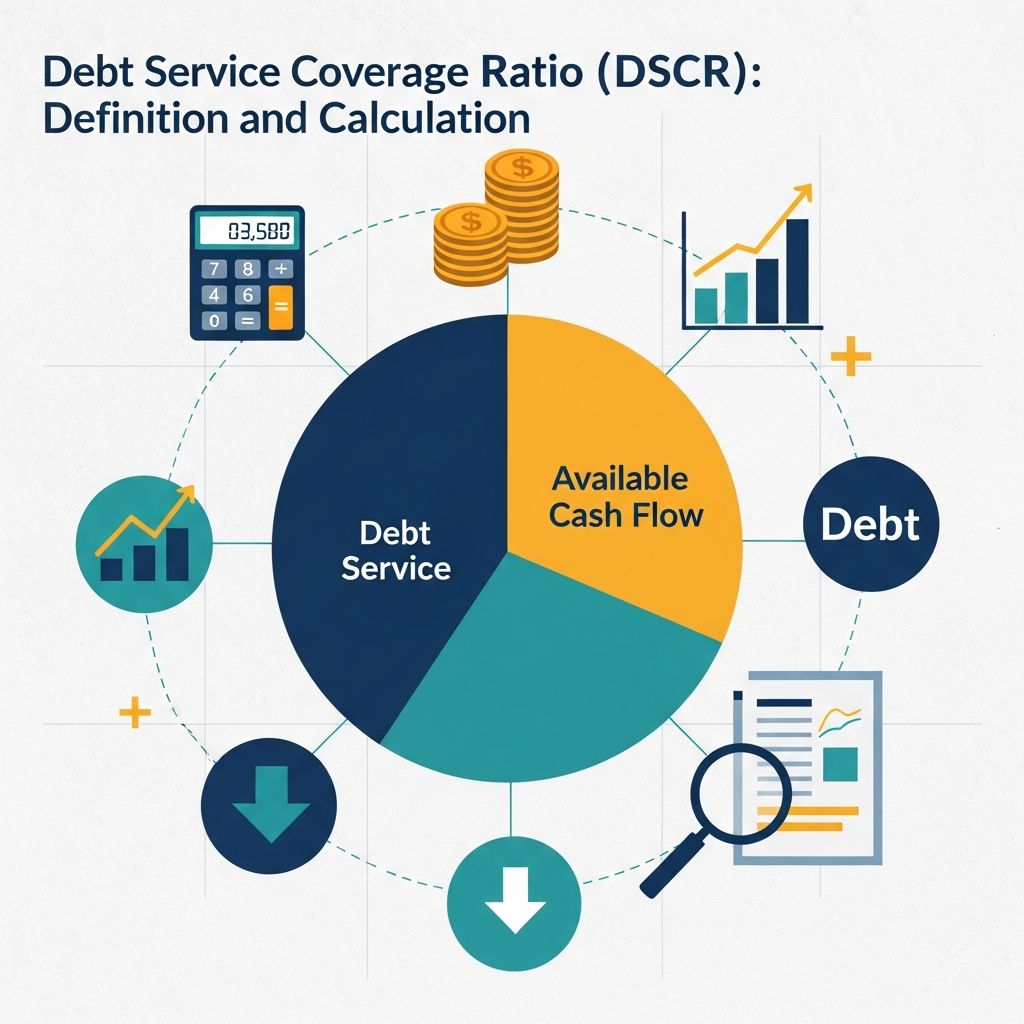
The DSCR is fundamentally a measure of cash flow relative to debt obligations. When an organization generates revenue and incurs operating expenses, the remaining amount—known as net operating income—represents the cash available for various purposes, including debt service. The DSCR specifically measures what proportion of this available cash is dedicated to servicing debt.
A ratio above 1.0 indicates that the entity generates more cash than required to cover its debt service, meaning operations produce surplus income after debt payments. Conversely, a ratio below 1.0 suggests insufficient operational cash flow to meet debt obligations, potentially requiring the entity to tap into reserves or seek additional financing. This simple distinction makes the DSCR an intuitive and powerful metric for understanding financial viability.
DSCR Formula and Calculation
The basic formula for calculating the Debt Service Coverage Ratio is straightforward:
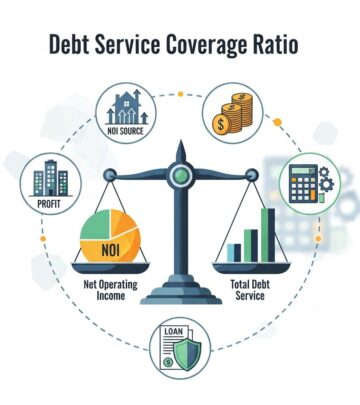
DSCR = Net Operating Income ÷ Debt Service
Breaking down the components:
- Net Operating Income (NOI) = Adjusted EBITDA = Gross Operating Revenue − Operating Expenses
- Debt Service = Principal Repayment + Interest Payments + Lease Payments
Net Operating Income represents the cash generated from regular business operations before accounting for taxes, interest, depreciation, and amortization. This figure excludes one-time expenses or gains and focuses on sustainable, recurring operational performance. Debt service encompasses all cash outflows required to meet debt obligations during the measurement period, typically calculated on an annual basis.
Interpretation of DSCR Values
Different DSCR values convey distinct messages about financial health and debt capacity:
| DSCR Range | Interpretation | Financial Status |
|---|---|---|
| Above 1.5 | Excellent coverage | Generates 50% more income than required for debt service |
| 1.25 to 1.5 | Strong coverage | 25–50% cushion above debt obligations |
| 1.0 to 1.25 | Adequate coverage | Meets obligations but limited buffer |
| Below 1.0 | Insufficient coverage | Negative cash flow; unable to cover debt from operations |
For example, a property with a DSCR of 1.5 generates enough income to cover all annual debt expenses and operating expenses while still producing fifty percent additional income beyond what is necessary for these payments. Conversely, a DSCR of 0.95 means the entity can only cover 95 percent of its annual debt payments from operating income, requiring supplemental funds from other sources to avoid default.
Applications Across Different Sectors
Corporate Finance
In corporate settings, the DSCR reflects the cash flow available for annual debt payments, including contributions to sinking funds designed to retire bonds ahead of schedule. Companies use this metric to assess their overall debt-servicing capacity and communicate financial health to stakeholders. A consistently strong DSCR signals management’s ability to balance growth investments with prudent debt management, while a declining DSCR may warrant concern among investors and creditors.
Personal Finance and Lending
Loan officers utilize DSCR to evaluate an individual’s debt repayment capacity when considering loan applications. Personal DSCR takes into account the applicant’s total income relative to all monthly debt obligations, including mortgages, auto loans, credit cards, and other liabilities. Lenders typically prefer borrowers with higher DSCRs, as they demonstrate greater capacity to absorb financial shocks and maintain consistent loan payments.
Commercial Real Estate
In commercial real estate lending, DSCR determines whether a property’s cash flow can sustain its debt obligations. This application is particularly critical because property income fluctuates based on occupancy rates, market conditions, and operational efficiency. Traditionally, banks required a DSCR of approximately 1.20 or higher for investment properties. However, some modern non-QM (non-qualified mortgage) and investor-focused lenders permit lower ratios under specific programs designed for qualified borrowers with strong outside income or reserves. The minimum DSCR set by lenders in the commercial real estate industry typically hovers around 1.25, ensuring that the property’s net operating income is at least 25 percent greater than annual debt service.
Why Lenders Set Minimum DSCR Thresholds
Lenders often establish minimum DSCR requirements in loan covenants to protect their interests and ensure loan repayment. These minimums typically exceed 1.0 to provide a safety buffer against revenue volatility and unexpected operational challenges. Falling below the lender-specified DSCR threshold may constitute a technical default, triggering loan acceleration or requiring immediate corrective action from the borrower.
The rationale behind these minimums is straightforward: a ratio significantly above 1.0 indicates the borrower has reliable cash flow to meet obligations even if circumstances deteriorate. This buffer protects both the lender’s investment and the borrower’s financial stability. Different lending products and risk profiles may justify different minimum thresholds, with conservative lenders demanding higher ratios and specialized lenders accepting lower ones for creditworthy borrowers.
DSCR Calculation Challenges and Solutions
Income Tax Complications
Income taxes present a significant challenge to DSCR calculation and interpretation. While conceptually the DSCR represents the ratio of cash flow available for debt service to required debt service, practical application is complicated because interest is tax-deductible while principal repayment is not. This creates ambiguity regarding which income figure most accurately represents cash available specifically for debt service.
EBITDA (Earnings Before Interest, Taxes, Depreciation, and Amortization) is appropriate for measuring a company’s ability to make interest-only payments, assuming working capital changes are negligible. However, EBIDA (without the “T”) provides a more accurate indicator of capacity to make required principal payments. Ignoring these distinctions can result in DSCR values that significantly overstate or understate true debt service capacity.
The Pre-Tax Provision Method
The Pre-Tax Provision Method addresses these calculation challenges by providing a single comprehensive ratio that reliably expresses overall debt service capacity despite tax complexities. This approach calculates DSCR as:
DSCR = EBITDA ÷ [Interest + (Pre-tax Provision for Post-Tax Outlays)]
The “Pre-tax Provision for Post-tax Outlays” represents the amount of pretax cash that must be reserved to meet required post-tax obligations, including principal repayment and taxes. This methodology provides a more nuanced and accurate assessment of debt service capacity by acknowledging the tax treatment differences between various debt components.
Debt Service Reserve Accounts (DSRA)
In project finance, entities may establish a Debt Service Reserve Account (DSRA) to offset temporary DSCR deficiencies. A DSRA functions as a financial safety net, holding reserves specifically designated for debt service payments. If operational cash flow temporarily falls below required debt service in a given period, funds from the DSRA bridge the gap, preventing default while the underlying business stabilizes.
DSRAs are particularly common in infrastructure projects, utility financing, and other capital-intensive ventures where revenue may be irregular or subject to seasonal fluctuations. By maintaining adequate reserves, project sponsors reduce lender risk and secure more favorable financing terms.
Strengths and Limitations of DSCR
Key Advantages
- Provides comprehensive assessment of all debt-related payments, not just interest
- Focuses on operational cash flow, offering practical insight into financial viability
- Applicable across diverse entities and industries
- Intuitive metric that stakeholders easily understand
- Directly relevant to lender decision-making and loan covenants
Important Limitations
- Net operating income can fluctuate significantly year to year
- Does not account for capital expenditure requirements or working capital needs
- May not capture one-time events or extraordinary circumstances
- Tax treatment complexities require careful interpretation
- Industry-specific norms vary, making cross-sector comparisons difficult
Practical Examples
Consider a retail business with annual gross operating revenue of $1,200,000 and operating expenses of $700,000, yielding a net operating income of $500,000. This company carries debt requiring $450,000 in annual principal repayment and $100,000 in annual interest payments, totaling $550,000 in debt service. The DSCR would be calculated as $500,000 ÷ $550,000 = 0.91. This ratio below 1.0 indicates the company’s operational cash flow covers only 91 percent of required debt service, meaning it must access additional funds monthly to maintain loan payments.
In contrast, a commercial real estate property generating $500,000 in net operating income with $400,000 in annual debt service would have a DSCR of 1.25, indicating 25 percent cushion above debt obligations. This property would likely satisfy typical lender requirements and demonstrate reasonable financial stability.
Frequently Asked Questions
What does a DSCR of 1.0 mean?
A DSCR of exactly 1.0 indicates that the entity generates precisely enough operational cash flow to cover its entire debt service. There is no surplus income available for other purposes, and any operational decline creates default risk. Most lenders prefer ratios significantly above 1.0.
Can a business with DSCR below 1.0 obtain financing?
While challenging, entities with DSCR below 1.0 may still secure financing under certain circumstances. Personal guarantees, strong outside income, substantial liquid reserves, or a compelling business plan may convince lenders to proceed. Specialized lenders often accept lower ratios than traditional banks but typically charge higher interest rates to compensate for increased risk.
How does DSCR differ from debt-to-income ratio?
DSCR focuses specifically on debt service payments relative to operational income, while debt-to-income ratio measures total debt relative to gross income. DSCR provides a more precise assessment of cash flow available for debt obligations.
What DSCR should businesses target?
Target DSCR depends on industry, business stage, and risk profile. Generally, established businesses should aim for 1.25 or higher, while growth-stage companies may be acceptable with ratios between 1.0 and 1.25. Real estate investors typically target 1.25 to 1.5.
How can a company improve its DSCR?
DSCR improvement requires either increasing net operating income through revenue growth and operational efficiency or reducing debt service through refinancing at lower rates or extending loan terms. Both strategies strengthen the ratio.
References
- Debt Service Coverage Ratio — Wikipedia. Accessed November 2025. https://en.wikipedia.org/wiki/Debt_service_coverage_ratio
- The Debt-Service Coverage Ratio (DSCR) — Investopedia. February 26, 2014. https://www.youtube.com/watch?v=MrlqbSDsSig
Similar Articles








Read full bio of Sneha Tete