Debt Relief Vs. Bankruptcy: How To Decide
Compare debt relief options and bankruptcy to find the best path to financial recovery and debt freedom.
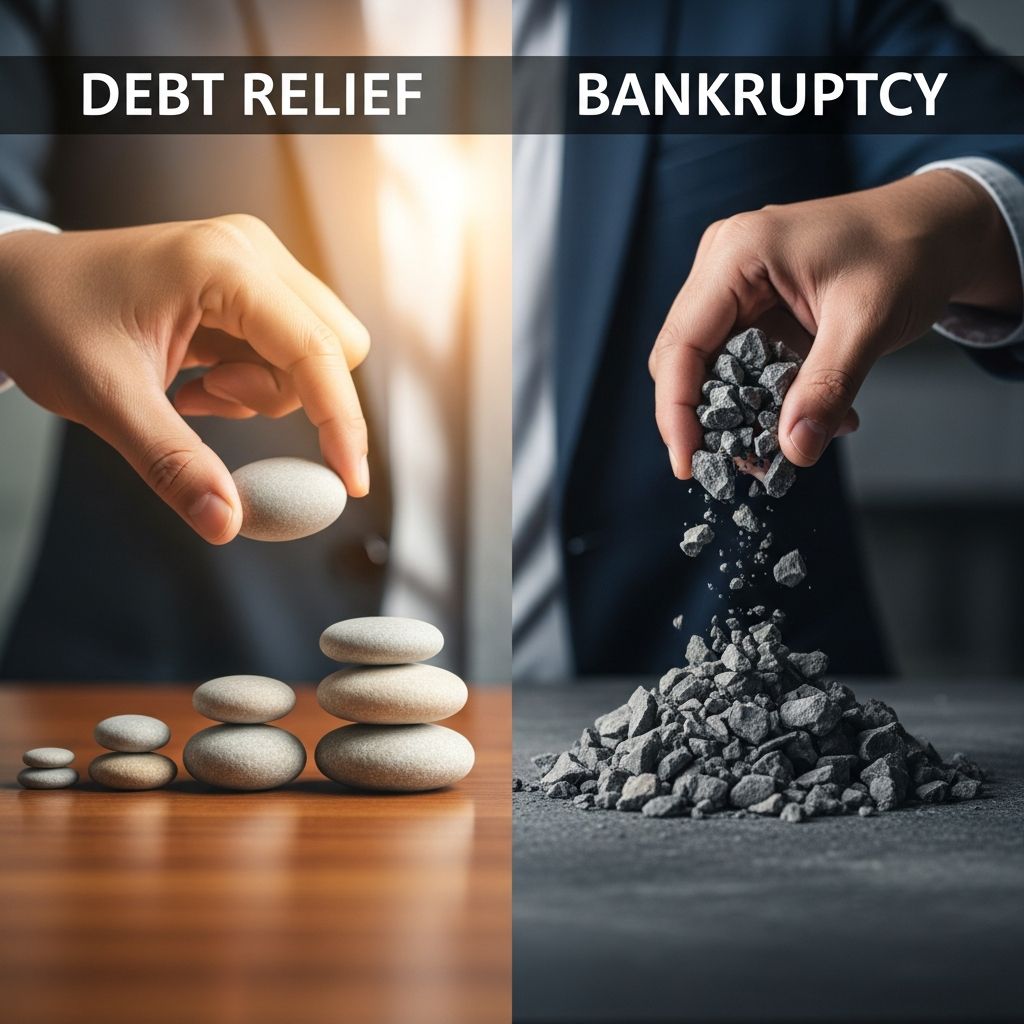
When overwhelming debt threatens your financial stability, two primary paths emerge: debt relief programs and bankruptcy filings. Debt relief encompasses strategies like settlement, consolidation, and management plans to negotiate better terms with creditors outside court. Bankruptcy, conversely, is a formal legal process offering court-supervised debt discharge or reorganization. Choosing between them hinges on debt amount, income, assets, and long-term goals, as each carries distinct consequences for credit, assets, and future borrowing.
What is Debt Relief?
Debt relief refers to non-judicial methods to reduce or manage unsecured debts such as credit cards, medical bills, and personal loans. Common types include debt settlement (negotiating lump-sum payments for less than owed), debt management plans (DMPs via credit counseling agencies that lower interest rates and consolidate payments), and debt consolidation loans (replacing multiple debts with one lower-interest loan). These approaches aim to make debt payable without court involvement, preserving privacy and flexibility.
Debt settlement companies negotiate with creditors to forgive 30-50% of balances, often requiring you to stop payments and save in an escrow account for 24-48 months. DMPs, offered by nonprofits, secure reduced rates (around 8%) and waived fees, with plans lasting 3-5 years. Consolidation suits those with good credit for new loans at lower rates. Success depends on creditor cooperation and your ability to fund settlements or plans.
Types of Debt Relief
- Debt Settlement: Creditors agree to accept 40-60% of balances as full payment; forgiven amounts may be taxable.
- Debt Management Plans (DMP): Single monthly payment to agency, distributed to creditors with concessions; no debt reduction but easier terms.
- Debt Consolidation: New loan pays off debts; risks home equity loans collateralizing assets.
Pros and Cons of Debt Relief
Debt relief avoids court stigma and offers tailored solutions. Advantages include debt reduction, lower payments, fixed payoff dates, and less severe credit damage (typically 7 years on reports). It maintains asset control without liquidation risk and allows ongoing negotiations.
Drawbacks involve no automatic creditor halt, potential lawsuits during negotiation, fees (15-25% of enrolled debt for settlement), tax on forgiven debt, and uncertain success if creditors refuse. Credit scores drop 100+ points from delinquencies needed for settlement.
| Aspect | Pros | Cons |
|---|---|---|
| Credit Impact | 7 years; less severe than bankruptcy | Delinquencies harm score significantly |
| Cost | Fees 15-25%; no court costs | Taxable forgiveness; failed plans waste money |
| Protection | Private process | No automatic stay; assets vulnerable |
What is Bankruptcy?
Bankruptcy is a federal court process under the U.S. Bankruptcy Code providing debt discharge (elimination) or reorganization. It triggers an automatic stay halting collections, lawsuits, garnishments, and foreclosures instantly upon filing. Primarily for individuals, it addresses unsecured and some secured debts when repayment is impossible.
Chapter 7 liquidates non-exempt assets for creditor payment, discharging remaining eligible debts in 4-6 months. Chapter 13 creates a 3-5 year repayment plan based on disposable income, allowing asset retention like homes and cars. Certain debts like student loans, recent taxes, child support, and alimony persist post-discharge.
Chapter 7 Bankruptcy
Chapter 7, or “liquidation,” suits low-income filers passing the means test (income below state median). A trustee sells non-exempt assets (exemptions protect home equity up to ~$27,900, vehicles ~$4,450 per IRS 2025 standards), distributing proceeds. Most filers lose no property due to exemptions; discharge erases credit cards, medical, payday loans.
Process: Credit counseling, filing petition ($338 fee), 341 meeting with trustee, financial management course, discharge. Ideal for overwhelming debt with few assets.
Chapter 13 Bankruptcy
Chapter 13, or “wage earner’s plan,” fits those with regular income failing Chapter 7 means test. Propose a plan paying priority/secured debts and portion of unsecured over 3-5 years. Keeps all assets; automatic stay protects against foreclosure/repossession. Discharge follows plan completion.
Filing fee $313; plans prioritize secured debts, arrears, then unsecured at 0-100% based on income. Suits homeowners or those with assets/non-dischargeable debts.
Pros and Cons of Bankruptcy
| Chapter | Pros | Cons |
|---|---|---|
| Chapter 7 | Quick discharge (6 months); fresh start; no taxes on discharged debt; stops collections | Asset liquidation risk; 10-year credit report; can’t file again 8 years |
| Chapter 13 | Retain assets/home/car; cramdown on loans; 2-7 year refile wait; stops collections | 3-5 year commitment; attorney fees; credit hit 7 years |
Key Differences: Debt Relief vs. Bankruptcy
| Factor | Debt Relief | Bankruptcy |
|---|---|---|
| Process | Private negotiation | Court-supervised |
| Credit Impact | 7 years; 100-150 pt drop | 7-10 years; 200+ pt drop |
| Debt Discharge | Partial settlement; taxable | Full for eligible; non-taxable |
| Asset Risk | Vulnerable to judgments | Protected by stay/exemptions |
| Cost | 15-25% fees; variable | $300-3,500 fees; predictable |
| Protections | None automatic | Immediate stay |
Eligibility and Limitations
Bankruptcy Chapter 7 requires passing means test; Chapter 13 needs steady income for plan funding. Both mandate pre-filing credit counseling and post-discharge courses. Can’t file Chapter 7 if recent prior filing.
Debt relief needs savable funds for settlements or income for DMPs; ineffective for no-income/no-asset cases or non-negotiable debts.
Credit Impact Comparison
Bankruptcy filings appear publicly: Chapter 7 for 10 years, Chapter 13 for 7 on reports, severely limiting loans/leases. Debt relief shows delinquencies/settlements for 7 years but allows faster rebuilding via secured cards. Post-bankruptcy, scores recover to 670+ in 1-2 years with good habits.
Which is Right for You?
- Choose Debt Relief if: Moderate debt, steady income, prioritizes privacy/minimal credit hit, creditors cooperative.
- Choose Bankruptcy if: Overwhelming debt, assets to protect, collections/lawsuits imminent, prior relief failed.
Assess debt-to-income, assets, goals. Consult NFCC-certified counselors or bankruptcy attorneys.
Frequently Asked Questions (FAQs)
What is the main difference between debt relief and bankruptcy?
Debt relief is informal negotiation outside court; bankruptcy is formal court process with legal protections.
Does debt relief hurt credit less than bankruptcy?
Yes, debt relief impacts for 7 years vs. bankruptcy’s 7-10; recovery faster but both lower scores substantially.
Can bankruptcy save my home from foreclosure?
Yes, automatic stay halts foreclosure; Chapter 13 allows catching arrears via plan.
Are forgiven debts in settlement taxable?
Yes, as income unless insolvent; bankruptcy discharges are not taxable.
How long does Chapter 7 bankruptcy take?
4-6 months from filing to discharge for most.
Can I file bankruptcy if I have a job?
Yes, Chapter 13 requires steady income; Chapter 7 if low per means test.
References
- Debt Relief vs. Bankruptcy — JG Wentworth. 2025. https://www.jgwentworth.com/resources/debt-relief-vs-bankruptcy
- Bankruptcy vs Debt Relief — National Debt Relief. 2025. https://www.nationaldebtrelief.com/resources/bankruptcy/bankruptcy-vs-debt-settlement/
- Bankruptcy vs. Debt Relief: Which Option Is Best for You? — InCharge Debt Solutions. 2025. https://www.incharge.org/bankruptcy/debt-settlement-vs-bankruptcy-which-is-right-for-you/
- Debt Relief vs. Bankruptcy: Why the Answer Isn’t Always One or the Other — BUCLaw Group. 2025-04. https://www.buclawgroup.com/blog/2025/april/debt-relief-vs-bankruptcy-why-the-answer-isn-t-a/
- Debt Settlement vs. Bankruptcy: Which Option Is Best? — Lyndon Ruhnke Law Firm. 2025. https://lyndonruhnke.com/blog/debt-settlement-vs-bankruptcy-which-option-is-best-for-your-financial-situation/
- Debt Relief vs. Bankruptcy: Pros, Cons & Key Differences — Debt.org. 2025. https://www.debt.org/bankruptcy/vs-debt-settlement/
Similar Articles








Read full bio of Sneha Tete