Debt Relief Strategies: Consolidation or Settlement?
Explore debt consolidation and settlement to find the best path to financial freedom tailored to your credit and budget needs.

Managing overwhelming debt requires strategic choices. Two prominent options—debt consolidation and debt settlement—offer distinct paths to financial recovery. Consolidation streamlines payments into a single account, often at reduced rates, while settlement negotiates lower balances with creditors. Understanding their mechanics, benefits, risks, and suitability helps debtors select the optimal approach.
Understanding Debt Consolidation
Debt consolidation merges multiple debts, such as credit cards or personal loans, into one new loan or account. This typically involves securing a consolidation loan with a lower interest rate or a balance transfer credit card. The goal is to simplify budgeting by replacing several payments with one manageable monthly obligation.
Borrowers qualify based on creditworthiness. Lenders assess income, debt-to-income ratio, and credit history. Those with good credit (scores above 670) often access rates from 6% to 18%, far below average credit card rates of 20%+.
- Types of consolidation: Personal loans, home equity loans, balance transfer cards, or debt management plans through nonprofits.
- Process: Apply for new credit, use funds to pay off existing debts, then repay the new loan on schedule.
- Timeline: Quick approval, often days to weeks.
Success hinges on affordability. Monthly payments must fit the budget, avoiding new debt accumulation. Consistent on-time payments can boost credit scores over time by reducing utilization and building positive history.
Decoding Debt Settlement
Debt settlement entails negotiating with creditors to accept less than the full owed amount, often via a third-party company. Debtors stop payments to old accounts, saving into a dedicated fund for lump-sum settlements. This targets unsecured debts like credit cards or medical bills.
No credit score minimum exists, making it accessible for those behind on payments. Companies charge fees (15-25% of enrolled debt) after successful settlements. The process spans 24-48 months, with creditors potentially forgiving 30-50% of balances.
- Steps involved: Enroll debts, cease direct payments, build savings, negotiate offers.
- Risks: Creditors may sue, accounts accrue fees/interest during negotiation.
- Forgiven debt: Taxable as income if over $600; expect IRS Form 1099-C.
Settlement resolves debt faster for high balances but trades short-term hardship for potential savings. Not all creditors agree, and partial enrollments may occur.
Key Differences: A Side-by-Side Analysis
| Aspect | Debt Consolidation | Debt Settlement |
|---|---|---|
| Payment Structure | Single monthly payment to new lender | Deposits to settlement account; irregular lump sums |
| Debt Reduction | No principal reduction; full repayment | Potential 30-50% reduction |
| Credit Requirements | Good to excellent credit needed | Poor credit acceptable |
| Timeline | Weeks to loan term (3-5 years) | 2-4 years |
| Costs/Fees | Interest (6-36%), origination fees | 15-25% fees + taxes on forgiven debt |
| Credit Impact | Temporary dip; improves with payments | Severe, long-term damage (7 years) |
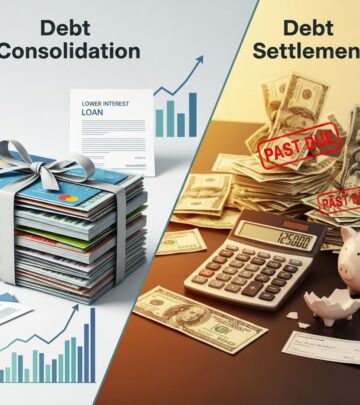
This comparison highlights consolidation’s structure versus settlement’s uncertainty. Consolidation preserves debt integrity; settlement gambles on creditor concessions.
Credit Score Consequences
Credit health is pivotal. Consolidation triggers a hard inquiry (5-10 point drop) and age reduction, but on-time payments lower utilization and add positive history, often yielding net gains within months.
Settlement devastates scores: missed payments mark delinquencies, settled accounts flag as derogatory for 7 years. Utilization spikes initially, hindering future approvals. Recovery demands years of flawless behavior post-resolution.
- Consolidation pro: Rewards discipline, maintains lender confidence.
- Settlement con: Signals risk, elevates borrowing costs long-term.
Financial and Tax Implications
Consolidation avoids tax hits since full principal repays. Interest may be deductible if qualified (e.g., home equity).
Settlement’s forgiven portions count as income. A $10,000 reduction triggers taxes on that amount, potentially $2,000+ liability at 20% bracket. Fees compound costs.
Budgeting differs: Consolidation demands steady income; settlement requires disposable funds for deposits amid income withholding.
Pros and Cons of Each Approach
Debt Consolidation Advantages
- Simplifies tracking with one payment.
- Lowers interest, accelerates payoff.
- Minimal credit disruption if managed well.
- No tax surprises.
Debt Consolidation Drawbacks
- Requires solid credit/income.
- Temptation to rack up old cards.
- Fees add to total cost.
Debt Settlement Advantages
- Reduces total owed significantly.
- Viable for defaulted debts.
- Avoids bankruptcy stigma.
Debt Settlement Drawbacks
- Credit ruin persists years.
- Lawsuits, collections during process.
- Fees + taxes erode savings.
- No settlement guarantee.
When to Pursue Consolidation
Opt for consolidation if current on payments, credit score exceeds 670, high-interest debts burden budget, and simplification aids control. Ideal for disciplined borrowers prioritizing credit health.
- Multiple cards at 20%+ APR.
- Affordable single payment.
- Future borrowing needs.
When Settlement Makes Sense
Choose settlement for insurmountable unsecured debt, poor credit, inability to pay full amounts, or bankruptcy avoidance. Best for those accepting credit hit for principal relief.
- Balances exceed 50% income.
- Already delinquent.
- No consolidation qualification.
Alternatives to Consider
Beyond these, explore debt management plans (nonprofit counseling, lower rates), balance transfers (0% intro APR), or bankruptcy (Chapter 7/13 for fresh start). Budgeting, increasing income, or creditor hardship programs complement strategies.
Steps to Get Started
- Assess situation: Tally debts, income, expenses; check credit report.
- Compare options: Prequalify loans, research settlement firms (AFCC-certified).
- Crunch numbers: Project costs, timelines via calculators.
- Seek advice: NFCC counselors for free guidance.
- Implement and monitor: Track progress, adjust as needed.
Frequently Asked Questions (FAQs)
Does debt consolidation hurt credit?
Temporarily yes, via inquiry and utilization shift, but improves long-term with payments.
Is debt settlement better than bankruptcy?
Often yes for unsecured debt, avoiding public record, though credit damage similar.
Can I do debt settlement myself?
Yes, but companies handle volume negotiations; success varies.
How much does consolidation save?
Depends on rate drop; e.g., 20% to 10% on $20k saves thousands in interest.
Will settlement stop collections?
Deposits help, but harassment may continue until settled.
References
- Debt Consolidation vs. Debt Settlement: How They Compare — National Debt Relief. 2024. https://www.nationaldebtrelief.com/es/blog/debt-guide/debt-consolidation/debt-consolidation-vs-debt-settlement-how-they-compare/
- Debt Consolidation vs Debt Settlement Which Is Better — MIDFLORIDA Credit Union. 2024. https://www.midflorida.com/resources/insights-and-blogs/insights/loans-credit/debt-consolidation-vs-debt-settlement-which-is-better
- Debt Consolidation vs. Debt Settlement: Which Is Better? — Experian. 2024. https://www.experian.com/blogs/ask-experian/debt-settlement-vs-debt-consolidation/
- Debt Consolidation vs Debt Settlement — InCharge Debt Solutions. 2024. https://www.incharge.org/debt-relief/consolidation-vs-settlement/
- Debt Settlement vs Debt Consolidation Pros & Cons — Debt.org. 2024. https://www.debt.org/settlement/vs-consolidation/
- Debt Consolidation Vs Debt Settlement — JG Wentworth. 2024. https://www.jgwentworth.com/resources/debt-consolidation-vs-debt-settlement
Similar Articles








Read full bio of Sneha Tete