Debt Financing: Definition, Types, Pros and Cons
Understanding debt financing: How businesses raise capital through loans and bonds.
What is Debt Financing?
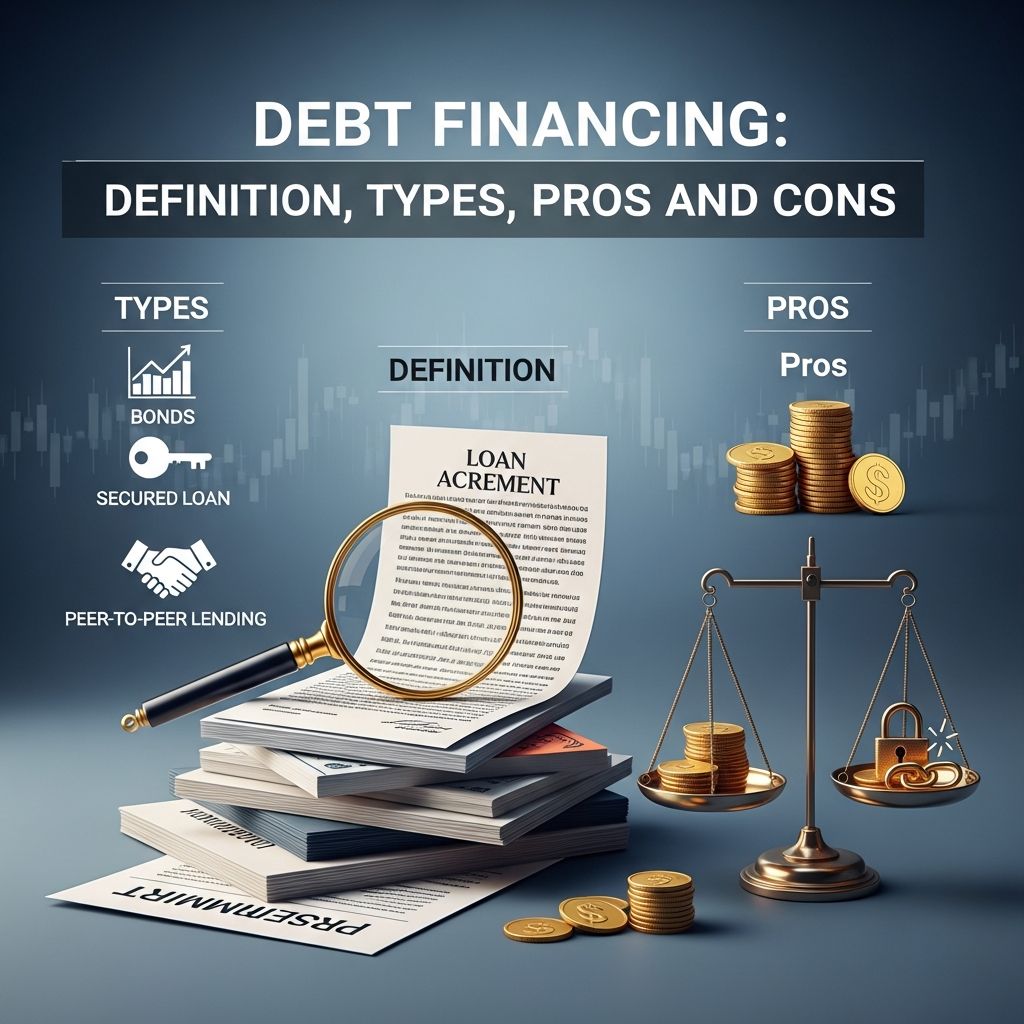
Debt financing occurs when a company raises capital by selling debt instruments, most commonly in the form of bank loans or bonds. This type of financing is often referred to as financial leverage, as it allows businesses to access funds while obligating themselves to repay the principal amount plus interest over a specified period. Understanding debt financing is essential for business owners, investors, and financial professionals who need to make informed decisions about how companies fund their operations and growth initiatives.
When a business pursues debt financing, it enters into a contractual agreement with lenders who provide capital in exchange for the promise of repayment with interest. Unlike equity financing, where investors receive ownership stakes in the company, debt financing preserves the business owner’s control and ownership. This distinction makes debt financing an attractive option for many established companies seeking to expand without diluting their equity.
How Debt Financing Works
The mechanics of debt financing are straightforward but require careful consideration. A business identifies its capital needs and approaches lenders or the securities market to borrow funds. Lenders evaluate the company’s creditworthiness, financial history, and ability to repay before extending credit. Once approved, the borrower receives the funds and is legally obligated to repay the debt according to agreed-upon terms.
The repayment structure typically includes both principal and interest. Principal represents the original amount borrowed, while interest is the cost of borrowing. Interest rates vary based on factors such as the company’s credit rating, the loan term, current market conditions, and the type of debt instrument used. Businesses must factor these costs into their financial planning to ensure they can service the debt while maintaining operations.
Types of Debt Financing
Bank Loans
Bank loans are the most common form of debt financing. Banks assess the individual financial situation of each company and offer loan sizes and interest rates accordingly. These loans can be structured as term loans with fixed repayment schedules or as revolving credit lines that provide flexible access to funds up to a predetermined limit. Banks typically require detailed financial statements, business plans, and sometimes collateral to secure the loan.
Bonds
Bonds are debt securities issued by companies to raise capital from the public market. A traditional bond certificate includes a principal value, a maturity term by which repayment must be completed, and an interest rate. Individuals or entities that purchase bonds become creditors by loaning money to the business. Bond financing allows companies to access large amounts of capital from multiple investors without relying on a single lender.
Other Debt Sources
Additional forms of debt financing include personal loans from family and friends and borrowing through credit cards. These options are particularly common with startups and small businesses that may not qualify for traditional bank financing. While these sources offer flexibility and potentially faster access to capital, they often come with higher interest rates and less formal terms.
Short-Term vs. Long-Term Debt Financing
Short-Term Debt Financing
Businesses use short-term debt financing to fund their working capital for day-to-day operations. This category includes paying wages, purchasing inventory, and covering costs for supplies and maintenance. The scheduled repayment for short-term loans is usually within one year. A common type of short-term financing is a line of credit, which is typically secured with collateral. Lines of credit are particularly useful for businesses struggling to maintain positive cash flow, such as startups.
Long-Term Debt Financing
Businesses seek long-term debt financing to purchase assets such as buildings, equipment, and machinery. The assets being purchased are usually also used to secure the loan as collateral. Long-term loans typically have scheduled repayment periods of up to 10 years, with fixed interest rates and predictable monthly payments. This structure allows businesses to match the repayment timeline with the useful life of the acquired assets.
Advantages of Debt Financing
Debt financing offers several compelling benefits for business owners and investors:
- Ownership Preservation: The primary reason companies choose debt financing over equity is to preserve company ownership. Unlike equity financing where investors retain voting rights and ownership stakes, debt financing keeps full ownership with the original business owners.
- Tax Deductibility: Interest paid on business debt is tax-deductible, reducing the company’s tax obligations and lowering the effective cost of borrowing.
- Fixed and Predictable Payments: Principal and interest payments are fixed and known, assuming the loan is repaid at a constant rate. This predictability facilitates accurate financial forecasting and budgeting.
- Lender Limitations: Debt capital is provided by lenders who are only entitled to repayment of capital plus interest. Once debt obligations are satisfied, the lender has no ongoing claim to the business.
- Faster Access to Capital: Established businesses with strong credit histories can often access debt financing more quickly than equity financing.
Disadvantages of Debt Financing
While debt financing provides substantial benefits, it also carries significant risks and drawbacks:
- Repayment Obligations: For some business owners, repaying debt can become a struggle. They must ensure the business generates sufficient income to pay regular installments of principal and interest, creating ongoing financial pressure.
- Collateral Requirements: Many lending institutions require business assets to be posted as collateral for the loan. These assets can be seized if the business fails to make payments, putting operational resources at risk.
- Credit Impact: Late or skipped payments negatively affect credit ratings, making it more difficult and expensive to borrow money in the future.
- Personal Asset Risk: Business owners sometimes must pledge personal assets as collateral, extending risk beyond the business itself.
- Bankruptcy Risk: If a business fails, the debt must still be repaid, potentially leading to personal bankruptcy if the owner has guaranteed the loan.
- Reduced Financial Flexibility: High debt levels can limit a company’s ability to take on additional financing or invest in new opportunities.
Debt Financing vs. Equity Financing
| Factor | Debt Financing | Equity Financing |
|---|---|---|
| Ownership Impact | Preserves original ownership | Dilutes ownership stake |
| Investor Control | Lender has no voting rights | Investors gain shareholder voting rights |
| Tax Treatment | Interest is tax-deductible | Dividends are not tax-deductible |
| Repayment Obligation | Fixed repayment schedule | No obligation to repay |
| Risk to Owner | High – collateral may be seized | Moderate – no collateral required |
| Cost of Capital | Lower – interest rates typically lower than required returns on equity | Higher – investors expect returns based on risk |
When Companies Choose Debt Financing
Well-established businesses that consistently generate sales, possess solid collateral, and are profitable typically rely on debt financing. These companies have demonstrated track records that make lenders confident in their ability to repay. Companies in stable industries with predictable cash flows are also well-suited for debt financing.
Conversely, newly launched businesses facing uncertainty in the future or businesses with high profitability but lower credit ratings are more likely to rely on equity financing. Startups often lack the financial history and collateral required for traditional debt financing, making equity investments from venture capitalists or angel investors more accessible.
Considerations for Choosing Debt Financing
Before pursuing debt financing, businesses should evaluate several critical factors. The company must assess its ability to generate sufficient cash flow to service debt payments consistently. Financial projections should include stress tests to ensure the business can maintain payments even during economic downturns.
The purpose of the borrowed capital is equally important. Short-term capital should not be used to fund long-term projects, and long-term debt should not be chosen to meet short-term needs. Matching the debt term to the intended use ensures financial stability and reduces risk.
Companies should also consider their current debt levels and debt-to-equity ratios. Overleveraging can create financial distress and limit future borrowing capacity. Industry standards and competitor financing structures can provide benchmarks for appropriate debt levels.
Impact of Debt Financing on Business Operations
Debt financing directly affects a company’s financial structure and operational flexibility. The fixed obligation to service debt reduces the cash available for other investments or operations. However, the tax benefits of debt financing can partially offset these costs by reducing tax liability.
The presence of significant debt can also influence how stakeholders perceive the company. Lenders and investors may view high debt levels as risky, potentially affecting the company’s ability to raise additional capital or negotiate favorable terms with suppliers and partners.
Frequently Asked Questions
What is the main difference between debt and equity financing?
The main difference is that debt financing preserves ownership while equity financing shares ownership. With debt, the business owner retains full control and must repay a fixed amount plus interest. With equity, investors receive ownership stakes and voting rights, but no repayment obligation exists.
Is debt financing suitable for startups?
Debt financing is generally challenging for startups because they lack financial history, established cash flows, and collateral. Startups typically rely more heavily on equity financing from angel investors or venture capitalists, though some may access small business loans or credit lines.
How does debt financing affect company taxes?
Interest payments on business debt are tax-deductible, reducing the company’s taxable income. This tax advantage effectively lowers the actual cost of borrowing and makes debt financing more attractive compared to equity financing, where dividends are not tax-deductible.
What happens if a company cannot repay its debt?
If a company cannot repay debt, lenders may seize collateral posted as security for the loan. The company’s credit rating deteriorates, making future borrowing more difficult and expensive. Severe cases may result in bankruptcy, where assets are liquidated to pay creditors.
How should businesses decide between short-term and long-term debt?
Short-term debt is appropriate for working capital and immediate operational needs with repayment within one year. Long-term debt suits capital expenditures for assets with longer useful lives. Matching the debt term to the intended use ensures financial stability and appropriate cash flow matching.
Can businesses use both debt and equity financing?
Yes, most established companies use a blend of debt and equity financing. The optimal capital structure balances the benefits and risks of each type, considering the company’s growth stage, industry, financial situation, and strategic goals.
References
- Debt Financing – Overview, How It Works, Pros and Cons — Corporate Finance Institute. 2024. https://corporatefinanceinstitute.com/resources/commercial-lending/debt-financing/
- What is Debt Finance? — ICAEW (Institute of Chartered Accountants in England and Wales). 2024. https://www.icaew.com/technical/corporate-finance/business-finance-guide/more-information/equity-vs-debt/what-is-debt-finance
- Small Business Administration Lending Guide — U.S. Small Business Administration. 2024. https://www.sba.gov/funding-programs/loans
- Understanding Business Finance and Capital Structure — Federal Reserve. 2024. https://www.federalreserve.gov/
Similar Articles








Read full bio of Sneha Tete