Debt Consolidation Loan vs. Balance Transfer Card
Understand the key differences between consolidation loans and balance transfer cards so you can choose the right strategy to pay off debt faster.
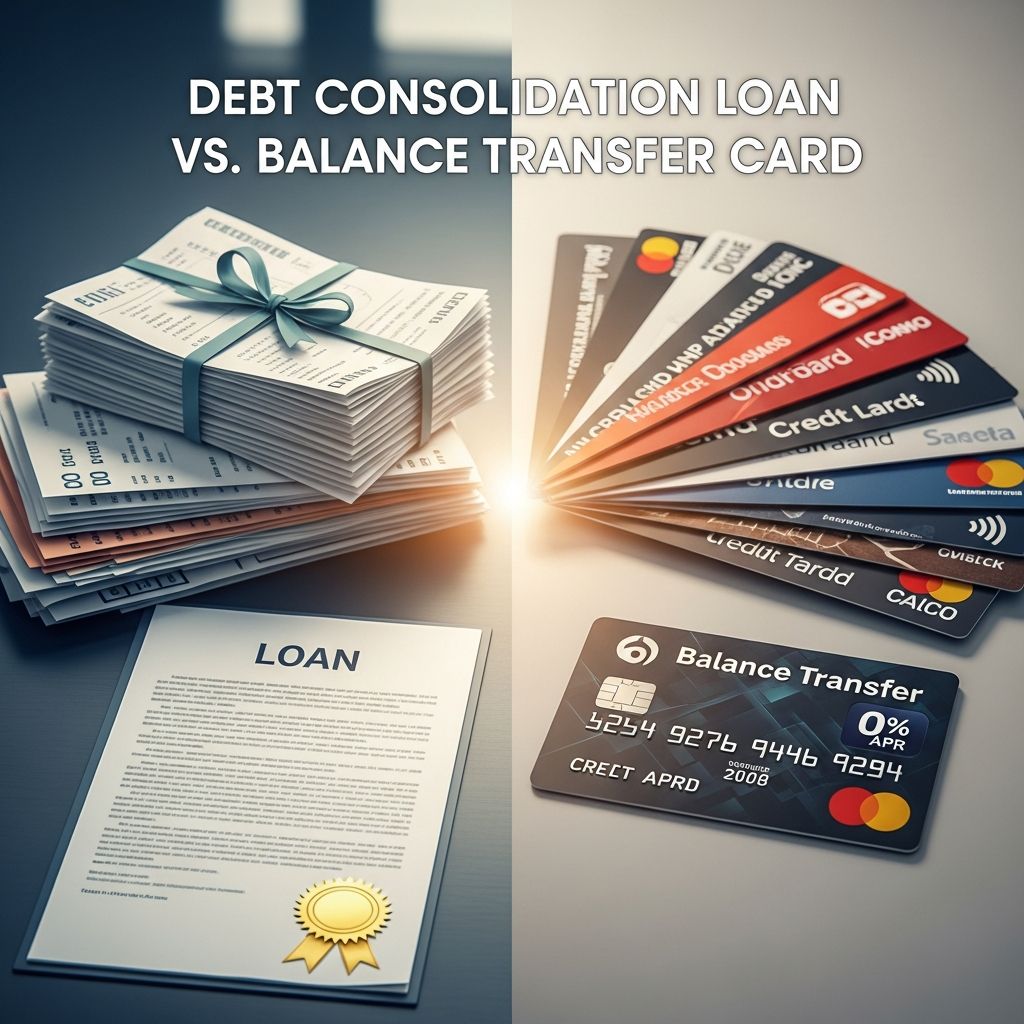
When high-interest debt starts to feel unmanageable, two popular strategies often come up: debt consolidation loans and balance transfer credit cards. Both can help you simplify payments and potentially save on interest, but they work very differently and suit different financial situations.
This guide explains how each option works, compares their pros and cons, and helps you decide which may be better for your debt payoff plan.
What Is a Balance Transfer Credit Card?
A balance transfer credit card lets you move existing credit card balances (and sometimes other types of debt) onto a new card, often with a low or 0% introductory APR for a set promotional period, typically 12–21 months.
During this promotional window, you can pay down the principal more quickly because little or no interest accrues. However, once the promo period ends, the card’s regular interest rate applies, which can be relatively high compared to personal loans.
Key Features of Balance Transfer Cards
- Introductory APR: Commonly 0% for 12–18 months, sometimes longer, on transferred balances.
- Balance transfer fee: Typically 3%–5% of the amount transferred.
- Revolving credit line: As you pay down your balance, your available credit replenishes.
- Approval based on credit: Best offers usually require good to excellent credit.
- Limited eligible debt types: Most cards focus on credit card debt, not all unsecured loans.
Pros of Balance Transfer Credit Cards
- Potentially pay no interest during the promo period, if you repay in full before it ends.
- Faster payoff when payments go mostly to principal instead of interest.
- Simplified payments if you move multiple credit card balances onto a single card.
- Flexible payments because it remains a revolving line of credit; you can adjust payments above the minimum as needed.
- You may end up with a card worth keeping for rewards or ongoing use after you’re debt-free (if you use it carefully).
Cons of Balance Transfer Credit Cards
- Balance transfer fees of 3%–5% can reduce the savings from the 0% APR.
- High interest after the promo period; any remaining balance may be subject to a much higher standard APR.
- Short payoff window: 0% periods are usually 12–21 months, which may not be enough for larger debts.
- Requires strong credit to qualify for the best offers and highest limits.
- Risk of new debt if you pay off old cards and then continue spending on them.
What Is a Debt Consolidation Loan?
A debt consolidation loan is usually a fixed-rate personal loan used to pay off multiple existing debts, such as credit cards, medical bills, or other unsecured loans.
You receive a lump sum, use it to pay your creditors, and then repay the new loan in fixed monthly installments over a set term, often between two and seven years. This transforms multiple variable-rate debts into one predictable payment.
Key Features of Debt Consolidation Loans
- Fixed interest rate: The rate stays the same over the life of the loan, giving you predictable payments.
- Term length: Commonly 24–84 months, allowing for longer payoff periods than most balance transfer promos.
- Wide debt coverage: Can be used for multiple types of unsecured debt, not just credit cards.
- Loan amount: Often higher than a typical balance transfer limit, useful for larger debts.
- Origination fees: Some lenders charge a fee for setting up the loan.
Pros of Debt Consolidation Loans
- Single monthly payment instead of juggling multiple creditors and due dates.
- Clear payoff date thanks to a fixed term and amortizing schedule.
- Potentially lower overall interest rate than high-interest credit cards, especially if your credit is fair to good.
- Longer payoff horizon, which can make payments more affordable if your debt is large.
- May be more accessible for fair or good credit compared with premium 0% balance transfer offers.
Cons of Debt Consolidation Loans
- Interest is always charged; there is no 0% promotional period.
- You may pay origination or prepayment fees, depending on the lender.
- The monthly payment may be high if you choose a shorter term to reduce interest costs.
- If you continue to use your credit cards after consolidating, you may end up with more total debt.
Balance Transfer vs. Debt Consolidation Loan: Side-by-Side Comparison
The table below summarizes the major differences between balance transfer credit cards and debt consolidation loans.
| Feature | Balance Transfer Card | Debt Consolidation Loan |
|---|---|---|
| Interest rate structure | Intro 0% APR for a limited period, then variable or fixed higher APR. | Fixed APR for the life of the loan. |
| Typical promo/term length | 0% APR usually 12–21 months. | 2–7 years for many personal loans. |
| Best for type of debt | Mainly credit card debt. | Multiple unsecured debts (cards, medical, personal loans). |
| Ideal debt amount | Smaller balances that can be paid off within the promo period. | Larger balances that require more time to repay. |
| Fees | Balance transfer fee (typically 3%–5%). | Possible origination or other loan fees. |
| Credit requirements | Generally good to excellent credit for best offers. | Available to a wider range of borrowers (including fair credit), though rates vary widely. |
| Payment structure | Revolving credit with variable monthly payment; minimums can be low. | Fixed monthly installment until paid off. |
| Risk if you don’t pay off in time | Remaining balance subject to higher APR after promo ends. | You pay interest for the full term; total cost may be higher if term is long. |
When a Balance Transfer Card Might Be Better
A balance transfer card can be a powerful tool if you are strategic and disciplined. It tends to work best when:
- You have good or excellent credit and can qualify for a 0% APR promo.
- Your total debt is relatively small and can realistically be paid off within the promotional window (e.g., 12–18 months).
- Your debt is mostly or entirely on credit cards, which are usually eligible for transfers.
- You can make consistently higher-than-minimum payments to eliminate the balance before the standard APR kicks in.
- You can avoid new spending on both the new balance transfer card and the old cards you just paid off.
Example Scenario: Good Fit for a Balance Transfer
Suppose you have $4,000 in credit card debt at 24% APR and can afford to pay $350 per month. If you obtain a 0% APR balance transfer card for 18 months with a 3% transfer fee, you would pay a $120 fee upfront, but if you stick to $350 monthly payments, you could pay off the balance within the promo period and avoid further interest. The key is ensuring your monthly payment plan fits comfortably within the promo timeframe.
When a Debt Consolidation Loan Might Be Better
A debt consolidation loan may be more suitable if:
- You have a larger total debt balance that would be hard to repay in 12–21 months.
- Your debt includes multiple types of unsecured debt, such as credit cards, medical bills, or personal loans.
- You prefer a fixed payment schedule and a definite payoff date.
- Your credit is fair or good rather than excellent, which may make a loan more attainable than a premium 0% card.
- You want to simplify budgeting with stable monthly payments at a single interest rate.
Example Scenario: Good Fit for a Consolidation Loan
Imagine you have $15,000 spread across several credit cards at rates between 20% and 26%. You qualify for a debt consolidation loan at 12% APR for five years. You now have one fixed monthly payment and a guaranteed payoff date, and your interest rate is significantly lower than on your previous cards. While you will still pay interest over those five years, it may be substantially less than what you would have paid keeping your balances on the cards.
Impact on Your Credit
Both options can affect your credit score in different ways.
Balance Transfer Card and Credit Score
- Opening a new card usually triggers a hard inquiry, which can cause a small, temporary score drop.
- If the new card raises your total available credit and you do not increase your balances, your credit utilization rate may fall, which is positive for your score.
- Closing old cards after transferring balances could reduce your total available credit and potentially hurt your utilization ratio and length of credit history.
Debt Consolidation Loan and Credit Score
- Applying for a personal loan also leads to a hard inquiry.
- Paying off revolving credit card balances with an installment loan can lower your credit utilization on cards, which can be beneficial because utilization is a major part of FICO Scores.
- On-time payments on the consolidation loan can help build a stronger payment history over time.
How to Choose Between a Balance Transfer and a Consolidation Loan
Consider the following questions to decide which solution better fits your needs:
- How much do you owe? Smaller balances often align better with a balance transfer; larger debts may require a consolidation loan.
- How quickly can you repay? If you can clear your debt within a 0% promo period, a balance transfer may save more. If you need several years, a loan may be more realistic.
- What is your credit profile? Excellent credit can unlock top-tier balance transfer offers; fair to good credit may be better suited to consolidation loans.
- What types of debt do you have? Credit card–only debt fits balance transfers; mixed unsecured debts fit consolidation loans.
- Do you need rigid structure or flexibility? Loans provide structure with fixed payments; cards offer flexibility but require more self-discipline.
Tips for Using Either Option Successfully
- Create a realistic payoff plan before you apply, including how much you will pay monthly and the payoff date.
- Compare total costs: interest, fees, and any potential charges if you miss payments or extend repayment.
- Avoid taking on new debt while you are still paying off consolidated balances.
- Consider free or low-cost credit counseling from reputable nonprofit organizations if you are unsure which route is best.
Frequently Asked Questions (FAQs)
Q: Is a balance transfer better than a debt consolidation loan?
A: Neither is universally better. A balance transfer may be better if you have strong credit, primarily credit card debt, and can pay it off during a 0% APR period. A consolidation loan may be better for larger or mixed debts, or if you need a longer, structured repayment schedule.
Q: Can I consolidate multiple types of debt with a balance transfer card?
A: Generally, balance transfer cards are best suited for credit card debt. Most issuers do not allow you to transfer installment loans or other unsecured debts to the card, which is where a debt consolidation loan can offer more flexibility.
Q: Will consolidating my debt hurt my credit score?
A: Both options involve a hard inquiry, which can temporarily lower your score slightly. Over time, consolidating and then making on-time payments and lowering your credit utilization can help improve your score.
Q: Are there any risks to using a balance transfer card?
A: The main risks include not paying off the balance before the promo period ends, which exposes you to higher interest, and running up new charges on your old cards, which can leave you with more debt instead of less.
Q: When should I consider professional help instead?
A: If your debt is so large that even a longer-term loan or multiple balance transfers are unlikely to make it manageable, or if you are consistently unable to meet minimum payments, consider speaking with a nonprofit credit counselor or financial advisor for additional options.
References
- Balance Transfer vs. Debt Consolidation Loan: Which Is Best? — Experian. 2023-05-15. https://www.experian.com/blogs/ask-experian/should-i-get-a-balance-transfer-card-or-debt-consolidation-loan/
- Debt consolidation loan vs. balance transfer credit card — Bankrate. 2024-03-01. https://www.bankrate.com/loans/personal-loans/balance-transfer-credit-card-vs-personal-loan/
- Balance Transfer Card or Personal Loan: Which Is Best? — NerdWallet. 2023-11-10. https://www.nerdwallet.com/personal-loans/learn/debt-consolidation-credit-card-balance-transfer
- What is the difference between a balance transfer and debt consolidation? — Freedom Federal Credit Union. 2022-06-01. https://www.freedomfcu.org/faq/what-is-the-difference-between-a-balance-transfer-and-debt-consolidation/
- Debt Consolidation Loan or Balance Transfer? Know Your Options — GreenPath Financial Wellness. 2023-09-20. https://www.greenpath.com/blog/debt/debt-consolidation-loan-or-balance-transfer/
- Debt consolidation loan vs. balance transfer credit card — Fortune. 2023-08-14. https://fortune.com/article/personal-loan-vs-balance-transfer-credit-card/
- How does a Debt Consolidation Loan compare to a balance transfer credit card? — People Driven Credit Union. 2022-04-10. https://www.peopledrivencu.org/faqs/how-does-a-debt-consolidation-loan-compare-to-a-balance-transfer-credit-card/
Similar Articles








Read full bio of medha deb