Daily vs. Monthly Compounding: Which Grows Savings Faster?
Understand how daily and monthly compounding work, how they affect savings growth, and when the difference in interest truly matters.
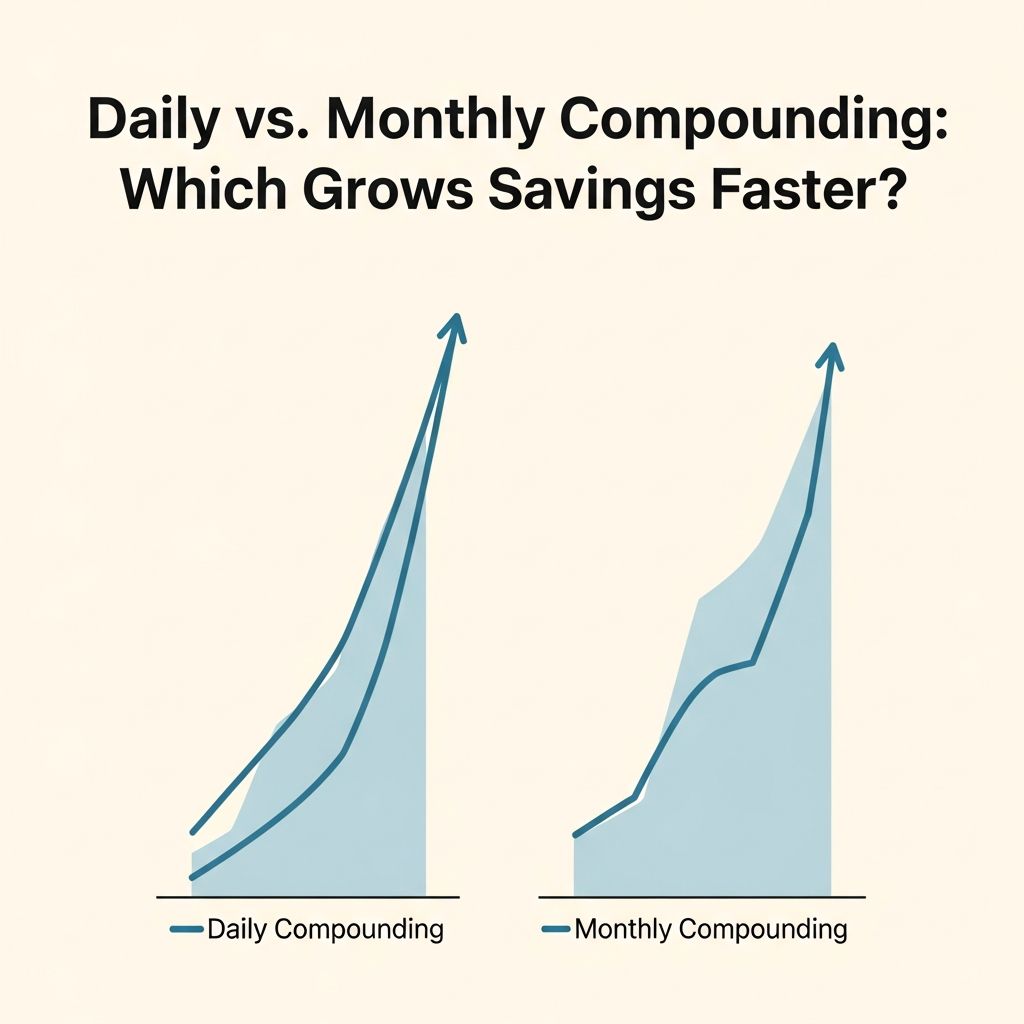
When you open a savings account, certificate of deposit (CD), or money market account, the way your interest is compounded can have a real impact on how quickly your money grows. Many banks highlight that interest is compounded daily or compounded monthly, but the difference between these two is often smaller than people expect. In most normal rate environments, the interest rate itself and the annual percentage yield (APY) matter more than the compounding frequency.
This article explains how daily and monthly compounding work, shows numerical examples, and helps you understand when the difference matters and when it is largely negligible.
What Is Compound Interest?
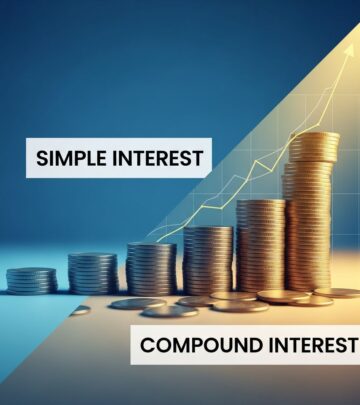
Compound interest is interest calculated not only on your original deposit (the principal) but also on any interest previously earned. Over time, this creates a snowball effect, because each period’s interest becomes part of the base that earns interest in the future.
In contrast, simple interest pays interest only on the original principal and never on accumulated interest.
Financial regulators require banks to disclose both the interest rate and the APY (Annual Percentage Yield), which includes the effect of compounding over a year. The APY is the most useful single number for comparing accounts with different compounding frequencies.
Key features of compound interest
- Interest on interest: Each period’s interest is added to your balance and itself earns interest in later periods.
- Time magnifies growth: The longer you leave money invested, the more compounding can accelerate your balance growth.
- Rate sensitivity: Higher interest rates make the compounding effect more powerful, especially over many years.
- Frequency matters, but less than rate: More frequent compounding (such as daily vs monthly) does increase your earnings, but typically by a modest amount compared with changes in rate or APY.
How Monthly Compounding Works
With monthly compounding, the bank calculates interest and adds it to your account once per month. Each month’s interest is based on your balance at the time of the calculation. Over the course of a year, your balance grows as interest is added twelve times.
A common formula for compound interest is:
A = P (1 + r/n)^(n t)
- A = the amount of money after compounding
- P = principal (your starting amount)
- r = annual interest rate (as a decimal)
- n = number of compounding periods per year
- t = time in years
For monthly compounding, n = 12.
Monthly compounding example
Suppose you deposit $100,000 into an account that pays a 3% annual interest rate, compounded monthly. Each month, the bank calculates interest on your balance, applies it, and your balance grows gradually over the year.
A simplified view of what happens over one year might look like this:
| Month | Starting Balance | Interest Earned (Monthly) | Ending Balance |
|---|---|---|---|
| January | $100,000.00 | ≈ $250.00 | ≈ $100,250.00 |
| February | ≈ $100,250.00 | ≈ $250.63 | ≈ $100,500.63 |
| March | ≈ $100,500.63 | ≈ $251.25 | ≈ $100,751.88 |
| … | … | … | … |
| December | ≈ $102,791.00 | ≈ $257.02 | ≈ $103,048.02 |
Over a full year, the account earns roughly $3,041.60 in interest with monthly compounding on a $100,000 balance at a 3% annual rate.
Monthly compounding vs annual compounding
If the same 3% rate were compounded annually (once per year) instead of monthly, the interest in one year would be almost exactly $3,000. Monthly compounding adds a modest boost—roughly $41.60 more in this example—because interest is added and itself earns interest several times instead of only once at year end.
This illustrates an important principle: moving from annual to monthly compounding has a noticeable effect, but that effect is still relatively small compared with the size of the principal and the interest rate itself.
Daily Compounding
With daily compounding, interest is calculated and added to your account balance every day. Each day’s interest is based on your current balance, including all previous days’ interest. Over the course of a year, this produces slightly more growth than monthly compounding, because interest is added more frequently.
In the compound interest formula, daily compounding uses n = 365 (or 366 in leap years).
How daily compounding works in practice
- The bank tracks your balance each day.
- It calculates a small amount of interest for that day using the daily rate (annual rate divided by 365).
- The daily interest is added to your balance, which then becomes the base for the next day’s interest.
- Over time, this leads to a slightly higher effective yield than monthly or annual compounding at the same nominal rate.
Daily compounding example
Using the same $100,000 deposit and 3% annual rate, but now compounded daily, your account might earn around $3,045.33 in one year. That is about $3.73 more than with monthly compounding, and roughly $45.33 more than annual compounding, for the same stated 3% rate.
This illustrates another key idea: every increase in compounding frequency adds a smaller and smaller marginal benefit. Moving from annual to monthly makes a bigger difference than moving from monthly to daily.
APY: The Best Way to Compare Daily vs Monthly Compounding
Because compounding frequency can be confusing, regulators require banks to quote an APY that reflects the combined effect of the interest rate and how often interest is compounded over a year.
Effective yield and APY
- Interest rate: The nominal or stated annual rate, such as 3% or 5%.
- APY: The effective annual rate of return, taking into account how often interest is added to the balance.
- More frequent compounding → higher APY: For the same nominal rate, daily compounding produces a slightly higher APY than monthly.
For example, a 3% nominal rate compounded monthly yields an APY of a little over 3.04%, while the same rate compounded daily might yield about 3.05%. The difference in APY is modest but does reflect the advantage of daily compounding.
When comparing accounts at different banks, it is usually better to compare APY than to focus on the raw interest rate or compounding frequency. A monthly-compounding account with a higher APY can outperform a daily-compounding account with a lower APY.
Daily vs Monthly Compounding: Side-by-Side Comparison
The table below summarizes the key differences between daily and monthly compounding at the same nominal rate.
| Feature | Daily Compounding | Monthly Compounding |
|---|---|---|
| Compounding frequency | 365 times per year | 12 times per year |
| Effective yield (APY) | Slightly higher | Slightly lower |
| Impact on a $100,000 balance at 3% for 1 year | ≈ $3,045.33 interest | ≈ $3,041.60 interest |
| Dollar difference vs monthly | +≈ $3.73 | Base case |
| Effect over many years and high balances | Advantage grows but remains modest | Still competitive; frequency is less important than rate |
| Which generally yields more? | Higher total return at the same rate | Slightly lower total return at the same rate |
Why the Difference Is Often Small
While daily compounding technically produces higher returns than monthly compounding, several factors limit how large that advantage becomes in everyday savings scenarios.
1. Typical interest rates
In consumer banking, interest rates on savings accounts are often in the low single digits, even when they are considered high-yield. At such rates, the extra benefit from compounding more frequently is relatively small on a year-to-year basis.
2. Compounding frequency has diminishing returns
- Moving from annual to monthly gives a clear bump in earnings.
- Moving from monthly to daily still helps, but the incremental benefit is much smaller.
- Pushing beyond daily (for example, continuous compounding in theoretical math) would add even less incremental gain.
3. Time horizon and account balance
The longer you keep money on deposit and the larger your balance, the more time compounding has to operate. Over decades, the difference between daily and monthly can become more visible, especially on very large balances. However, for many savers working with modest balances over shorter periods, the dollar difference remains small compared with the overall growth produced by the rate itself.
Daily vs Monthly Compounding for CDs vs Savings Accounts
Both savings accounts and certificates of deposit (CDs) may use daily or monthly compounding. CDs typically pay a fixed rate for a set term, while savings accounts often have variable rates.
CDs (Certificates of Deposit)
- Offer a fixed rate over a defined term (for example, 12 months, 24 months, or longer).
- Often compound daily or monthly, with daily becoming more common among online banks.
- Because funds are locked in, the impact of compounding can be easier to forecast using the disclosed APY.
Savings and money market accounts
- May compound daily or monthly, depending on the institution.
- Rates are variable and can change over time.
- The primary decision factor should still be APY, along with fees, minimum balance requirements, and access to funds.
How to Choose Between Daily and Monthly Compounding Accounts
When evaluating savings or CD options, it is tempting to focus on the compounding frequency. Yet, in most cases, other features deserve more weight.
Key things to compare
- APY: Reflects both rate and compounding frequency; usually the best single comparison metric.
- Fees and minimum balances: Monthly fees or high minimum requirements can offset the benefit of a slightly higher APY.
- Rate stability: For savings accounts, ask how often the institution changes its rates.
- FDIC or NCUA insurance: Verify that deposits are insured up to the legal limits at banks or credit unions.
- Accessibility: Consider withdrawal limits, transfer options, and any penalties for early withdrawals (especially for CDs).
When daily compounding is more attractive
- You are choosing between two otherwise similar accounts with identical APYs except for compounding frequency.
- You plan to maintain a large balance for an extended period, so even small percentage differences can add up.
- The account is free of monthly fees and other costs that could erode the small extra interest.
When monthly compounding is perfectly fine
- The monthly-compounding account offers a higher APY than a daily-compounding alternative.
- The bank or credit union has better service, lower fees, or more convenient access to your funds.
- Your balance and time horizon are modest, so the dollar difference between daily and monthly would be minimal.
Frequently Asked Questions (FAQs)
Q: Does daily compounding always beat monthly compounding?
Daily compounding produces a higher effective yield than monthly compounding at the same nominal interest rate, because interest is added more frequently. However, a monthly-compounding account with a higher APY can easily outperform a daily-compounding account with a lower APY.
Q: Is it good if interest is compounded daily?
Yes. All else equal, daily compounding is beneficial because it slightly increases the amount of interest you earn compared with monthly or annual compounding. That said, the practical difference on typical savings balances is often small, so you should focus first on APY, fees, and account features.
Q: How much more can I earn with daily vs monthly compounding?
The extra amount depends on your balance, interest rate, and time horizon. On a $100,000 deposit at a 3% annual rate for one year, daily compounding might earn around $3,045.33 in interest, versus about $3,041.60 with monthly compounding—a difference of roughly $3.73. Over longer periods and larger balances, the gap grows but remains modest compared with the overall growth from the rate itself.
Q: Should I prioritize APY or compounding frequency?
You should prioritize APY. APY already incorporates the effect of compounding frequency over a year, so it captures the true annual return on your deposit. Between two accounts, the one with the higher APY generally offers better growth, regardless of whether it compounds daily or monthly.
Q: Where can I find accounts that compound interest daily?
Many online banks and some traditional institutions offer savings accounts, money market accounts, and CDs that compound interest daily. When researching options, look at the bank’s disclosures or account details to confirm the compounding frequency and APY, and verify that the institution is insured by the FDIC or NCUA.
References
- Truth in Savings Act (Regulation DD) — Federal Deposit Insurance Corporation (FDIC). 2023-06-01. https://www.fdic.gov/regulations/compliance/manual/8/viii-1-1.pdf
- Bank Find and Deposit Insurance FAQs — Federal Deposit Insurance Corporation (FDIC). 2024-02-01. https://www.fdic.gov/resources/deposit-insurance/
- Investment Basics: Compound Interest — U.S. Securities and Exchange Commission (SEC). 2023-04-15. https://www.investor.gov/introduction-investing/investing-basics/how-compound-interest-works
- Interest Compounded Daily vs. Monthly — SmartAsset. 2023-08-10. https://smartasset.com/checking-account/interest-compounded-daily-vs-monthly
- What Is Compound Interest and How Does It Work? — Ally Bank. 2022-11-03. https://www.ally.com/stories/save/what-is-compound-interest-and-how-does-it-work/
Similar Articles








Read full bio of medha deb