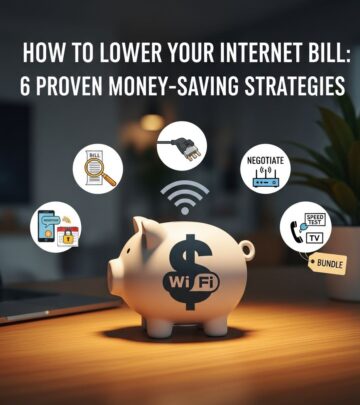
Cut Internet Costs Now: 6 Smart Ways To Save $20–$50 Monthly
Discover proven strategies to slash your monthly internet bill without sacrificing speed or reliability for seamless online living.

In today’s digital world, reliable internet is essential for work, entertainment, and staying connected. Yet, monthly bills can strain budgets, often climbing due to hidden fees or uncompetitive rates. This guide reveals actionable steps to reduce your internet expenses significantly while preserving performance. By comparing options, negotiating smarter, and adopting efficient habits, households can save $20–$50 monthly or more.
Why Internet Bills Keep Rising
Internet service providers (ISPs) frequently adjust promotional rates after initial periods, adding equipment fees, taxes, or speed upgrades that inflate costs. Cable and fiber plans average $60–$100 monthly, but competition among providers like Xfinity, Spectrum, and AT&T offers leverage for better deals. Economic pressures and demand for higher speeds during remote work eras exacerbate this, making proactive management crucial.
Understanding your current plan’s details—speed tiers, data caps, and contract terms—forms the foundation for savings. Most users overpay for unused bandwidth, with average households needing only 100–300 Mbps for streaming and browsing.
Step 1: Assess Your Household Needs
Before cutting costs, evaluate usage. Track devices connected, peak activities like 4K streaming (25 Mbps per stream), video calls (3–5 Mbps), or gaming (50 Mbps minimum).
- Light users: Email, browsing—50 Mbps suffices.
- Moderate: HD streaming, multiple devices—100–200 Mbps.
- Heavy: 4K, gaming, large downloads—300+ Mbps.
Tools like speed tests help confirm if you’re paying for excess speed. Downgrading shaves $10–$30 off bills without disruption.
Step 2: Hunt for Competitive Providers
Availability varies by location, but multiple ISPs often compete. Fiber from AT&T or Verizon delivers superior speeds up to 4,700 Mbps at $45+/mo with no caps or contracts. Cable options like Spectrum start at $30/mo for 100 Mbps, ideal for wide coverage.
| Provider | Starting Price | Max Speed | Key Perk |
|---|---|---|---|
| Xfinity | $40/mo | 2,000 Mbps | No-contract options |
| Spectrum | $30/mo | 2,000 Mbps | No data caps |
| AT&T Fiber | $45/mo | 4,700 Mbps | No equipment fees |
| Verizon Fios | $35/mo | 2,300 Mbps | High satisfaction |
| T-Mobile 5G | $40/mo (w/ mobile) | 498 Mbps | Widest coverage |
Enter your address on comparison sites to reveal local deals. Switching to a promo rate can halve costs initially.
Step 3: Master the Art of Negotiation
Contact retention departments, as they hold authority to match competitor offers. Mention specific rival plans, like Spectrum’s $30 entry or AT&T’s fiber perks. Loyalty discounts or price locks often emerge. Be polite but firm; threaten cancellation if needed—many ISPs offer win-back credits.
Timing matters: Negotiate near contract end or promo expiration. Record calls for reference. Success rates exceed 70% for persistent callers, yielding $10–$240 annual savings.
Step 4: Leverage Bundling and Discounts
Combine internet with mobile, TV, or home phone for 20%+ savings. AT&T discounts fiber bills 20% with unlimited wireless. Verizon and Xfinity mirror this for mobile bundlers.
- Senior, military, or low-income programs: FCC’s Affordable Connectivity offers $30/mo subsidies.
- Student/employee perks: Universities partner with providers for free or discounted access.
- Autopay/paperless: $5–$10/mo rebates common.
Avoid unnecessary TV bundles if streaming suffices—Netflix and Hulu cost less than cable add-ons.
Step 5: Ditch Rentals and Hidden Fees
Modem/router rentals add $10–$15/mo. Purchase compatible devices for $50–$150; DOCSIS 3.1 modems support gigabit cable. Verify ISP approval lists to prevent service issues.
Scrutinize bills for taxes, regional fees, or broadcast surcharges. Opt for fixed wireless like T-Mobile 5G in rural areas—no wires, self-install, $40/mo bundled.
Step 6: Optimize Usage for Efficiency
Reduce data waste: Limit background updates, use Ethernet for stability, and enable QoS settings to prioritize traffic. Smart thermostats or cameras consume bandwidth—monitor via router apps.
Off-peak usage and Wi-Fi extenders improve coverage, minimizing speed upgrade needs. Families save by scheduling downloads overnight.
Emerging Options: 5G and Fixed Wireless
5G home internet from T-Mobile or Verizon rivals cable at lower entry prices, with 133–498 Mbps and no contracts. Starlink suits remote users at $120/mo, but latency lags fiber. Availability expands rapidly, per FCC data.
Long-Term Strategies for Sustained Savings
Review bills quarterly; set calendar reminders for promo ends. Build a provider shortlist for quick switches—churning legally nets repeated new-customer deals. Track satisfaction via ACSI scores: Verizon and Xfinity lead.
Invest in mesh Wi-Fi for better coverage, reducing dead zones and upgrade temptations. Energy-efficient routers cut power bills marginally.
Frequently Asked Questions
What’s the cheapest reliable internet?
Spectrum at $30/mo for 100 Mbps or T-Mobile 5G bundled at $40/mo offer strong value with wide reach.
Can I negotiate without switching?
Yes, retention teams often match competitors, especially if you’re a long-term customer.
Is buying my own equipment safe?
Absolutely—use ISP-certified models to ensure compatibility and support.
How much can I save annually?
Average households trim $240–$600 yearly through these methods.
Does bundling always save money?
Not if unused; calculate true needs versus discounts.
Potential Pitfalls to Avoid
Beware data caps on some cable plans—overages add $10/50GB. Confirm no early termination fees when switching. Test speeds post-changes to validate value.
References
- Find the Best Internet Providers Near You | Allconnect — Allconnect. 2026. https://www.allconnect.com/internet
- Compare Internet Providers: Find the Best ISP Where You Live — HighSpeedInternet.com. 2026. https://www.highspeedinternet.com/compare-internet-providers
- Reliable, High-Speed Home Internet Service Provider | AT&T — AT&T. 2026. https://www.att.com/internet/
- BroadbandSearch: Compare Internet & TV Providers Near You — BroadbandSearch.net. 2026. https://www.broadbandsearch.net
Similar Articles








Read full bio of Sneha Tete